

Space has always been a centre of curiosity and wonder for humankind. The shining sun during the day and the moon and millions of twinkling stars in the night sky have filled us with awe. In our childhood, we all heard stories about the moon and stars from our grandmothers. While listening to and pondering on these stories, the human mind has always harboured the imagination and desire to travel through space, to journey far from Earth to the moon, stars, and other planets, and observe them up close. Modern science and technology have greatly helped in fulfilling this age-old human desire. The journey of space exploration began in 1957 with the Soviet Union’s artificial satellite Sputnik 1, a milestone that led to another in 1961 when the first human, Yuri Gagarin, set the record for reaching space. The next significant global milestone came in 1969 when the US space mission Apollo 11 reached space and Neil Armstrong landed on the surface of the moon. This single step by a man on the moon was, in fact, a giant leap for mankind in the realm of science. Following this, initiatives such as the establishment of the International Space Station, powerful telescopes like Hubble, and robotic explorers like Voyager and the Mars Rover have proven to be remarkable steps in the direction of space exploration.
MAJOR MILESTONES IN INDIAN SPACE EXPLORATION
India has also not lagged behind in space exploration. Under the guidance of the visionary scientist Dr Vikram Sarabhai, India formed the Indian National Committee for Space Research (INCOSPAR) in 1962, which later evolved into the Indian Space Research Organisation (ISRO) on 15 August 1969. ISRO’s primary objective is to conduct space exploration and research for communication, broadcasting, and resource management to support the country’s progress. In 1972, the Department of Space (DOS) was formed, and ISRO was made an integral part of it. ISRO has given a robust structure to India’s space programme and has many historical achievements to its credit. These achievements include the development of the first Indian satellite, Aryabhata, in 1975, which was successfully launched into space using a Soviet rocket. In 1975-76, the Satellite Instructional Television Experiment (SITE) was launched, which initiated satellite-based television broadcasting in India. In the 1980s and 1990s, ISRO developed indigenous satellite launch vehicles, the Polar Satellite Launch Vehicle (PSLV) and the Geosynchronous Satellite Launch Vehicle (GSLV). And who can forget the successful launches of India’s lunar mission Chandrayaan and the Mars Orbiter Mission (Mangalyaan)! Now, India is preparing for its human space mission, Gaganyaan.
Gaganyaan is a highly ambitious Indian space mission being implemented by ISRO under the leadership and inspiration of the current central government which is targeted for launch in 2027. Four Indian Air Force officers (Group Captain Prasanth Balakrishnan Nair, Group Captain Ajit Krishnan, Group Captain Angad Pratap, and Wing Commander Shubhanshu Shukla) have been selected as Gaganyaan astronauts (Gaganyatris) and are undergoing rigorous training for space travel before the Gaganyaan mission launch. Shubhanshu Shukla was given the opportunity to travel to the International Space Station (ISS) during 26 June to 15 July 2025, becoming the first Indian astronaut to visit the ISS. The first Indian space traveller ever was Rakesh Sharma, who traveled to space on 3 April 1984, aboard the Soviet Soyuz T-11 spacecraft (a joint ISRO-Soviet space mission).
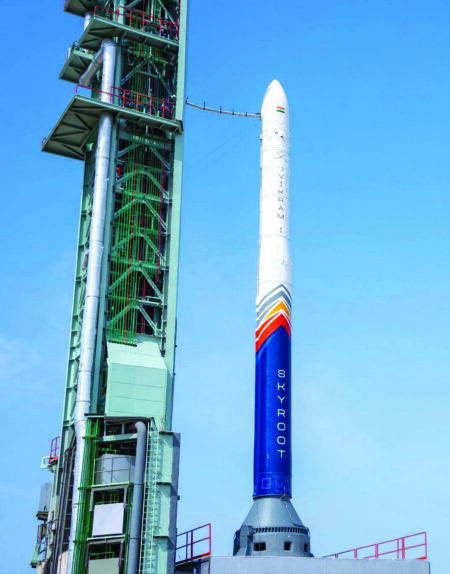
India’s space ambitions continue to expand, and ISRO’s future goals reflect a strategic vision for scientific leadership, national development and global collaboration. Key priorities include the successful execution of the Gaganyaan human spaceflight mission and development of a sustained human space programme, including space stations. ISRO aims to deepen planetary exploration through upcoming missions to the Moon, Mars and Venus, along with advanced solar studies. Strengthening satellite constellations for communication, navigation and Earth observation will support climate resilience, agriculture, disaster management and governance. ISRO is also working on reusable launch vehicles, heavy-lift capabilities and next-generation propulsion to reduce mission cost. Increasing private sector participation through space-tech start-ups and promoting international partnerships remain core goals to build a robust space ecosystem for a self-reliant and globally competitive India.
CSIR-ISRO SPACE MEET FOCUSED ON INDIA’S HUMAN SPACEFLIGHT MISSION
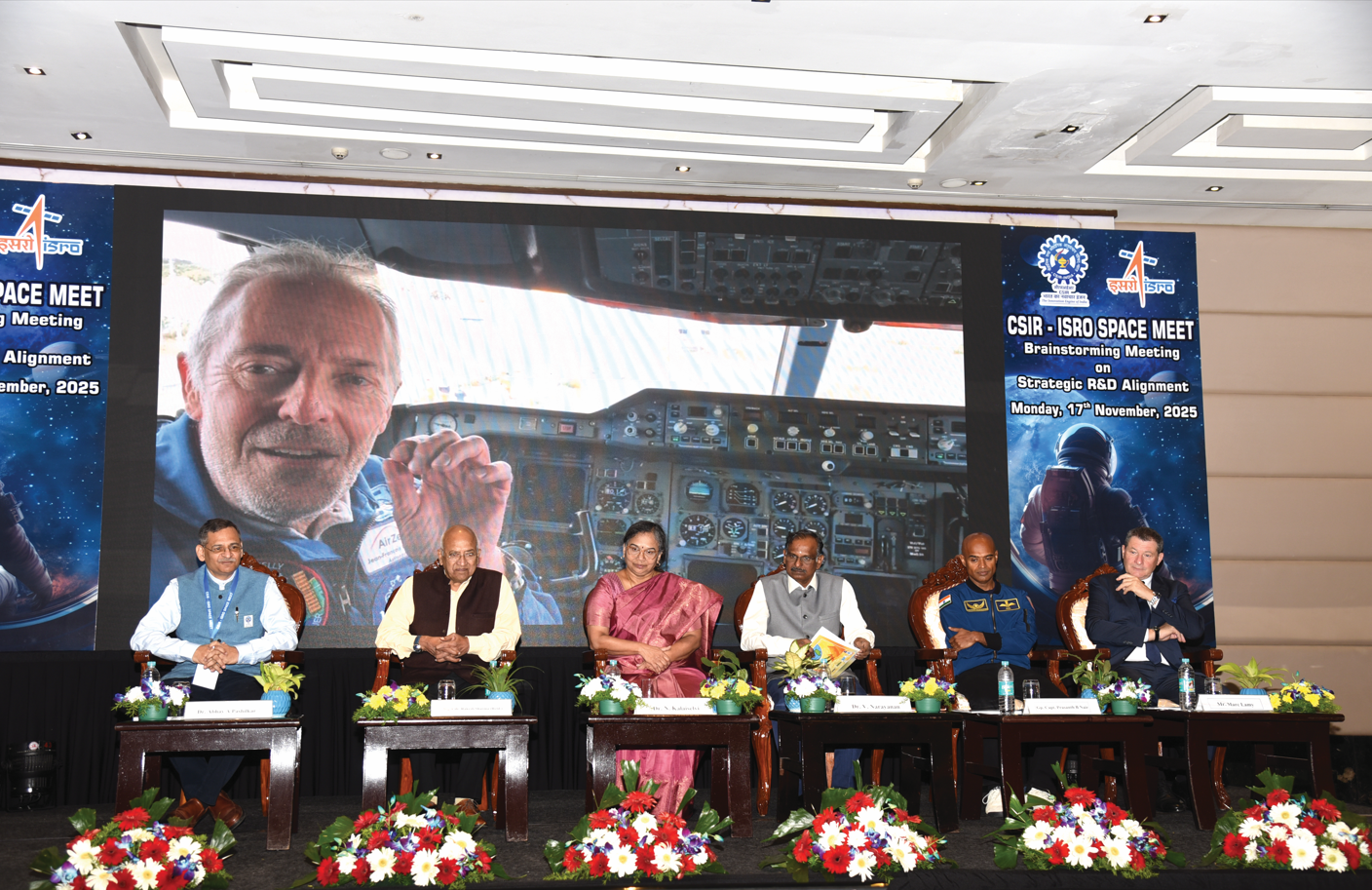
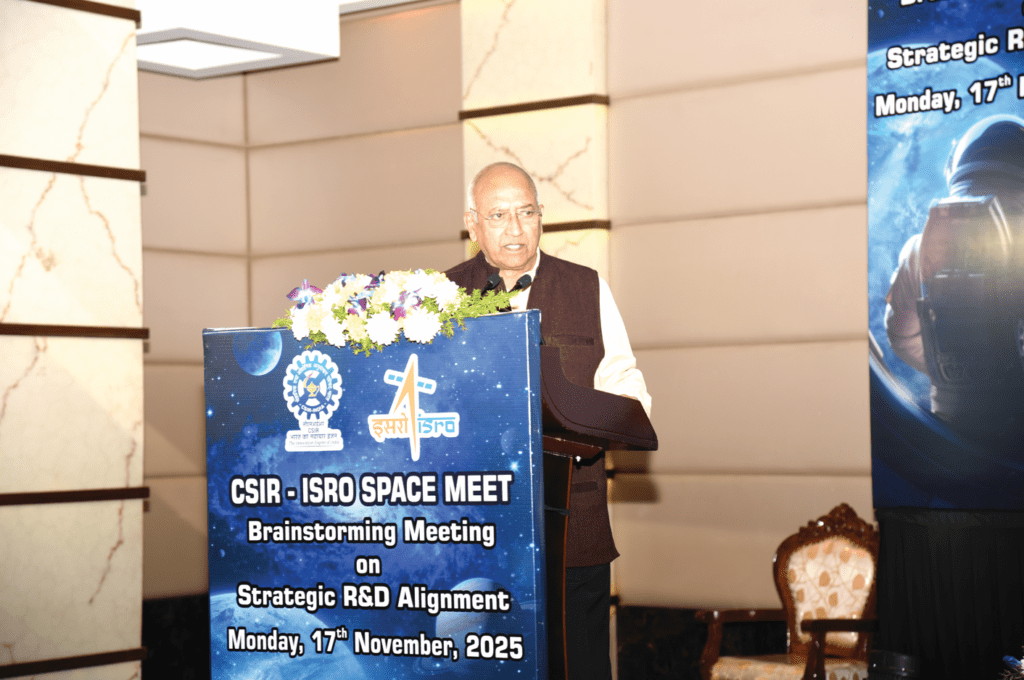
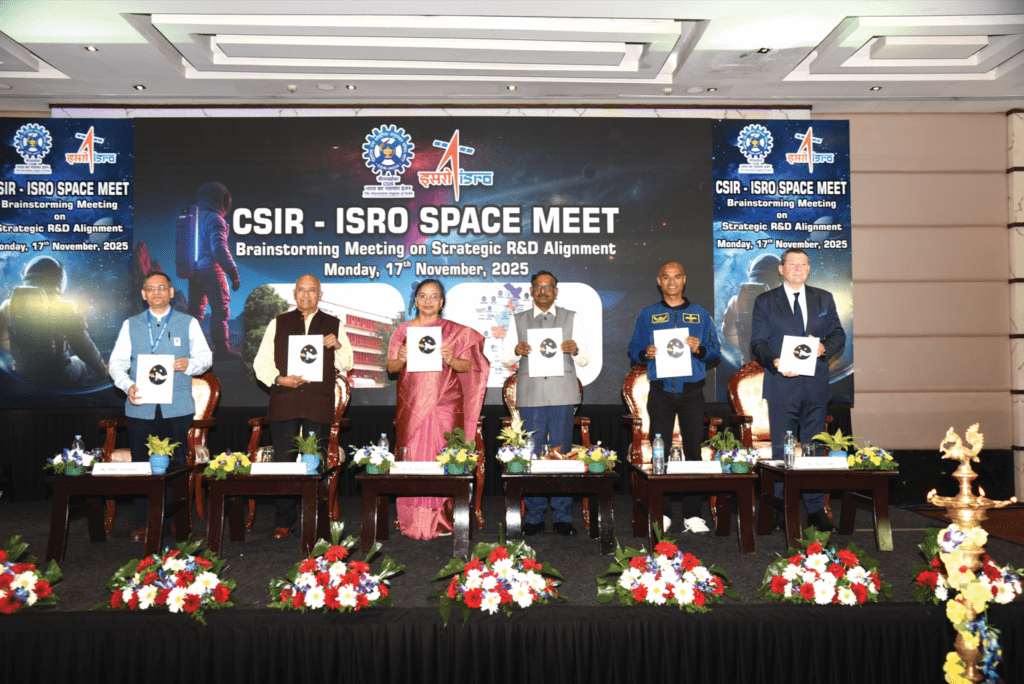
Topics related to space exploration are discussed within the intellectual and scientific fraternity, but the general public often remains unaware of these discussions. Another point of concern that emerges is that while ISRO is the only organisation mentioned when it comes to space-related missions and research in India, the contributions of several other scientific organisations in the country to space research often go unnoticed. Many a time, information about significant contributions is not shared with the general public, and these roles remain unknown. A similar kind of silent and unacknowledged scientific and technical contribution has been made by the Council of Scientific and Industrial Research (CSIR) to ISRO in its various space missions. Considering India’s human spaceflight mission, the CSIR-ISRO Space Meet was held on 17 November 2025, at CSIR’s Bengaluru-based laboratory, the National Aerospace Laboratories (NAL), in which ISRO and CSIR brainstormed on India’s Human Spaceflight Mission. It is worth considering that CSIR is one of India’s largest scientific organisations, established in 1942, and currently operates 37 national laboratories across the country, conducting research in cutting-edge S&T fields such as oceanography, metallurgy, genomics, materials science, energy, engineering, environment, medicine, and agricultural technology. Several CSIR laboratories also develop technologies and equipment related to space science, which have been used in ISRO’s space missions. The aforementioned meet focused on the key issue of how CSIR laboratories will strategically provide technical support to India’s upcoming human spaceflight mission.
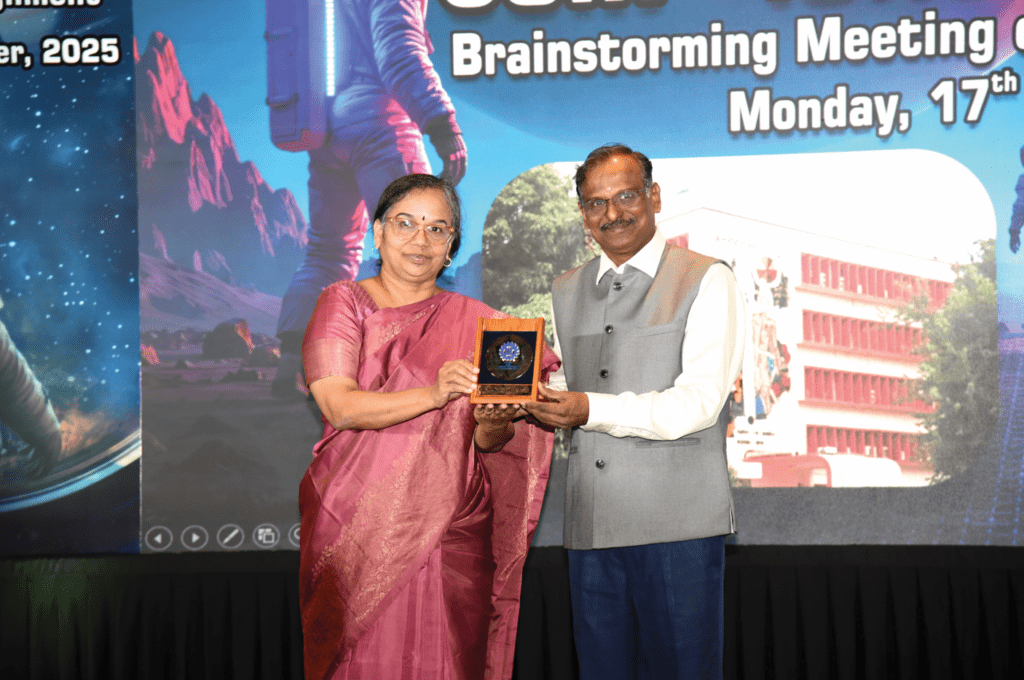
By 2025, approximately 90% of the Gaganyaan mission’s development will be complete, including the human life support system and crew safety technologies. At a space meet in Bengaluru, Dr N Kalaiselvi, Director General of CSIR, highlighted CSIR’s contributions to space technologies, including advanced materials and life support systems, and emphasised knowledge exchange and the use of indigenous innovations. ISRO Chairman and Secretary of the Department of Space, Dr V Narayanan, spoke about CSIR’s role and collaboration in India’s human spaceflight mission. He also proposed a Joint Steering Committee to give a new push and direction to this collaborative relationship. Dr Abhay Pashilkar, Director of CSIR-NAL, highlighted his laboratory’s capabilities in space technologies, materials research, and testing facilities. NASA astronaut Jean-François Clervoy, through a video message, emphasised the role of international collaboration in the progress of human spaceflight. Indian astronaut Prashanth Balakrishnan Nair also attended the meeting and shared his training insights related to Gaganyaan, including microgravity simulations, operational protocols, and recovery frameworks.
CSIR LABS: CLOSE PARTNERS IN ISRO’S SPACE RESEARCH
CSIR-National Aerospace Laboratories (NAL) provides critical testing infrastructure to ISRO for space missions. Its 1.2m Trisonic Wind Tunnel, operational since 1967, validates aerodynamics for HLVM3 and Gaganyaan’s orbital module. NAL’s Acoustic Test Facility (ATF) simulates intense launch noise to qualify satellites and vehicle subsystems before flight. NAL also contributes through aero-elastic and structural testing, advanced composites and materials research, and collaborative R&D that enhances propulsion and aerospace systems used in space missions. These contributions have been crucial in successful ISRO missions, including Chandrayaan and Gaganyaan preparations.
All Images Courtesy: Dr Manish Mohan Gore
Ceramic Matrix Composites (CMCs) developed by CSIR-Institute of Minerals and Materials Technology (IMMT) offer ablation resistance above 1600°C for Gaganyaan’s heat shield, outperforming imported phenolics by 30% in erosion tests. It developed silica-phenolic ablators for re-entry vehicles and carbon-phenolic nozzles for solid rocket motors.
CSIR-National Physical Laboratory (NPL) ensures precision metrology. NPL calibrated sensors for the Environmental Control and Life Support System (ECLSS). NPL’s atomic clock standards synchronise mission timing to 10^-12 seconds is vital for orbital rendezvous.
CSIR-Centre for Cellular and Molecular Biology (CCMB) has contributed to space research endeavours that align with the Indian space programme, including collaborations with ISRO in life science and space biology experiments. Records show that CCMB worked with ISRO on proposals and documentation to conduct life science experiments associated with NASA’s Spacelab missions, reflecting CCMB’s role in studying biological processes in microgravity alongside space agencies. CCMB’s involvement in space biology underlines the interdisciplinary contributions of life science institutes to space research objectives linked with ISRO and broader international space projects.
Mysuru based CSIR lab, Central Food Technological Research Institute (CFTRI) formulates space nutrition. CFTRI’s retort-pouched meals (thermo-stabilized biryani, dal) and 3D-printed nutrient bars provide 2500 kcal/day, preserving 95% vitamins after six months via high-pressure processing. CFTRI supplied specially formulated Indian space food for Group Captain Shubhanshu Shukla’s Axiom-4 mission to the International Space Station in June-July 2025. Shubhanshu carried items like gajar ka halwa, moong dal halwa, vegetable biryani, dal, rajma-rice, khichdi, roti, and mango nectar, designed for long shelf life and nutritional density in microgravity. CFTRI developed these via high-pressure processing and retort packaging, ensuring 95% vitamin retention after months and 2500 kcal/day intake in compact form. Shubhanshu noted missing authentic home tastes post-mission, informing CFTRI’s Gaganyaan refinements like millet tablets (4 pills = 1 meal) and reformulated sambar-rice or paratha equivalents. These address sensory satisfaction alongside nutrition for psychological well-being.
CSIR-National Chemical Laboratory (NCL) synthesises liquid crystal polymers for spacesuits, offering breathability (MVTR >500 g/m²/day) and puncture resistance. Additional contributions include CSIR-Indian Institute of Chemical Technology (IICT) refining hypergolic propellants with 2% higher density; CSIR-Structural Engineering Research Centre (SERC) conducting seismic and hypervelocity impact tests on habitats.
We have seen how Indian scientific institutions are doing remarkable work in space research. A major driving force behind this is the fact that space is a boundless resource for human existence in the near future. The significant milestones India has achieved in space exploration clearly demonstrate that we are among the world’s most powerful nations in the field of space research. Our space capabilities not only strengthen socio-economic development but also ensure global leadership. The country’s space research is making a remarkable contribution to communication, navigation, weather forecasting, agriculture, Earth observation, and disaster management. Besides Gaganyaan, the development of the Venus Orbiter, Chandrayaan-4, and the Indian Space Station are key objectives of the Indian space programme in the coming years. All these efforts related to space exploration will make the lives of the country’s citizens easier and also help realise the dream of a Viksit Bharat by 2047.
*The writer is Senior Scientist, CSIR-National Institute of Science Communication and Policy Research, New Delhi.