



NATIONAL SCIENCE DAY 2026
Science, technology, and innovation have transformed human life in profound ways. Medical advances such as vaccines and diagnostic tools developed by entities like the World Health Organization at global level and the Indian Council of Medical Research at national level have increased life expectancy and reduced disease. Communication technologies connect people instantly across the globe. Innovations in transportation, including electric vehicles, promote sustainability. Digital platforms, artificial intelligence, and renewable energy systems improve productivity and environmental protection. Overall, science and technology enhance education, healthcare, communication, and economic growth, making life more efficient, comfortable, and interconnected.
The engagement and celebration of science and innovation in India are marked by the National Science Day, observed every year on February 28. It honours the discovery of the Raman Effect by Sir C V Raman. The day promotes scientific awareness, creativity, and technological advancement among students and citizens across the country.
WHY DO WE CELEBRATE NATIONAL SCIENCE DAY?
India celebrates National Science Day every year on 28 February. This day marks the discovery of the Raman Effect by Sir C V Raman in 1928. His discovery explained how light changes when it passes through a transparent material. This was a major breakthrough in physics and brought global recognition to Indian science. For this discovery, he received the Nobel Prize in Physics in 1930, becoming the first Indian to win a Nobel Prize in any discipline of science. In fact, he was the first Asian to receive a Nobel Prize in Science. Another interesting fact is that Raman got the Nobel at a time when India was under the British rule.
In 1986, the Government of India decided to celebrate 28 February as National Science Day. The purpose was not only to honour Sir C V Raman’s achievement but also to promote scientific thinking among people and especially youth. Scientific thinking means asking questions, observing carefully, testing ideas, and believing in proof rather than superstition. It helps society move forward with logic and innovation.
National Science Day is celebrated in schools, colleges, universities, and research institutions across the country. Students take part in science exhibitions, quizzes, seminars, and model competitions. Scientists deliver lectures, and new research is showcased. The day spreads awareness about how science improves our daily lives. From mobile phones and the internet to medicines, clean water systems, weather forecasting, farming techniques, and transportation, science is everywhere.
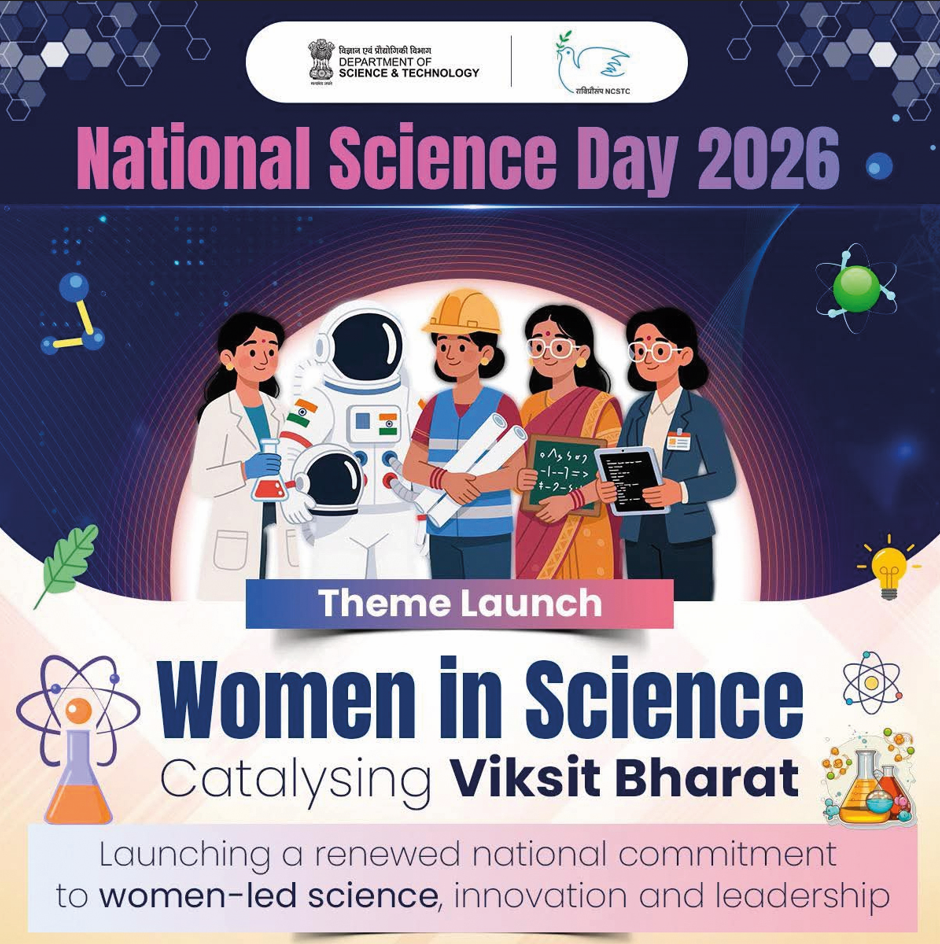
Theme of the National Science Day 2026 is “Women in Science: Catalysing Viksit Bharat”. India is presently working towards the goal of becoming Viksit Bharat by 2047, when the nation will complete 100 years of independence. A developed India will need strong infrastructure, advanced technology, economic growth, environmental protection, and social equality. None of this is possible without science and innovation. But development will be incomplete if women are not equal partners in this journey.
WOMEN IN SCIENCE: LEADING INDIA TOWARDS VIKSIT BHARAT
Women form almost half of India’s population. Their participation in science is not just about reducing inequality; it is about national progress. When women join scientific research, education, and innovation, the country gains new ideas and broader perspectives. Diversity in science leads to better solutions because people from different backgrounds think differently and approach problems in unique ways.
India has a proud history of women who contributed to science despite facing social barriers. Janaki Ammal was one of India’s first women scientists. She made important contributions to cytogenetics. Her research helped improve sugarcane varieties and strengthened India’s agricultural system. At a time when few women had access to higher education, she showed courage and determination.
In space science, Kalpana Chawla became a symbol of dreams and determination. Although she worked with NASA, her Indian roots inspired millions of girls. Today, Indian women scientists are actively contributing to space missions.
During missions such as Mangalyaan and Chandrayaan-3, women scientists of India played key roles in mission planning, software development, navigation systems, and project management. Images of women scientists in sarees celebrating successful space launches became powerful symbols of modern India. These achievements showed that Indian women are not only participating in science but leading it. ISRO scientist Ritu Karidhal Srivastava deserves special mention as she played a crucial role in India’s Chandrayaan-2 mission. Known as the ‘Rocket Woman of India’, she served as Mission Director, contributing significantly to mission planning, navigation, and spacecraft operations in India’s lunar exploration program.
In defence research, Tessy Thomas made the nation proud through her work in missile technology at the DRDO. She led important missile projects and earned the title ‘Missile Woman of India’. Her leadership in a traditionally male-dominated field broke stereotypes and opened doors for many young women engineers.
Women have also made strong contributions in medical science. Dr Indira Hinduja was one of the pioneers of in vitro fertilization (IVF) techniques in India. Women researchers have also worked in vaccine development, disease control, and biotechnology. During health crises, their research and dedication helped protect millions of lives.
India’s renowned particle physicist Prof Rohini Godbole inspired women in physics through her research and advocacy. Lilavati’s Daughters is a landmark volume edited by Prof Godbole along with Ram Ramaswamy. The book documents the inspiring journeys and achievements of Indian women scientists from ancient times to the modern era. Through personal essays, it highlights their struggles, perseverance, and contributions across disciplines, serving as a powerful source of inspiration for future generations of women in science.
Women scientists are contributing in many other fields too; environmental science, renewable energy, artificial intelligence, climate research, agriculture, health, and digital technology. For India to become a developed nation, it must find solutions to pollution, water scarcity, climate change, food security, and public health challenges. Women researchers often focus on community needs and social impact, making scientific solutions more practical and inclusive.
However, challenges still remain. Many women face difficulties in balancing family responsibilities and demanding research careers. Some leave science due to lack of support, limited leadership opportunities, or workplace bias. The Government of India has launched programmes to continue scientific research for women facing such difficulties. To truly build Viksit Bharat, India must ensure equal opportunities for women in laboratories, universities, and research organisations. Policies such as flexible work hours, maternity support, childcare facilities, safe campuses, mentorship programmes, and equal funding opportunities can make a big difference.
Encouraging girls to study science from an early age is also very important. Schools must promote curiosity and confidence among girls in subjects like mathematics, physics, chemistry, and computer science. Parents and teachers play a key role in breaking stereotypes. When young girls see women scientists as role models, they begin to believe that they too can become researchers, engineers, doctors, or space scientists.
National Science Day is a reminder that science belongs to everyone. It is not limited by any division. A scientific nation is one that values knowledge, creativity, and innovation. When women and men work together, the country benefits from the full power of its talent.
As India moves toward 2047, the dream of Viksit Bharat depends on strong research, advanced technology, and inclusive growth. Women in science are already shaping this future.
In simple words, National Science Day celebrates discovery, learning, and progress. It honours the legacy of Sir C V Raman and encourages future generations to think scientifically and act scientifically. Most importantly, it reminds us that a truly developed India will rise only when both women and men contribute equally. By supporting and empowering women in science, India can move faster toward its goal of becoming a confident, innovative, and self-reliant Viksit Bharat.
*The writer is Senior Scientist, CSIR-National Institute of Science Communication and Policy Research, New Delhi, and editor, Vigyan Pragati.New Delhi.