





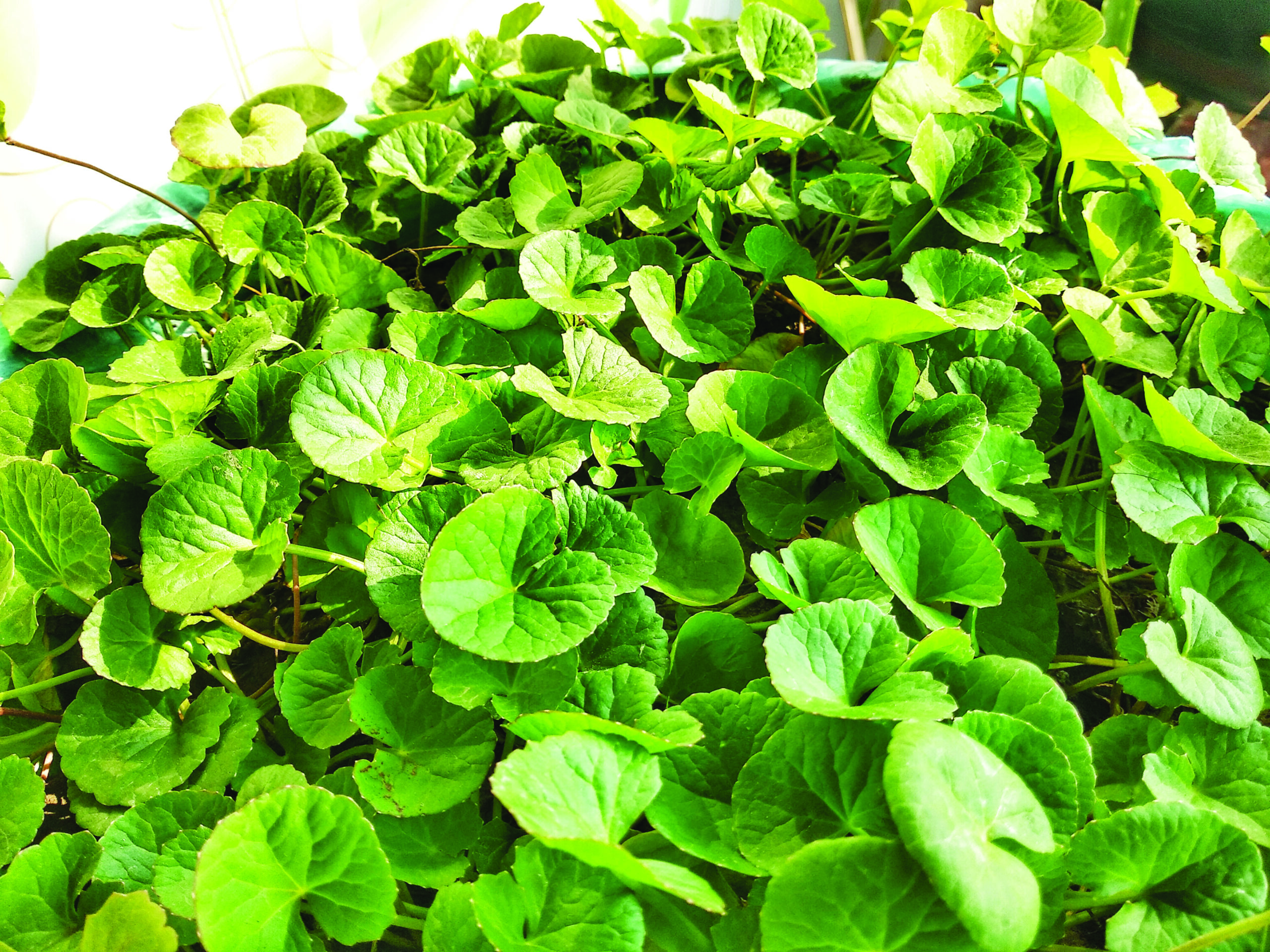
HERB HERITAGE: MANDUKPARNI (CENTELLA ASIATICA)
Mandukparni is described among the Medhya Mahakashaya in the Charaka Samhita (Sutra Sthana 4), where Acharya Charaka lists herbs that promote intellect and mental clarity. The relevant passage reads: Mandukaparni, Yashtimadhu, Guduchi and Shankhapushpi are Medhya in action.
The inclusion of Mandukparni in this elite group signals not only its cognitive action but its Rasayana potential. Further references in the Sushruta Samhita describe its utility in wound healing and inflammatory conditions, linking it to tissue repair and skin integrity.
WHY ‘MANDUK’ PARNI?
The name derives from manduka (frog), referring to the shape of its leaves resembling a frog’s foot. In some regional practices, Mandukparni was believed to enhance clarity during prolonged scriptural study. Students in gurukul were traditionally given Medhya herbs, including Mandukparni, to sustain focus and retention.
Mandukparni as Medhya: Neural Regeneration in Classical and Modern Thought
AYURVEDA CLASSIFIES MANDUKPARNI AS:
- Rasa:Tikta, Kashaya
- Guna: Laghu, Sara
- Virya: Shita
- Vipaka: Madhura
Its prabhava (specific action) is medhya.
From a biomedical perspective, Centella contains triterpenoids such as asiaticoside and madecassoside, which are studied for neuroprotective and antioxidant effects. Experimental research suggests roles in synaptic modulation, stress resilience and neuronal repair.
This aligns with Ayurveda’s broader concept of medhya—not merely improving memory recall but supporting adaptive intelligence and clarity.
Yet Ayurveda physicians did not isolate cognition from systemic health. The same properties that cool Pitta and nourish tissues also explain its relevance in inflammatory skin conditions.
SKIN, RAKTA AND THE RISE OF CICA
In dermatology-inspired skincare, Cica has become a celebrated ingredient—recommended for barrier repair, redness reduction and scar modulation. Marketed as a Korean beauty innovation, it is in fact none other than Centella asiatica—known in Ayurveda as Mandukparni.
While widely recognised in popular discourse as a memory enhancer, classical Ayurvedic literature positions Mandukparni far beyond cognitive enhancement. It is a Medhya Rasayana, a wound healer, a Pitta-pacifier and a rejuvenator. The renewed global fascination with Cica offers an opportunity to revisit Mandukparni not as a cosmetic trend, but as a multi-system herb whose dermatological and neurocognitive actions are deeply interlinked.
In Ayurvedic physiology, skin health depends on balanced Rakta dhatu and controlled Pitta. Tikta-Kashaya rasa herbs with shita virya are commonly indicated in inflammatory dermatoses, burning sensation, and redness.
MANDUKPARNI IS TRADITIONALLY USED IN:
- Vrana (wounds)
- Dushta vrana (chronic ulcers)
- Pitta-dominant skin disorders
- Burning sensation and erythema
MODERN DERMATOLOGICAL RESEARCH ON CENTELLA DEMONSTRATES:
- Enhanced fibroblast proliferation
- Improved collagen synthesis
- Reduced oxidative stress
- Modulation of scar formation
Thus, new-age “Cica creams” mirror classical Ropana (healing) and Pitta-shamana actions described centuries ago.
The translational insight is striking: what is marketed today as advanced barrier science was embedded in Ayurvedic wound-care protocols.
DERMATOLOGY MEETS TRADITION: UNDERSTANDING “CICA”
The term “Cica” in skincare is shorthand for Centella asiatica. Popular K-beauty formulations emphasise:
- Redness reduction
- Barrier repair
- Post-inflammatory calming
- Scar modulation
What is noteworthy is that these functions map closely to classical descriptions of Mandukparni in inflammatory and Pitta-predominant conditions.
However, Ayurveda rarely limits an herb to topical use alone. Internal administration was considered essential for sustained correction of tissue pathology. This systemic perspective differentiates traditional practice from purely cosmetic application.
BEYOND SKIN AND BRAIN: A SYSTEMIC RASAYANA
Mandukparni’s Madhura vipaka and Rasayana classification indicate deeper tissue nourishment. Ayurveda physicians used it in chronic debility, stress disorders and inflammatory states.
Emerging evidence suggests immunomodulatory and adaptogenic potential, though further rigorous clinical trials are required.
The integrative message is clear: Mandukparni acts at the intersection of neural regulation, connective tissue biology and inflammatory modulation.
MANDUKPARNI AND CONNECTIVE TISSUE BIOLOGY
Ayurveda texts describe Mandukparni as beneficial in vrana, dushta vrana and chronic inflammatory states. These conditions often reflect impaired tissue remodelling.
Centella’s triterpenoids are reported to modulate collagen type I synthesis and extracellular matrix remodelling. Experimental models show improved tensile strength in wound tissue and reduction in hypertrophic scarring.
From an Ayurvedic lens, this correlates with Ropana (healing) and Rasayana (rejuvenation) actions.
MANDUKPARNI AS MEDHYA: NEUROCOGNITIVE RELEVANCE
The classification of Mandukparni as a Medhya Rasayana places it among herbs that support intellect (buddhi), retention (smriti) and mental clarity. In classical contexts, it was used in conditions of cognitive fatigue, anxiety, epilepsy and mental instability.
Modern research correlates this traditional understanding with neuroprotective and anxiolytic effects. Phytoconstituents such as asiaticoside and madecassoside have demonstrated antioxidant, neurotrophic and synaptic-modulating properties in experimental models. Studies suggest improved memory consolidation, stress resilience, and possible modulation of BDNF pathways.
From a translational standpoint, this aligns with Ayurveda’s Medhya classification—supporting not merely memory enhancement but neural integrity and adaptive stress response.
FROM TEXT TO TABLE: MANDUKPARNI AT A GLANCE
- Medhya Rasayana: Supports memory, focus, and adaptive stress response.
- Pitta-Rakta pacifier: Useful in redness, burning sensation, inflammatory skin states.
- Wound healing: Enhances tissue repair and collagen modulation.
- Skin Barrier support: Modern topical relevance echoes classical Ropana action.
MANDUKPARNI IN DAILY LIFE: PRACTICAL INCORPORATION
Mandukparni can be integrated thoughtfully in day-to-day routines.
1. For Cognitive Clarity and Mental Fatigue
- Mandukparni Swarasa (fresh juice): 10–15 ml once daily in the morning, diluted with water.
- Churna with warm milk: 1–2 grams at night for students during high cognitive load.
2. For Stress-Prone Individuals
- Powder combined with a small quantity of ghee may support calmness, particularly in Pitta-dominant constitutions.
3. For Minor Skin Irritation
- Leaf paste (external): Fresh leaves crushed and applied over minor inflammatory lesions.
- Decoction wash: Mild kwatha used to cleanse superficial wounds.
4. For General Skin Glow
- Mandukparni powder mixed with sandalwood and rose water as a weekly face pack in Pitta-predominant skin.
5. For Post-Sun Exposure Redness
- Simple paste of fresh leaves with aloe gel applied locally for soothing effect.
INTEGRATING TRADITION WITH CONTEMPORARY SCIENCE
Mandukparni offers a model for translational Ayurveda. Rather than fragmenting its actions into isolated indications, Ayurveda texts recognised its systemic intelligence.
The same herb that nourishes the nervous system cools inflammatory skin. The same Rasayana that supports cognition assists tissue regeneration. Modern pharmacology, through collagen studies and neuroprotection research, is gradually articulating mechanisms long embedded in Ayurvedic doctrine.
For the present generation of scientists and students, Mandukparni demonstrates that traditional classifications such as Medhya and Rasayana may encode complex biological insights.
Mandukparni is not merely a “memory herb.” It is a bridge between neurons and dermis, between Rasayana and regenerative science, between folklore and laboratory investigation.
In rediscovering Mandukparni, we rediscover a principle central to Ayurveda: true rejuvenation is systemic. The skin reflects the mind; the mind reflects tissue health.
Such integrative understanding is not only historically faithful—it is scientifically relevant for our times.
*The writer is an Ayurveda physician, DST Woman Scientist A, AIIMS New Delhi, and founder of Pratha Ayurveda.