




Image Courtesy: AI Generated
In an era where strategic dominance increasingly extends beyond terrestrial borders into the realm of space, India is making decisive moves to secure its place among the world’s top space-faring nations. At the heart of this effort lies a bold initiative—the Space-Based Surveillance (SBS) programme. Designed to establish a fully indigenous and technologically advanced constellation of reconnaissance satellites, the SBS programme is not only a milestone in India’s space journey but a cornerstone of national security for the 21st century.
SECURING SPACE FOR NATIONAL DEFENCE
Modern military doctrines are increasingly shaped by the realisation that whoever controls space may hold the upper hand in conflicts. From missile tracking and border surveillance to maritime domain awareness and encrypted communication, space assets have become indispensable for national defence.
India’s SBS programme is being implemented in three progressive phases, culminating in the most ambitious effort yet—SBS-III. Once completed, the programme will comprise 52 advanced surveillance and communication satellites placed in Low Earth Orbit (LEO) and Geostationary Orbit (GEO). This comprehensive constellation will provide India with unprecedented real-time monitoring capabilities, spanning land, sea, and air.
Beyond mere observation, the SBS initiative represents a significant step toward technological parity with global space powers—particularly in defending against evolving threats such as:
- Direct-Ascent Anti-Satellite (ASAT) Missiles: These can destroy satellites through high-speed collisions, disrupting space-based communications and intelligence.
- Co-Orbital Satellites: While often masked as servicing or inspection units, such satellites can potentially damage or disable enemy satellites during wartime scenarios.
- Electronic Warfare (EW) Systems: Capable of jamming satellite links and scrambling GPS signals, EW platforms can severely undermine both military and civilian systems during conflict.
- Directed Energy Weapons (DEWs): These futuristic systems use lasers or microwave beams to disable or destroy satellites without creating debris, offering a cleaner form of anti-satellite warfare.
India’s development of a resilient and autonomous space surveillance network is both a strategic necessity and a technological ambition.
FROM SBS-I TO SBS-III:
TRACING THE TRAJECTORY
India’s tryst with satellite surveillance began in 2001 with the launch of SBS-I, deploying four satellites from the Cartosat and RISAT series. These early missions were designed to provide imaging intelligence along sensitive borders, monitor troop movements, and track vital military installations. Notably, they played a pivotal role during the India-Pakistan military standoff of 2001-02, delivering high-resolution imagery (around 1-meter accuracy) that informed tactical and strategic decisions.
In 2013, the success of SBS-I paved the way for SBS-II, which incorporated more advanced payloads including Cartosat-2C, 2D, 3A, 3B, Microsat-1, and RISAT-2A. These six satellites enhanced India’s ability to monitor regional security dynamics with greater frequency and precision.
Now, with SBS-III, India is poised to take a generational leap.
SBS-III: REDEFINING SURVEILLANCE WITH NEXT-GENERATION TECHNOLOGY
The third phase of the programme, SBS-III, is not merely an expansion but a complete transformation of India’s surveillance architecture. Backed by an allocation of $3.2 billion over the next decade, this phase will introduce:
- AI-enabled satellites for autonomous detection and data analysis.
- Quantum communication capabilities to ensure unhackable, ultra-secure data transmission.
- Rapid-response satellite launch systems for resilience in conflict scenarios.
Of the 52 planned satellites, the Indian Space Research Organisation (ISRO) will develop the initial batch of 21, while the remaining 31 are being opened to the private sector, marking a bold move toward commercialising and democratising India’s space industry.
This public-private synergy will boost domestic space-tech innovation, create high-skill jobs, and reinforce India’s ambitions of becoming a global leader in space-based technologies.
ARTIFICIAL INTELLIGENCE IN SPACE: SMARTER SATELLITES, FASTER DECISIONS
A defining feature of SBS-III is the use of Artificial Intelligence. These AI-driven satellites are designed not to function in isolation, but in coordination with one another—forming a collaborative network that can:
- Analyse large volumes of imagery and sensor data onboard.
- Communicate among themselves to identify and confirm objects of interest.
- Automatically prioritise targets and relay data to ground stations in real time.
Imagine a scenario where a satellite in higher orbit detects a moving military convoy. Instantly, it can alert a lower-orbit satellite to zoom in for a more detailed view. Together, they can validate the target and transmit high-fidelity intelligence to command centres, all without human intervention. This kind of autonomous space surveillance drastically reduces response time and enhances battlefield awareness.
QUANTUM COMMUNICATION: THE NEXT FRONTIER IN SECURE DATA TRANSFER
Alongside AI, SBS-III envisions incorporating quantum communication satellites—a field where India has already made early strides. Quantum encryption uses the principles of quantum mechanics to secure data, making it practically immune to interception or decryption.
Within the next few years, India plans to integrate such technology to fortify military communications and critical command-and-control systems. This would give Indian defence planners a strategic edge in an environment increasingly vulnerable to cyberattacks and electronic surveillance.
India is also exploring international collaborations—notably with France and other like-minded countries—to co-develop some of these next-generation satellites. These partnerships aim to combine technical excellence with strategic independence.
THE ROLE OF THE DEFENCE SPACE AGENCY (DSA)
The operational command of SBS-III will fall under the Defence Space Agency (DSA), India’s specialised military arm tasked with integrating space assets into defence operations. A key innovation being pursued by the DSA is launch-on-demand capability.
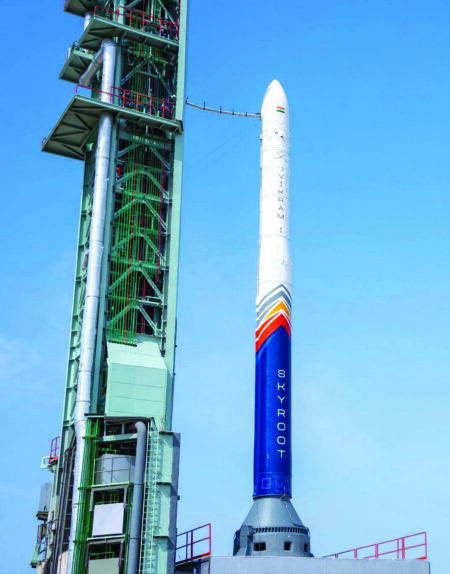
This concept involves deploying a satellite—typically weighing around 650 kilograms—into orbit within 60 minutes from a mobile launch platform. Such agility would prove crucial in scenarios where satellites are lost to attacks or accidents and must be replaced swiftly to maintain surveillance continuity.
In effect, the DSA is working to build a resilient, flexible, and rapid-response space force—a hallmark of 21st-century warfare.
CLOSING THE SURVEILLANCE GAPS
Legacy satellites like Cartosat-2C had revisit times of up to four days—meaning they could only monitor a location intermittently. SBS-III addresses this limitation by deploying a denser satellite mesh, ensuring near-continuous coverage across critical geographies.
This persistent surveillance will enhance India’s ability to:
- Detect and track enemy troop movements.
- Identify the deployment of mobile missile systems.
- Monitor maritime traffic across strategic choke points.
Additionally, SBS-III will significantly expand India’s encrypted communication network, enabling secure, seamless communication between the Army, Navy, Air Force, and Space Command—even in high-conflict or electronic warfare environments.

Image Courtesy: Pixabay
MARITIME SURVEILLANCE AND STRATEGIC REACH
The Indian Ocean Region (IOR) has become a theatre of geopolitical tension, with rising naval deployments by global powers. The ability to monitor surface and aerial movements in real time is critical to safeguarding Indian interests, from trade routes to island territories.
Although current technology does not allow for detection of deep-sea submarines via satellite—something even the most advanced militaries have yet to master—the SBS-III constellation, when integrated with drones, sonar buoys, and maritime patrol aircraft, will greatly improve India’s maritime domain awareness.
SELF-RELIANCE AND STRATEGIC AUTONOMY
One of the most vital outcomes of SBS-III is the reduction of India’s dependence on foreign intelligence data. Historically, India had to rely on satellite feeds from international allies during border standoffs or disaster response situations.
With its own constellation of real-time surveillance satellites, India can access mission-critical data autonomously, ensuring faster decision-making and reducing vulnerability during crises. This capability will be vital in both wartime and peacekeeping scenarios.
THE MILITARISATION DILEMMA
While SBS-III strengthens India’s defence posture, it also signals a broader global shift—the militarisation of space. As India enhances its capabilities, neighbouring countries and major powers may respond with their own upgrades, including:
- Deploying anti-satellite weapons (both kinetic and non-kinetic).
- Launching rival surveillance constellations.
- Developing space-based early warning and missile defence systems.
This dynamic introduces a new form of arms race—one that is not fought on land or sea, but in orbit. India’s efforts, while defensive in intent, could spark countermeasures and strategic recalibrations among other spacefaring nations.
BALANCING PROGRESS WITH RESPONSIBILITY
As India expands its military footprint in space, it must also uphold its long-standing commitment to the peaceful use of outer space. The challenge lies in balancing security imperatives with ethical and environmental considerations, such as:
- Space debris mitigation: Avoiding collisions and ensuring sustainability of orbital paths.
- Transparency in dual-use technologies: Building confidence with other nations through clear demarcation of military and civilian applications.
- International cooperation: Supporting frameworks like the United Nations’ guidelines on long-term sustainability of space activities.
India, as a responsible space power, must lead by example in ensuring that space remains a safe and stable domain for future generations.
CONCLUSION: INDIA’S STRATEGIC VISION IN ORBIT
India’s Space-Based Surveillance Network—especially under the SBS-III phase—is more than just a technical milestone. It reflects a broader strategic vision, one that integrates defence, science, innovation, and international diplomacy.
By investing in AI, quantum encryption, and rapid satellite deployment, India is preparing for a world where space will be as vital to national security as land, sea, or air. At the same time, it is nurturing a vibrant space ecosystem that can power both military and civilian advancements.
For the Indian public, this initiative is a symbol of confidence and capability. For the global community, it is a signal that India is ready—not just to defend its skies, but to shape the future of space as a responsible and forward-looking nation.
*The writer has 37 years’ global experience in IT and is presently Director, AI, Theta Dynamics, Bengaluru.