



THE OCEAN: HEART OF THE EARTH SYSTEM
The ocean is the heart of our planet’s life-support system. It governs weather and climate, regulates temperature, cycles nutrients, and sustains a diversity of life unmatched on land. Covering over 70 percent of the Earth’s surface, it contains about 97 percent of all water and absorbs nearly 90 percent of the excess heat generated by human activity. The ocean’s vastness belies its fragility, yet its stability is indispensable for life on Earth.
Through the photosynthetic activity of marine phytoplankton (microscopic plants), the ocean produces at least half of our oxygen; i.e., every second breath we take originates from the sea. It also absorbs about a quarter of all anthropogenic carbon dioxide, moderating global warming but at the cost of increasing ocean acidification. The ocean’s dual role as both a carbon sink and heat regulator makes it central to the functioning of the climate system.
Economically, the ocean is a frontier of opportunity. Fisheries, shipping, offshore energy, tourism, biotechnology, and mineral extraction collectively contribute trillions of dollars annually to the global economy. This interconnected framework of economic activities, when pursued responsibly, forms what is known as the Blue Economy—the sustainable use of ocean resources for economic growth, improved livelihoods, and ecosystem health.
Globally, the Blue Economy is estimated to generate between USD 3 and 6 trillion annually and supports over 250 million jobs. India, endowed with a coastline of more than 11,000 km, 1,382 islands, and an Exclusive Economic Zone (EEZ) of about 2.37 million sq. km, is uniquely positioned to benefit from ocean-based growth. Yet, the sector currently contributes only around 4 percent to India’s GDP, signalling vast untapped potential.
Recognising this, the Government of India has identified the Blue Economy as one of the ten core dimensions of growth under the Vision for Viksit Bharat 2047, aligning national development with the principles of sustainability and ocean stewardship.
THE PHILOSOPHY OF SUSTAINABLE UTILISATION
The Blue Economy challenges the old dichotomy between growth and conservation. It is founded on the philosophy of sustainable utilisation—extracting value from ocean resources without compromising ecological integrity.
This principle resonates deeply with India’s civilisational ethos. The ancient Indian seers regarded the ocean, or samudra, as a symbol of abundance, wisdom, and balance. The Arthashastra of Chanakya articulated a concept of governance that drew from nature—using resources prudently, much like bees collect nectar without harming flowers.
In the modern context, this philosophy underpins the call for inclusive, data-driven ocean governance. Sustainable utilisation demands a clear understanding of ocean systems and the cumulative impacts of human activity. Integrating scientific, economic, and social data enables the creation of holistic indices that assess not just marine productivity but also ecosystem health and the well-being of coastal communities.
As human pressures on the ocean intensify—through pollution, overfishing, and climate change—the need for science-based stewardship becomes paramount. The sustainable Blue Economy is not a race for exploitation but a quest for harmony—between human aspiration and the ecological boundaries of our planet.
INDIA’S MARITIME LEGACY AND VISION
India’s maritime connection is as ancient as its civilisation. The Rig Veda contains over 150 references to samudra, reflecting early familiarity with seafaring and coastal livelihoods. The epic Samudra Manthan—the churning of the ocean—symbolises the eternal struggle to harness nature’s power responsibly, with wisdom and restraint.
From the thriving port cities of Lothal and Dwaraka to the maritime networks of the Cholas and Kalingas, India’s history bears witness to a deep understanding of the sea’s economic and cultural value. The oceans carried not only trade but also ideas, technologies, and philosophies across the Indian Ocean Rim, connecting civilisations long before modern globalisation.
Today, that ancient legacy converges with new scientific and technological ambitions. As terrestrial resources deplete and climate challenges mount, the ocean offers both sustenance and solutions. Yet, this new era of ocean exploration must be guided by sustainability and scientific foresight—values deeply embedded in India’s development philosophy.
GENESIS OF THE DEEP OCEAN MISSION
The Deep Ocean Mission (DOM) emerged from this recognition—that the ocean holds the key to India’s sustainable future. Conceived under the leadership of the Ministry of Earth Sciences (MoES), the mission embodies a national commitment to explore, understand, and utilise ocean resources responsibly.
The genesis of the mission can be traced to the visionary call of the Prime Minister Narendra Modi, who, at the Indian Science Congress in 2016, emphasised the need to strengthen India’s ocean-based research and technology capabilities. At the 2017 Science Congress in Tirupati, he formally announced the Deep Ocean Mission, marking a transformative step toward scientific and technological self-reliance in ocean exploration.
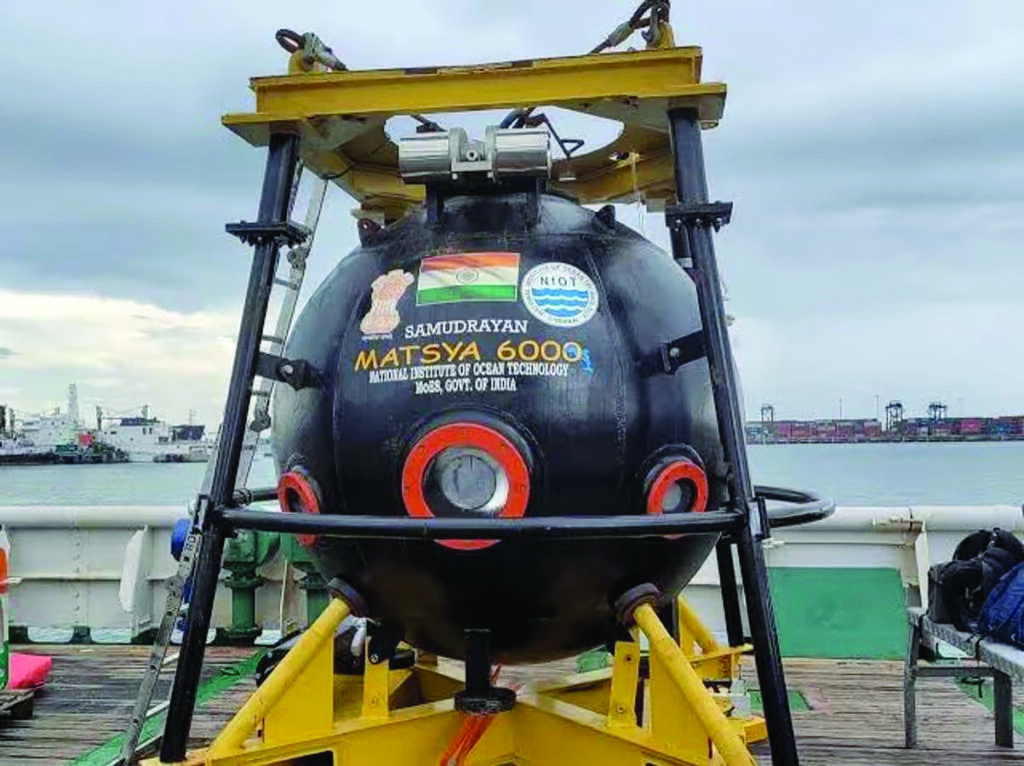
Image Courtesy: PIB
Following this, MoES organised a national brainstorming session in July 2017 with experts from government, academia, and industry. Six thematic components were identified to drive the mission—integrating scientific excellence with technological innovation and societal relevance.
In June 2021, the Cabinet Committee on Economic Affairs approved the mission with a total cost of Rs 4,077 crore for implementation in two phases (2021–2024 and 2024–2026). The mission functions under the strategic oversight of the Prime Minister’s Science, Technology and Innovation Advisory Council (PM-STIAC).
THE STRATEGIC SIGNIFICANCE OF THE DEEP OCEAN MISSION
The importance of the Deep Ocean Mission rests on four converging imperatives:
1. Resource Security: As global demand for critical minerals—such as cobalt, nickel, and rare earths—rises sharply, deep-sea resources offer a viable future source. Securing access to these is essential to sustain India’s renewable energy and high-technology sectors.
2. Climate and Environmental Resilience: Oceans buffer the planet from climate change. Understanding their processes is vital for accurate prediction of monsoons, cyclones, and long-term climate impacts.
3. Food Security: India’s growing population demands an increasing supply of food and nutrition. The rapidly rising demand for seafood cannot be met solely through capture fisheries, which have remained within the range of 2.7 to 3.8 million metric tons (MMT) over the past several years, against an estimated potential of about 5.3 MMT. Promoting deep-sea fishing and mariculture along the country’s extensive coastline can enhance marine fish production to nearly 10 MMT. Moreover, land-based agriculture—an integral component of food security—depends on accurate weather and climate predictions, both of which are significantly influenced by changes in the ocean.
4. Geostrategic and Scientific Leadership: Situated at the crossroads of major maritime trade routes, India’s ability to explore and protect its EEZ strengthens both its economic resilience and strategic autonomy.
PILLARS OF THE DEEP OCEAN MISSION
1. Technologies for Deep-Sea Mining and Manned Submersibles
India has been granted exclusive exploration rights by the International Seabed Authority (ISA) for 75,000 sq. km in the Central Indian Ocean Basin for polymetallic nodules and 10,000 sq. km along the Carlsberg Ridge for polymetallic sulphides. These areas host metals such as manganese, cobalt, nickel, and copper—critical for clean energy systems such as lithium-ion batteries, wind turbines, and solar technologies.
The technological challenges are immense: Mining must occur at depths exceeding 5,000 meters under high pressure and low temperature, in an environmentally responsible way. The mission aims to develop indigenous deep-sea mining technology, including:
• Matsya 6000, a manned submersible capable of descending to 6,000 metres, designed to carry three persons for direct observation and sampling of deep-sea ecosystems.
• An integrated mining system, featuring a crawler-based collector, riser and lift mechanisms, and environmental monitoring tools, enabling minimally invasive resource recovery. The crawler-based collector will gather polymetallic nodules scattered on the ocean floor, while the riser and lift systems will transport the crushed nodules to a mother ship with minimal disturbance.
Once operational, these systems will place India among an elite group of nations—such as the USA, Japan, France, and China—with the capability to undertake human and robotic exploration of the deep ocean.

Image Courtesy: Parametri Architecture
2. Ocean Climate Change Advisory Services
As the ocean absorbs increasing heat and carbon, its physical and biological systems undergo profound change. The mission strengthens India’s ocean observation network through autonomous sensors, self-powered buoys, and profiling Argo floats. High-resolution coupled climate models—run on supercomputers—simulate interactions between the ocean and atmosphere, predicting changes along Indian coasts on seasonal to decadal time scales.
These systems will provide:
• Seasonal to decadal projections of ocean waves, sea level, cyclone frequency, and storm surges.
• Assessments of ocean acidification, deoxygenation, and biological productivity.
• Tailored climate advisory services for policymakers, industry, and coastal communities.
Such forecasts will support climate-resilient planning in fisheries, agriculture, ports, and disaster preparedness. Coastal vulnerability maps at 1:25,000 scale have already been developed, and over 50 Argo floats, 57 wave drifters, and 11 glider missions have been deployed in the Bay of Bengal and Arabian Sea.
3. Exploration and Conservation of Deep-Sea Biodiversity
The deep sea—Earth’s last great wilderness—harbours unique life forms adapted to extreme pressure, darkness, and chemistry. Many produce bioactive compounds with potential in pharmaceuticals, cosmetics, and biotechnology.
The DOM will undertake:
• Inventories and genomic characterisation of deep-sea flora and fauna.
• Development of a biodiversity grid aligned with national conservation targets.
• Bioprospecting of deep-sea microbes for drugs and industrial uses.
• Capacity building in taxonomy, genomics, and marine biotechnology.
These efforts will expand India’s scientific understanding while ensuring conservation of fragile ecosystems.
4. Deep Ocean Survey and Exploration
High-resolution seabed mapping is essential for understanding geological features and identifying areas rich in minerals or biodiversity. The mission supports integrated programmes for bathymetry, sediment analysis, and habitat mapping using autonomous and remotely operated vehicles.
It will:
• Generate detailed seabed maps of the selected areas of the Indian Ocean.
• Explore hydrothermal vents and sulphide fields along mid-ocean ridges.
• Identify mineral-rich zones and unique biological communities.
• Commission an indigenous, multi-purpose ocean research vessel built in India.
The new research vessel, being constructed by Garden Reach Shipbuilders & Engineers Ltd., Kolkata, will enhance India’s long-duration exploration capability.
5. Ocean Energy and Freshwater
As India transitions to a low-carbon economy, the ocean offers vast renewable potential. The mission promotes technologies such as Ocean Thermal Energy Conversion (OTEC), wave energy, and Low-Temperature Thermal Desalination (LTTD).
A pilot OTEC-based low-temperature thermal desalination plant, capable of producing 0.1 million litres of freshwater per day, is under development at Kavaratti, Lakshadweep. Once commercialised, these technologies will contribute to India’s Blue Energy portfolio and sustainable development goals.
6. Advanced Marine Station for Ocean Biology (AMSOB)
The Advanced Marine Station for Ocean Biology, being established at Nemmeli, Tamil Nadu, will serve as a hub for marine research, innovation, and entrepreneurship. It will:
• Develop capacity and enterprise in ocean biology and engineering.
• Translate applied research into market-ready products.
• Host incubators promoting blue trade and manufacturing.
Equipped with facilities for molecular biology, bioprospecting, and mariculture innovation, AMSOB will nurture startups and link research to entrepreneurship, strengthening India’s ocean economy workforce.
GLOBAL CONTEXT AND ALIGNMENT
The Deep Ocean Mission aligns with the United Nations Decade of Ocean Science for Sustainable Development (2021–2030), which calls for “the science we need for the ocean we want.” By investing in exploration and observation, India positions itself as a global leader in sustainable ocean governance.
It complements India’s commitments under the Paris Agreement, the Convention on Biological Diversity, Marine Biological Diversity of Areas Beyond National Jurisdiction (BBNJ) and the Sustainable Development Goals (SDGs)—particularly SDG 14: Life Below Water.
IMPLEMENTATION, GOVERNANCE, AND PARTNERSHIPS
The mission operates under a three-tier governance structure:
• Steering Committee chaired by the Minister of Earth Sciences.
• Deep Ocean Council chaired by the Principal Scientific Adviser.
• Mission Management Council chaired by the Secretary, MoES.
Collaborating institutions include NIOT, NCPOR, CSIR-NIO, INCOIS, Department of Atomic Energy, IITs and leading universities. Partnerships with industry and international agencies will enhance capacity through joint R&D and technology sharing.

Implementation occurs in two phases (2021–2024 and 2024–2026), managed by a Mission Directorate with dedicated Project Directors for each thematic component. This collaborative model ensures efficient coordination and alignment with national priorities.
DELIVERABLES AND EXPECTED IMPACT
By 2026, the Deep Ocean Mission will deliver:
• A fully operational 6,000-metre manned submersible.
• Prototype systems for deep-sea mining.
• Comprehensive bathymetric and environmental maps.
• Long-term oceanographic datasets for policy use.
• Genomic and biochemical inventories of deep-sea biodiversity.
• Functional OTEC-based desalination system.
• A state-of-the-art marine research and innovation centre at Nemmeli.
Together, these will elevate India’s ocean science and technology capabilities, generate skilled employment, and foster sustainable growth in ocean-based sectors.
LINKING THE DEEP OCEAN MISSION TO CLIMATE ACTION AND NATIONAL DEVELOPMENT
The Deep Ocean Mission is not merely a scientific pursuit—it is a national transformation initiative. By deepening understanding of ocean–atmosphere interactions, it enhances monsoon prediction and disaster preparedness.
Its technologies and data will support India’s Nationally Determined Contributions (NDCs) under the Paris Agreement and the goal of Net Zero by 2070. Aligned with Atmanirbhar Bharat, it will reduce dependence on imported critical minerals, stimulate innovation, and create opportunities for coastal and island communities.
TOWARDS KNOWLEDGE-DRIVEN OCEAN GOVERNANCE
The mission marks a paradigm shift—from fragmented, project-based efforts to an integrated, mission-mode approach uniting science, policy, and technology. It bridges fundamental research with applied innovation, ensuring that ocean knowledge translates into tangible societal benefits.
By fostering open data, collaboration, and human resource development, it is nurturing a new generation of ocean professionals who will carry India’s leadership in marine science into the future.
CONCLUSION: CHARTING INDIA’S BLUE FUTURE
The Deep Ocean Mission encapsulates India’s aspiration to lead globally in the responsible exploration and sustainable utilisation of the oceans. It is a journey that combines ancient wisdom with modern science, and national ambition with planetary responsibility.
As the mission unfolds, it will not only unlock new scientific knowledge but also reinforce the foundations of resilience, sustainability, and self-reliance. It will ensure that India’s growth remains aligned with the rhythms of nature—balancing development with duty, exploration with ethics, and progress with preservation.
By reaching into the depths, India is charting its destiny—transforming its oceanic heritage into a sustainable and prosperous Blue Future.
*The writer is Former Director, Indian National Centre for Ocean Information Services (INCOIS), Hyderabad.