


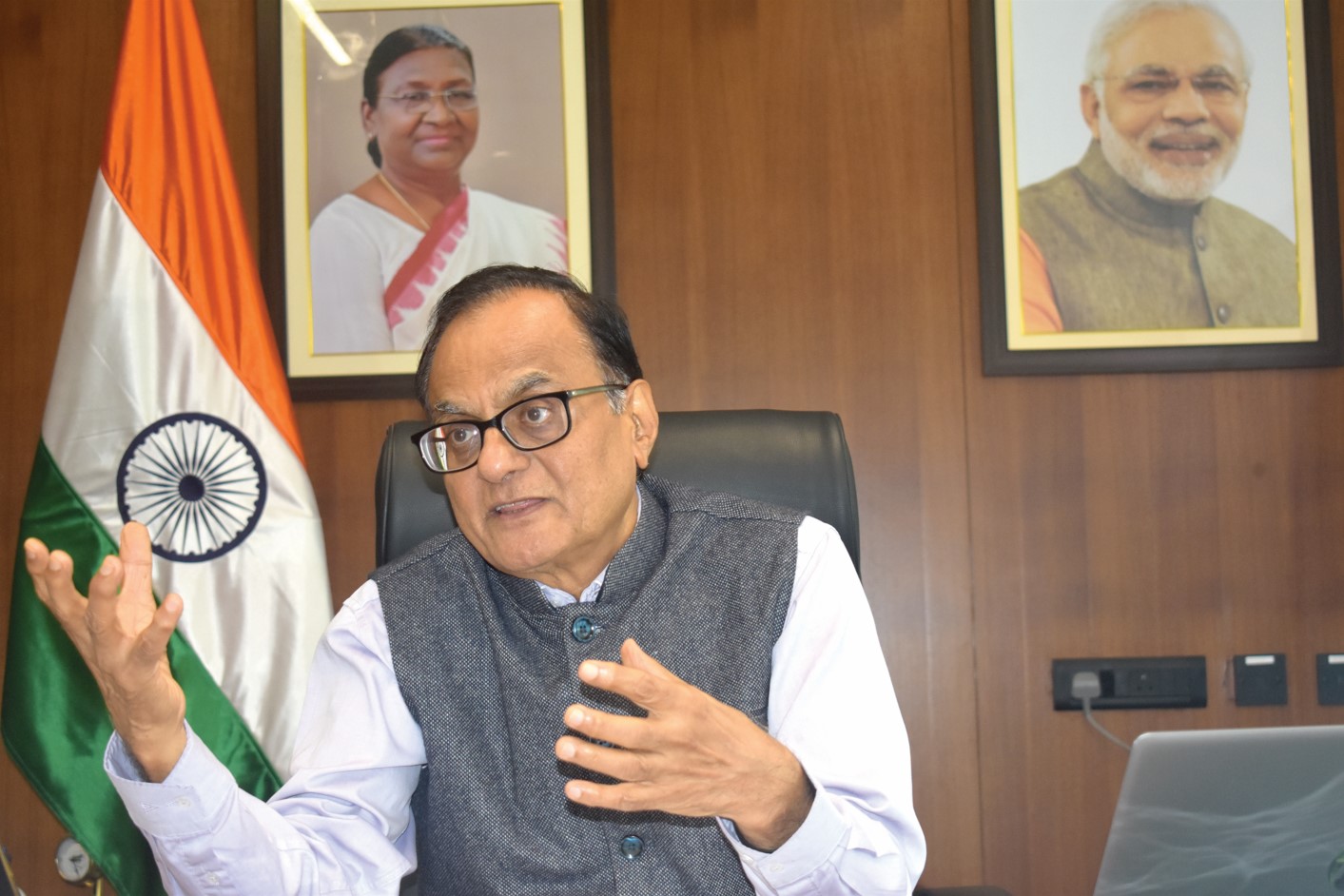
EXCLUSIVE INTERVIEW – PSA Prof Ajay K Sood
The current era of rapid technological advancement and innovation in India has not only energised the scientific community but renewed general interest in the country towards a culture of scientific enquiry, innovation for social good, and a desire to create and produce at par with the leading scientific nations of the world. A big push for this ambient atmosphere continues to come from the government that is paying attention to long neglected areas, such as high-impact research, through tangible funding, and inspiring young people to help convert India from a service nation to a product nation, among other things.
At the helm of these paradigm changes in the way science is conducted and utilised in India, is Prof Ajay K Sood, who is the fourth Principal Scientific Adviser to the government of India. He is at the apex of all thinking bodies that are introducing epochal reforms in scientific domains to metamorphose India into one of the global leaders in science and research. He speaks at length with Debobrat Ghose of Science India, in an interview whose excerpts are as follows:
The scientific world across the globe is celebrating the Year 2025 as ‘100 Years of Quantum Mechanics’. Where does India stand today as far as the ambitious Quantum Mission is concerned?
What we are seeing today in Quantum technology is the second revolution. The first phase of Quantum science was when it started to understand nature, atoms, molecules, electromagnetic radiation, and so on. We witnessed enormous technological progress—the invention of transistors, lasers, semiconductors—in that phase. But we did not know how to control the quantum systems, the quantum states.
In the second revolution which has been happening for the last 15 years, we are now able to control the quantum states, the atomic states. So, quantum mechanics is not new. What is new is the control on those states.
We have come a long way in quantum mechanics. The Nobel Prize 2025 has been awarded to a subject of study related to quantum mechanics, as was the case three years back as well.
India has taken cognisance of the situation because quantum technologies will be essential for technological sovereignty of any country, as this technology will be used to weaponise.
India’s National Quantum Mission was launched in 2023. This comes under the Prime Minister Science Technology Innovation Advisory Council (PM-STIAC), which is chaired by the PSA. It has been formulated and implemented by the Department of Science and Technology along with ISRO, Department of Atomic Energy, DRDO, MeitY (Ministry of Electronics and Information Technology), DoT (Department of Telecommunications), etc. The mission comprises four verticals—Quantum Computing, Quantum Communication, Quantum Censors, and Quantum Devices—and opened four hubs on each theme.
Each hub is a multi-institutional arrangement. For example, in Quantum Computing, the hub is IISc Bangalore. Each hub will also have four-five Technical Groups (spokes) in the same vertical, again each spoke having four-five institutes. This makes more than 50 institutes in the country involved in the mission. So, the approach is from fundamental science to product development to deployment—taking above from TRL 1 to TRL 7 or 9.
We are also funding start-ups in the mission and eight have already been funded. For example, in quantum computing, we have funded to make quantum computer hardware because what will be a quantum computer is not yet finalised even in the world. What will be a qubit? Will it be a superconducting base? Will it be photonic? Will it be a neutral ion? May be all these in some way. All these questions are being worked upon in the world.
Right now, India has a seven qubit machine at TIFR and a start-up, QpiAI from Bengaluru, is putting together a 25 qubit machine. Our goal is to go up to 1000 physical qubit quantum computers with error correction, etc.
Another important project has been launched on quantum algorithms. I will give you one example. All your devices, data transfer, bank, etc., are based on the RSA encryption. This is based on a simple principle of, let’s say, factorisation of a 128 bit number. By the time you factorise, it will be 100,000 years, so your data is safe.
The question is, if you can have a quantum computer to break this encryption, everything is unsafe. For example, Shor’s Algorithm can break this code. This potentially puts all your financial sector in trouble. People are working on PQC (post-quantum cryptography) to make encryption quantum safe. There are enormous international efforts in this direction, in which India is also deeply involved.
The Anusandhan National Research Foundation (ANRF) is a promising reform of the Modi government. How will it become an agile, transparent, and impactful body? How can ANRF fulfil its objective of giving hand holding to state universities?
This is a very transformational step with several objectives, one of which is to have a collaborative approach between agencies. We have a programme to uplift Tier 2 and Tier 3 institutes that have lagged behind in research. Under the PAIR programme, established institutes (hubs) partner with Tier 2/ Tier 3 institutes (spokes). We received a large number of proposals under this programme and have funded a few of them. But the funding is very interesting—only 30% goes to the hub while 70% goes to the spoke.
Second, we have launched mission oriented programmes. An example is the e-mobility mission, on electric mobility. Right now, this sector sees a lot of imports. To reduce that, we need to invest in cutting-edge R&D, which will translate into products. The third one is a mission on medical devices, launched in collaboration with ICMR and Gates Foundation as co-funders, and ANRF as the lead.
The other programme which again has been hugely received is the early career grant—PMECG (Prime Minister’s Early Career Grant). It gives up to Rs 60 lakh per person for three years plus some other benefit, to undertake research. The idea is to support scientists at the start of their careers, in their best productive years, when they don’t have a support system. We were enormously oversubscribed. We could fund, say 700 of them but we have got more than 8000 applications. This also shows the hunger we have and there are so many young people, raring to do things.
How can the Office of the Principal Scientific Adviser (OPSA) prioritise and support research and development in areas vital for our community’s well-being?
The OPSA plays a central role in India’s S&T landscape. Its core mandate is to offer practical and objective advice to the PM and the Cabinet on matters related to S&T and innovation. There are two key mechanisms for this: PM-STIAC (Prime Minister’s Science, Technology and Innovation Advisory Council), which helps identify challenges, suggest solutions and develop strategic roadmaps to guid national priorities; and the ETG (Empowered Technology Group) that provides expert advice on technology-related policies, including R&D investments and procurement strategies for high-impact technologies.
Meetings at PM-STIAC have led to the launch of about 12 national missions including the National One Health Mission, India Semiconductor Mission, National Quantum Mission, AI Mission, Deep Ocean Mission, and Green Hydrogen Mission, among others. Some other missions such as Carbon Capture Utilisation and Storage (CCUS) and National Plant Health Initiative are in the making. Similarly, ETG meetings brought together 176 experts to review 135 policy notes, resulting in initiatives like BioE3, Sustainable Livestock Health & Production, Mausam Mission and PINAKA Rocket Launch System.
The OPSA works to bridge the gap between researchers, decision-makers and citizens—making science more accessible to everyday life. Both PM-STIAC and ET are headed by the PSA who reports to the PM.
With Artificial Intelligence and high publication volumes, verisimilitude and reproducibility in science are emerging concerns. Can there be a national mechanism for validation, replication, or a registry of verified research?
It is true that the advent of AI and swollen publication volumes have amplified the concerns over consistency, authenticity and reproducibility in research. We need to look at appropriate software to check the AI generated content.
The ANRF and One Nation, One Subscription scheme are two important levers and they have the potential to act as critical instruments in addressing verisimilitude in science.
Our office has helped bring out a national governance policy for AI, which has been released recently by MeitY, on November 5. Ethics will be an integral part of it but it will not be overly regulated as that would kill innovation. But it cannot be free for all also. Innovation and nimble regulation have to go side-by-side.
In which critical areas do we most need indigenous technological development to reduce our dependence on imports, and work towards Atmanirbhar Bharat (self-reliant India)?
That’s an excellent and very timely question. There are many such areas but the immediate example that I can tell you is that of drones. Operation Sindoor told us all what is urgent. A large percentage of the components in our drones are imported. The Civil Aviation department’s new mission, the Drone Shakti Mission, will enable, with some incentives, to make these components indigenously. We are deeply involved in this mission as R&D in this sector is also the need of our time.
Second, we need to have a commitment to be a Product Nation. We should not only be a service nation. This has to begin at the design stage. We have designers but they work on somebody else’s specifications. Indian designers and innovators should come up with what we need in the next two years. An example is our electronic product scheme, with a corpus of Rs 26,000 crore, to make electronic components.
Ideally, a country of India’s size and ambition should strive for self-reliance across as many domains as possible, particularly in those with high economic potential and strategic relevance. However, we must also recognise that no nation in today’s interconnected world can be completely indigenous with zero dependency on external actors. What truly matters is securing sovereignty in technologies that are critical to our long term social, economic, environmental, and security interests.
The OPSA has initiated a structured exercise to identify critical technologies for India. Some examples are:
* In energy, emerging domains like green hydrogen and advanced battery chemistries.
* In digital technologies, indigenous capabilities in AI, especially multilingual large language models, neuromorphic computing, and future artificial general intelligence or AGI systems.
* In quantum communication, computing, and sensing.
* In aerospace and drone technologies, which are already transforming logistics surveillance and precision agriculture.
How can we harness the incredible potential of digital technologies, including AI, IoT, and big data analytics, as well as emerging fields like Quantum Technology, to more effectively address the complex challenges faced by our nation?
India has already proved that DPI (digital public infrastructure) is our strength. We have the highest number of UPI payments, highest number of Aadhaar transactions, almost 18 billion transactions a month. This is an incredibly large number. All that has happened because of public-private partnership. I will give you an example. Government made the structure for UPI but it is not in the business of rolling out UPI. We have Google Pay, Paytm and PhonePe among others—all are using the same structure and authentication.
Now, we have rolled out DPI 1.0—Aadhaar, DigiLocker, Cowin, etc. We are the leaders in this field. No country has so much data. But what next? To keep the leadership, we need to now build on DPI 1.0. We can call it DPI 2.0. That is my dream. We will need R&D. DPI 2.0 will have intelligence built into the data.
How can the government create more effective and accessible platforms that truly foster collaboration among researchers, national labs, academia, and industry across various disciplines?
This is a key policy priority for us. India’s innovation potential is immense but often remains fragmented. The challenge is to bring these strengths together for large scale impact. The government, therefore, is taking a steady approach to move from fragmented, project-based support to mission driven, collaborative ecosystems. For instance, the Indian Science, Technology and Engineering Facilities map (i-STEM) provides a digital platform that allows researchers and industry to access high-end R&D facilities across the country, breaking down institutional silos and maximising utility and national investments in infrastructure.
Manthan, an open innovation and collaboration platform brings together problem owners from government, industry and foundations with solution providers from academia and startups, catalysing partnerships in critical and emerging areas such as AI, quantum, clean energy and materials. This is along with technologies for rural sector [such as Rural Technology Application Group (RUTAG) and Rutag Smart Village Centres-RSVCs].
DST, ANRF and OPSA are operationalising the Research, Development and Innovation (RDI) Fund to provide catalytic core funding support for collaborative research. It will encourage shared risk-taking between the government and the industry.
At the Indian Science Congress, 2015, Prime Minister Narendra Modi gave a clarion call that India must restore pride and prestige of its scientific heritage. What is the roadmap to ensure that India achieves its aspiration of becoming one of the top three global leaders in science and research by 2047?
The PM has said on many occasions that our heritage, our Virasat, and Viksit Bharat, both have to go together. The point is we have to be careful. We should not equate fantasies with our heritage even as we remain proud of what we have.
Look at our ancient astronomy, as expostulated in texts such as Brihat Samhita and Surya Siddhanta, for example. Even astronomical references in the Mahabharata and the Ramayana are mindboggling. It also tells us that the earth is not static and that the earth is not the centre. It was all explained thousands of years ago. If you look at the Mahabharata, it tells you the exact nakshatras at that time. The present pole star is not the pole star of that time because you know the pole star changes in about 26,000 years due to slow wobble in the Earth’s rotation axis. That is very deep science. It is not fantasy.
Sushruta Samhita mentions instruments for medical surgery. One should refer to Dr M S Valiathan’s volumes on Sushruta Samhita and Charaka Samhita. That’s science.
We have so much. Promote these things, not the wrong things. By promoting one wrong thing, we bring harm to 100 right things. Let us be proud of our heritage but we should do it with the lens of modern science.
To realise India’s aspiration of becoming one of the top three global leaders in science and research by 2047, we must pursue a bold, integrated road map that builds on our strengths and anticipates future needs.
First, we must continue investing in mission-driven, high-impact research that addresses both national priorities and global challenges. Over the past decade, India has launched several transformative missions such as the India AI mission, Semiconductor Mission, and the One Health Mission, etc., which not only strengthen our scientific and technological capabilities but also position India as a credible global contributor in emerging domains.
Second, we are focused on building world class research ecosystems by upgrading our universities and national laboratories, expanding the scope and reach of ANRF and fostering collaborations across academia, industry, and government. A key enabler in this direction is the newly approved RDI Fund.
Both ANRF and RDI funds are aimed at breaking silos across institutions and sectors, promote convergence, and catalyse collective outcomes.
Third, we are nurturing youth-led innovation and talent development through initiatives such as the Atal Innovation Mission and Prime Minister’s Research Fellowship for the new generation.
Fourth, India is deepening its global partnerships in scientific diplomacy by actively engaging in bilateral and multilateral collaborations in frontier research, space exploration, and climate science. The CSAR (Chief Science Advisers’ Roundtable) initiative under India’s G20 presidency has been instrumental in fostering global scientific dialogue and cooperation.
*The interviewer is Editor, Science India.