


Image Courtesy: Vijnana Bharati
IISF 2025 TAKEAWAYS
The 11th edition of the India International Science Festival (IISF) 2025 concluded in Panchkula (Haryana) in December 2025 with a resounding message: Science in India is no longer confined to laboratories, but is increasingly shaping national policy, societal transformation and India’s civilisational journey towards becoming a developed nation. Held at the Dussehra Ground in Panchkula from 6 to 9 December, IISF 2025 emerged as one of the largest science outreach events in the country, drawing scientists, policymakers, students, innovators, start-ups and citizens from across India and several foreign delegations.
Organised by the Ministry of Earth Sciences in collaboration with other science ministries and departments of the Government of India, and Vijnana Bharati, IISF 2025 was anchored around the theme “Vigyan Se Samruddhi: For Aatmanirbhar Bharat”, underlining the government’s vision of science-led prosperity and inclusive development.
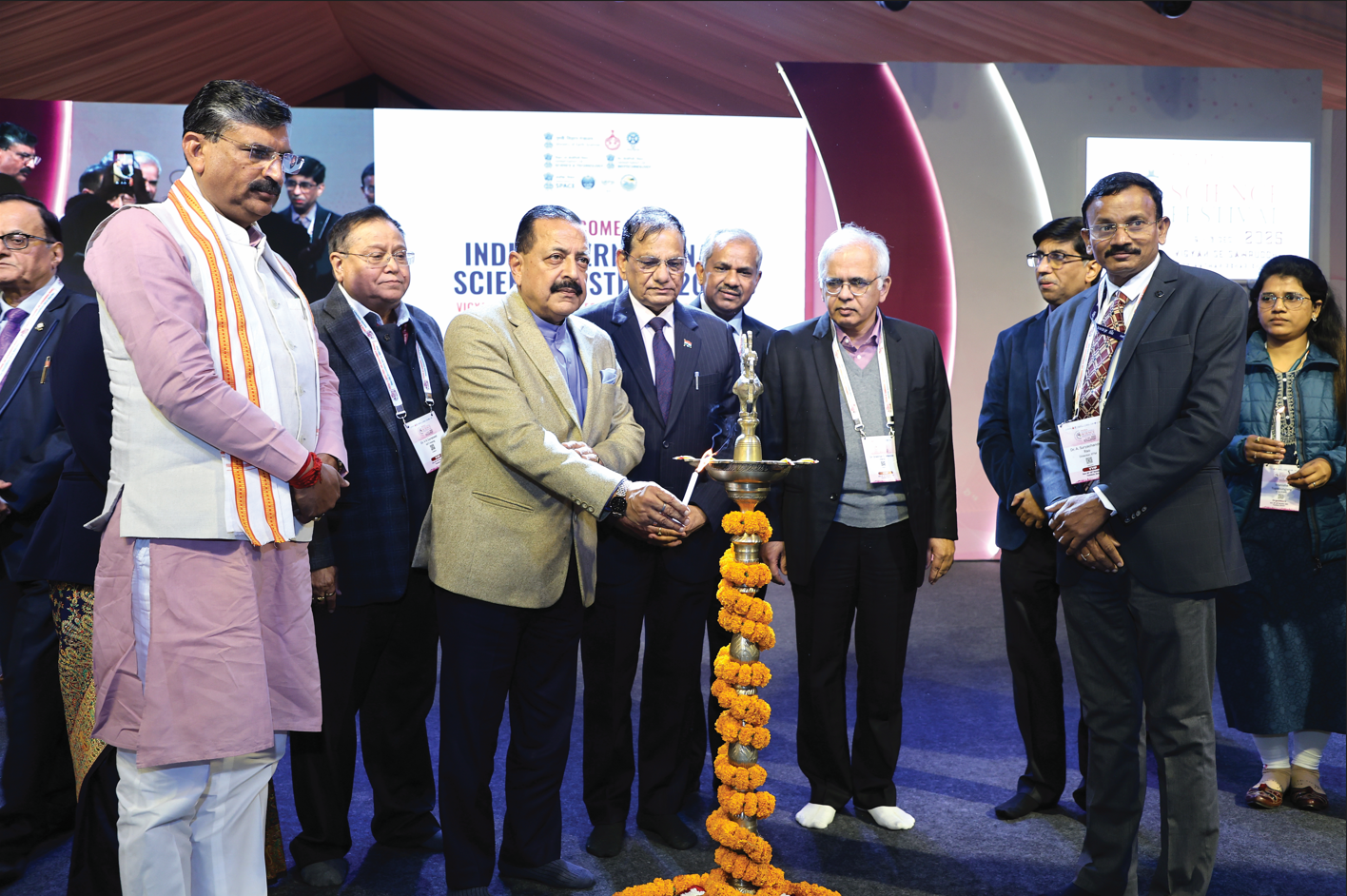
The festival was inaugurated in the presence of Union Minister of State (Independent Charge) for Science and Technology, Earth Sciences and MoS, PMO, Dr Jitendra Singh, along with Dr M Ravichandran (Secretary, MoES), Prof Ajay Sood (Principal Scientific Adviser to GoI), Dr Shekhar C Mande (President, VIBHA), and NITI Aayog members Dr VK Saraswat and Dr VK Paul.
In his inaugural address, Dr Singh emphasised that IISF was conceived not merely as a scientific conference but as a mass movement to democratise science.
“Science must move from institutions to households, from journals to janata,” he said, reiterating that IISF rests on three core pillars—Celebration, Communication and Career. He highlighted that India’s scientific ecosystem has undergone a fundamental shift in the last decade, marked by indigenous innovation, start-up culture, and policy-driven research aligned with national priorities.
Dr Singh underlined how India’s achievements in space technology, biotechnology, deep ocean research, nuclear science and digital public infrastructure reflect the country’s growing scientific self-confidence and its commitment to global good.
A HUB OF SCIENTIFIC CHURNING
Over four days, the IISF venue transformed into a vibrant science city, hosting more than 150 thematic sessions, exhibitions, workshops and outreach programmes. The festival witnessed the participation of tens of thousands of students, teachers, researchers and citizens, making it one of the most inclusive science festivals held in India to date.
The event brought together scientists from premier institutions such as ISRO, DRDO, CSIR, IISc, IITs, AIIMS, ICAR and several universities, alongside start-ups, industry leaders and policy experts. Special focus was laid on engaging school and college students through hands-on demonstrations, interactive exhibits and science communication sessions.
Addressing the festival, Haryana Chief Minister Nayab Singh Saini described Students’ Science & Technology event as a ‘New Nalanda’, reflecting India’s ancient tradition of knowledge centres adapted to modern scientific needs.
A special session featured Group Captain Shubhanshu Shukla, India’s Gaganyaan astronaut-designate, whose presence drew immense interest among students and young science enthusiasts. Shukla spoke about India’s human spaceflight ambitions, the rigorous training process undertaken by astronaut candidates, and the larger significance of the Gaganyaan mission in establishing India as a frontline space power.
The event ‘Matsya-6000’ showcased India’s first indigenous crewed deep-sea submersible, developed under the Deep Ocean Mission. The scientists explained how deep-sea research is critical for understanding climate change, marine biodiversity, mineral resources and disaster preparedness.
One of the most widely attended segments at IISF was ‘Operation Sindoor: An Untold Story’, in which Lt Gen Rajeev K Sahni (DG, EME, Indian Army) highlighted the role of indigenous defence technologies, scientific preparedness and inter-agency coordination in national security operations that led to the success of this operation. The EXPO as ever was a major attraction for the visitors at IISF.