


IN FOCUS: INTER-UNIVERSITY ACCELERATOR CENTRE (IUAC), NEW DELHI
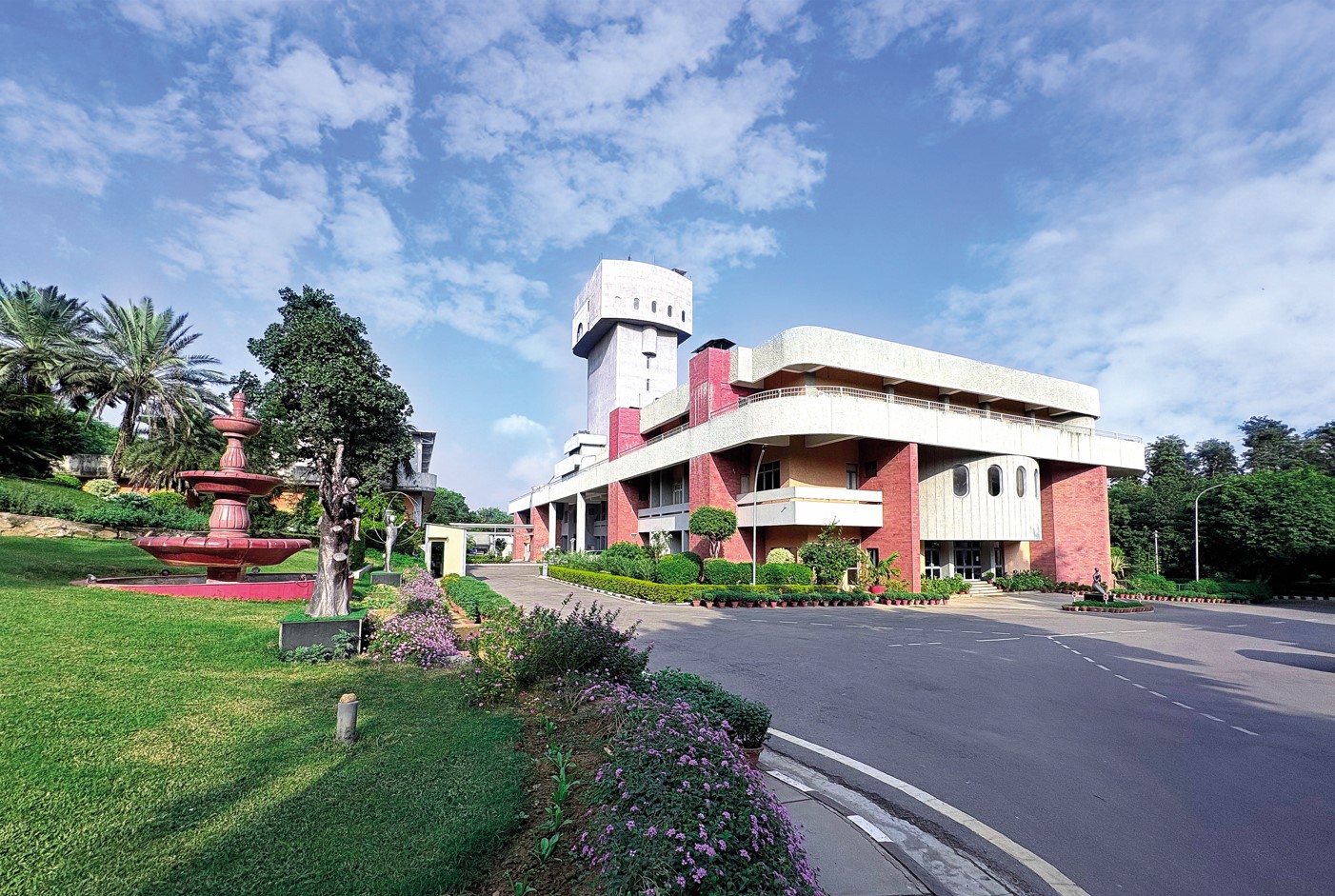
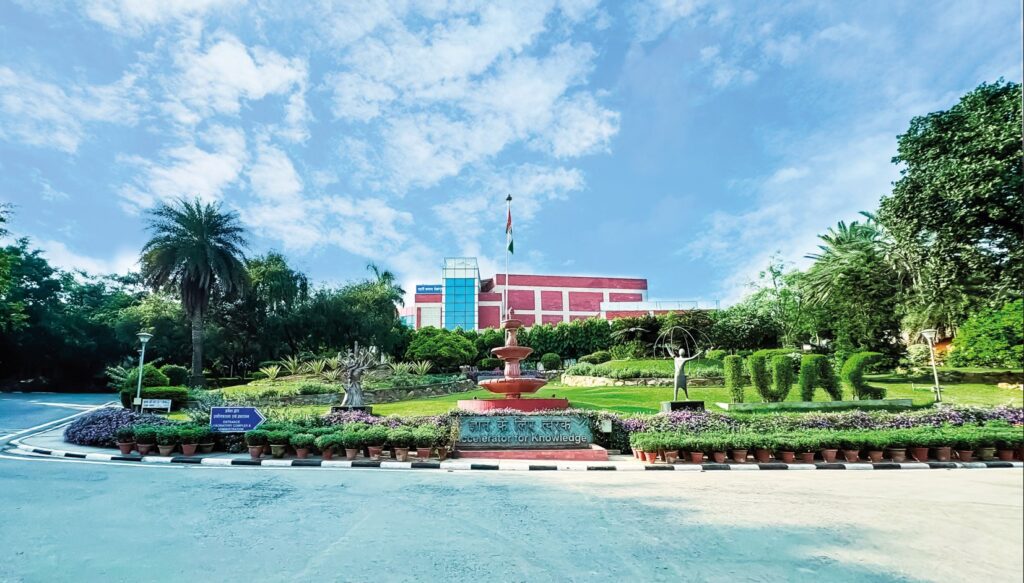
Inter-University Accelerator Centre (IUAC), earlier known as Nuclear Science Centre (NSC), is an autonomous Inter-University Centre established in 1984 by the University Grants Commission (UGC) under the Ministry of Human Resource Development (MHRD). The centre, which came up as a green-field project, is spread over 25 acres of land provided by Jawaharlal Nehru University in Qutub Institutional Area of New Delhi, with a lush green, environmentally friendly campus. The construction of the Laboratory Complex and other infrastructure for establishing the centre started in 1986, and it was dedicated to the nation in 1990. It has since been fulfilling its mandate by providing research facilities round-the-clock to more than 700 research groups from nearly 160 universities, 85 colleges, and 60 other national laboratories. Till now, more than 1250 PhD scholars have completed their theses using the centre’s state-of-the-art research facilities. In the year 2005, the Nuclear Science Centre was renamed as Inter-University Accelerator Centre (IUAC), which reflects its character and mandate.
The main aim of the centre has been to establish a national institute to provide internationally competitive, front-ranking accelerator-based research facilities to researchers from Indian universities, research institutes, and other national laboratories in many interdisciplinary fields. The centre was established, considering the great demand in the Indian research community, to not only provide accelerator-based research facilities but also to develop world-class accelerators and research programmes. Emphasis is laid on encouraging group activities and sharing of the facilities at the centre in synergy with those existing elsewhere in India and abroad.

USER SUPPORT WITH EXCELLENCE
With a focus on user support, IUAC endeavours to make every user feel welcome and respected and encourages all to contribute towards achieving excellence while continually looking for ways to improve work, advance skills, and make the best use of its experience and talent. Even while celebrating individual strengths and talents, a collaborative environment is encouraged, acknowledging the fact that we achieve more by performing pioneering research with national and global partners. Creativity is cherished while developing self-reliance through indigenous development and implementing new ideas with courage and confidence for competitiveness. Acknowledging IUAC’s excellence in operation and maintenance of accelerator-based facilities, the centre has also been mandated to provide support to other ion accelerator-based facilities and has proactively supported many such facilities.
ACCELERATOR HUB
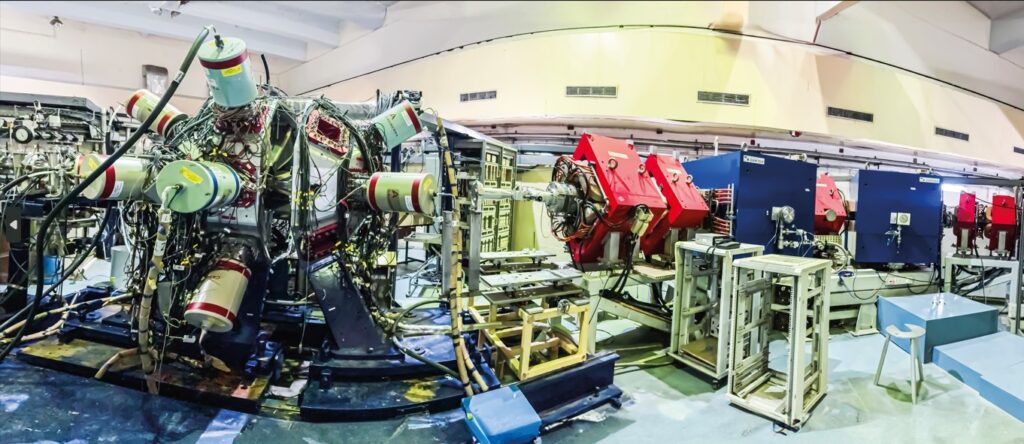
IUAC has commissioned many types of accelerators, etc. The 15UD Pelletron Accelerator, operational since 1990, with terminal potential up to 16MV, is the biggest in India and one of the world’s about half-a-dozen operational large Tandem Accelerators. The superconducting linear accelerator (SC Linac) at IUAC serves as a booster to the 15 UD Pelletron. The superconducting Linac consists of three accelerating modules, each housing eight Niobium Quarter Wave Resonators (QWR), and was designed and developed in the early 1990s in collaboration with Argonne National Laboratory (ANL), USA, and at present IUAC takes up its in-house production.
The multiply charged positive ion beam facility has been set up using an Electron Cyclotron Resonance (ECR) ion source mounted on a 400-kV voltage deck, whereas the negative ion accelerator (or implanter) facility provides negative ion beams up to 200 keV. The Rutherford Back-Scattering (RBS) facility is based on a 1.7 MV Pelletron accelerator for the determination of elemental analysis. A new state-of-the-art 500 kV Pelletron accelerator-based Accelerator Mass Spectrometry (AMS) facility for radiocarbon dating has been established for dating or time-stamping of geological and prehistoric samples. The High Current Injector (HCI) project will accelerate the ion beam from the ECR source using normal temperature as an alternate injection system for the IUAC LINAC.
IUAC has also been sharing its expertise in the development of various accelerator systems with other national and international labs. A collaboration ongoing with VECC, Kolkata, aims to fabricate cavities used in accelerator development for Fermilab under the Indian Institution and Fermilab Collaboration (IIFC), with IUAC contributing technical expertise and SRF infrastructure.
PIONEERING ACCELERATOR-BASED INTERDISCIPLINARY RESEARCH
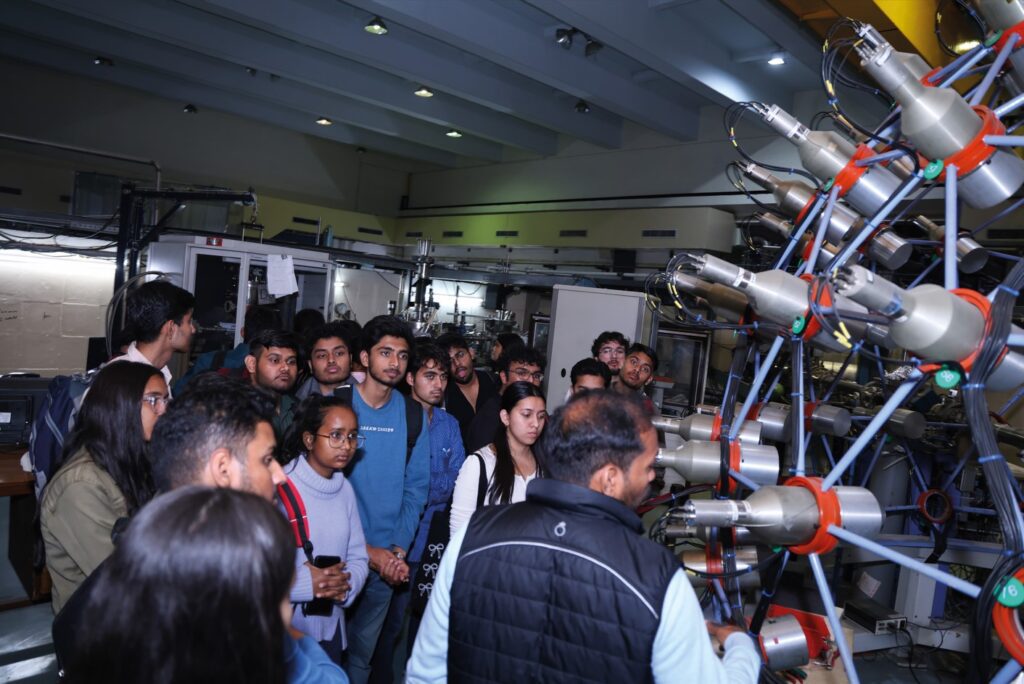
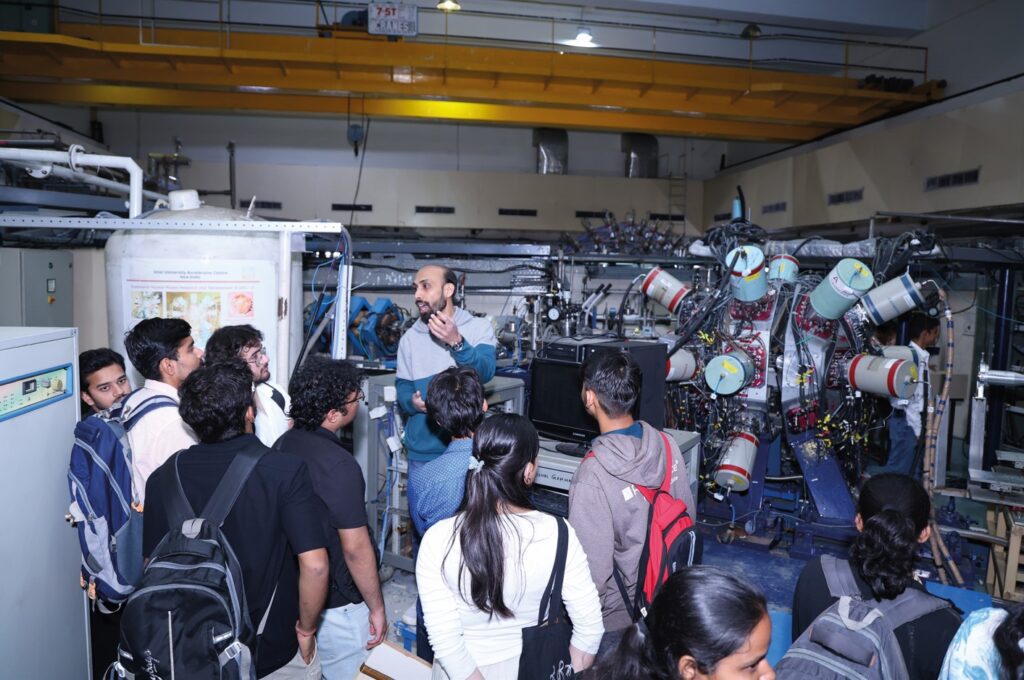
The research activities at the centre are credited with a major contribution to reviving nuclear physics research in Indian universities. The Nuclear Physics programme covers almost all the current thrust areas with state-of-the-art experimental facilities. HYbrid Recoil mass Analyzer (HYRA) is a unique, state-of-the-art Recoil Mass Spectrometer/ Separator and is one of only five other gas-filled separators in the world for heavy element detection. The national facility for γ-spectroscopy, Indian National Gamma Array (INGA) consisting of 24 Compton-suppressed Ge Clover detectors, is one of the few large gamma detector arrays in the world and was created with a formal agreement between various institutions. National Array of Neutron Detectors (NAND) is an array of 100 liquid-scintillator-based neutron detectors and is one of the few large neutron detector arrays in the world.
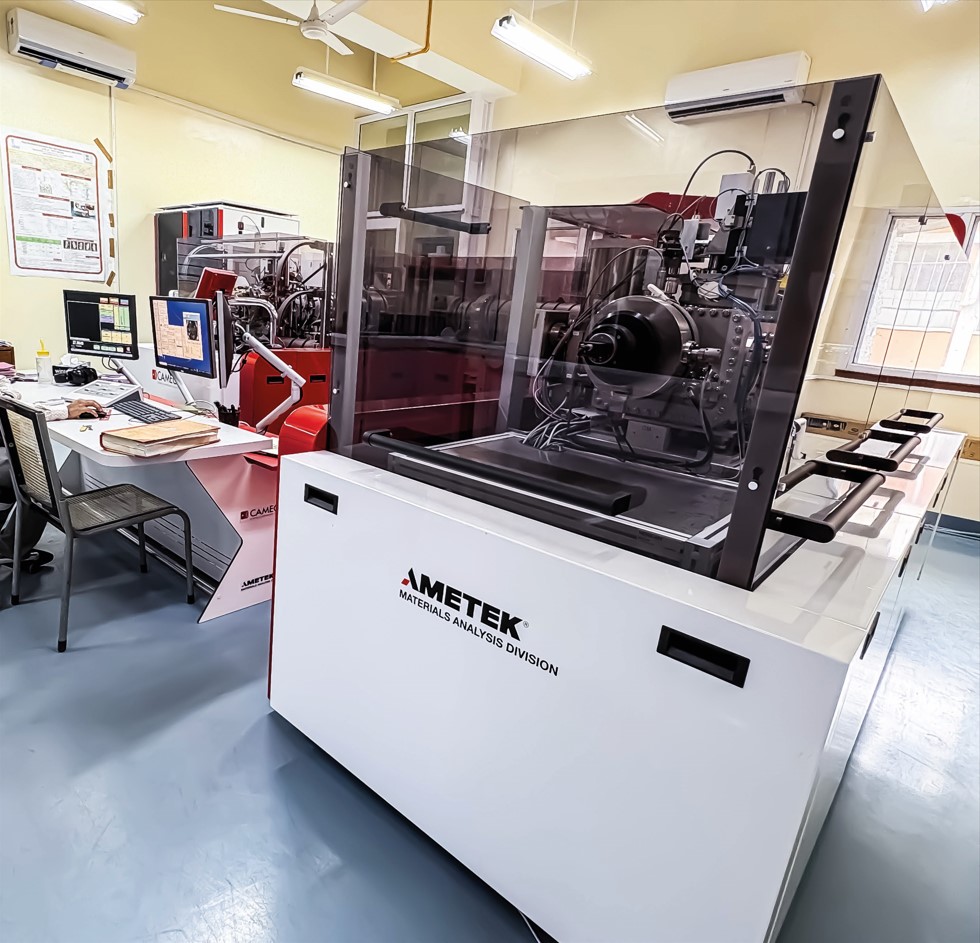
Material Science research facilities include state-of-the-art in-situ XRD and Raman facilities, with similar facilities existing in only a few labs across the world. Heavy Ion Radiation Biology is an interdisciplinary applied science, and the radiation biology beamline at IUAC facilitates research in the effects of energetic charged particles on biological systems at the molecular level. A unique cell line irradiation system, ASPIRE (Automatic Sample Positioning for Irradiation in Radiation Biology Experiments), is installed at the dedicated Radiation Biology beam-line.
INDIAN HERITAGE THROUGH SCIENCE: NATIONAL FACILITY FOR GEOCHRONOLOGY
Accelerator Mass Spectrometer (AMS) & High-Resolution Secondary Ion Mass Spectrometer (HR-SIMS) with ancillary instruments facilities available at IUAC are capable of performing isotope research and dating an entire geological age spectrum from the youngest (years, kilo years) to the oldest (Hadean/Archean rocks ~billions of years and Meteorites), thus covering the geological history of the Earth, the Solar system down to the Neogene/Anthropocene. IUAC is setting up a National Geochronology Facility (NGF) with the support from the Ministry of Earth Sciences, Govt of India, which is equipped with Accelerator Mass Spectrometry (AMS) facility for the measurement of 14C, 10Be and 26Al radio nuclides for different time scale measurements. Some of the initiatives undertaken are: 14C dating for archives and heritage chronology of documents of national importance preserved/maintained by the National Archives of India (NAI), bio-based assessments of essential oils, aromatics & flavour products, testing the content of biofuel in blended fuel, etc. This effort is in response to India’s commitment on international forums (COP28) to phase out energy dependency on fossil fuels and to achieve the target of Net zero.
FREE ELECTRON LASER
To address the growing demand for intense and coherent photon beams in India, an accelerator-based photon source is being developed at IUAC. The facility, named Delhi Light Source (DLS), is based on the principle of a Pre-bunched Free Electron Laser. An advanced fibre-laser system with a pulse width in the range of several hundred femtoseconds is being developed in collaboration with KEK Japan.
TOWARDS NATIONAL MISSIONS: ISRO PROJECTS
The missions undertaken by the Indian Space Research Organization (ISRO) have been utilising IUAC’s Pelletron Facility for more than two decades. IUAC has made significant contributions in many projects and several complex microelectronic devices, such as FPGAs, memories, controllers, synthesisers, power converters, oscillators, detectors, Application Specific Integrated Circuits (ASICs), etc., have been tested at IUAC for Chandrayaan-1 & 2, Mars Orbiter Mission, Navigation & Disaster Management application missions, and Earth Observation Missions.
Recently, several such devices were qualified for the prestigious national space missions—Chandrayaan-3 and ADITYA-L1, Technology Demonstration Satellite-01 (TDS-01), OCEANSAT-3A and SPADEX.
ATMANIRBHAR BHARAT AND MAKE IN INDIA INITIATIVES
High Performance
Computing facility
In alignment with the initiatives for Atmanirbhar Bharat and Make in India, IUAC has enhanced its computing infrastructure with the installation of a 3 PF supercomputing facility under the National Supercomputing Mission (NSM-TAC), designated as ‘Virtual IUC for Supercomputing’, with technical support from the CDAC team. This supercomputing system utilises Indian PARAM Rudra servers. The facility was formally dedicated to the nation by Prime Minister Narendra Modi on 26 September 2024. Users from multiple universities and institutes commenced utilising the facility for their computational applications for research in Nuclear Physics, Material Science, Atomic and Molecular Physics, Biology, and Artificial Intelligence, etc.
THE MEITY-FUNDED MRI PROJECT
IUAC has made a significant contribution to a project for developing a whole-body MRI magnet system in collaboration with MEITY and CDAC. The magnet system was successfully energised to a strength of 1.5 T and stabilised at that level using an indigenously developed Magnet Ramping Unit (MRU). The final tests for the MRI system are currently being planned before its commissioning at SAMEER (Society for Applied Microwave Electronics Engineering & Research).
ELECTRONIC INSTRUMENTATION AND POWER SUPPLIES
IUAC has been proactively involved in the development of many electronic sub-systems used in data acquisition, and many of these import substitutions were designed and developed indigenously for the first time in India. Some of such devices are high-performance compact power supplies, VME Master controller for beam transport magnets, indigenously designed double slit controllers, and various power supplies. The facilities also require a lot of custom-made electronics, interlocks, and control systems solutions, which are not available off the shelf and hence are very expensive. IUAC has also fulfilled requirements for many types of high-voltage/ high-current power supplies with in-house fabrication.
OUTREACH
Academic programmes
The Acquaintance Programme of IUAC is conducted in different parts of the country to make the local scientific community aware of the IUAC programmes and facilities. IUAC conducts a two-semester PhD Programme every year for interested university research scholars. The outreach is strengthened by the organisation of workshops, schools, and conferences on specialised topics. IUAC provides various opportunities to students at different levels to familiarise them with the programmes and facilities at IUAC including Orientation Programme for MSc students, and a summer programme for BSc students. Visits of school/college students to the various facilities are arranged throughout the year at IUAC. IUAC has also taken the initiative in organising various workshops and special courses on the Indian Knowledge system in line with the objectives of the New Education Policy.
Experiments for Young Engineers and Scientists
As a part of IUAC’s outreach programme, a project ExpEYES (Experiments for Young Engineers and Scientists), with an objective of developing a computer-interfaced device capable of performing the role of a number of laboratories, and training college/university teachers in its usage and development of new experiments, is initiated.
THE WAY FORWARD
Accelerators are becoming increasingly vital in a wide array of applied fields such as medical science, archaeology, semiconductor technology, and quantum computing, while also making significant contributions to foundational interdisciplinary research. The Inter- University Accelerator Centre (IUAC) is committed to addressing these multifaceted challenges by fostering a robust ecosystem. This initiative will focus on enhancing capacity building and spearheading innovative research in interdisciplinary domains, ultimately paving the way for breakthroughs that can transform our understanding and utilisation of these cutting-edge technologies.