





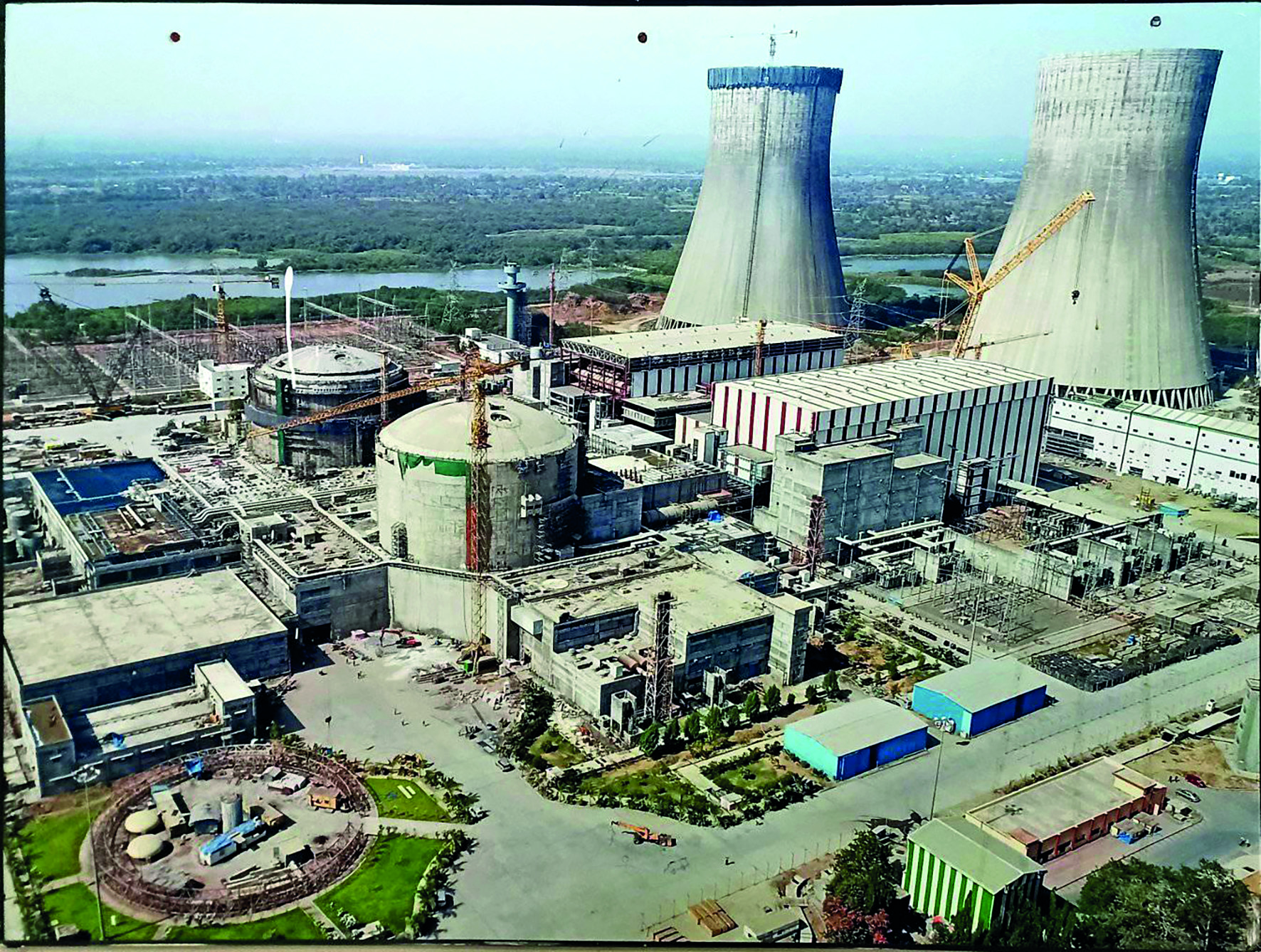
Image Courtesy: Nuclear Power Corporation of India Limited
India stands at a defining moment in its energy journey. Rapid economic growth, expanding digital infrastructure, urbanisation, and rising aspirations have led to an unprecedented surge in electricity demand. At the same time, climate change, environmental degradation, and geopolitical uncertainties linked to fossil fuels have made the existing energy paradigm increasingly unsustainable. It is within this complex scientific, environmental, and policy landscape that the SHANTI Act 2025 (Sustainable Harnessing and Advancement of Nuclear Technology for India) assumes critical importance, it was introduced in the Lok Sabha on 15 December 2025 and passed on 17 December, passed by the Rajya on 18 December, and received the President’s assent on 20 December, becoming an act.
The SHANTI Act is not merely a legislative reform, it represents a scientifically informed rethinking of nuclear energy’s role in India’s green transition. By modernising outdated legal structures, strengthening safety governance, enabling carefully regulated private participation, and aligning nuclear power with climate goals, the Act places nuclear science firmly within India’s clean energy strategy. For a country striving to balance development with sustainability, this marks a decisive shift from viewing nuclear power as an isolated technology to recognising it as a systemic solution.
India’s electricity demand is projected to more than double over the next two decades. While renewable energy, particularly solar and wind, has expanded rapidly, these sources alone cannot meet the requirements of a stable, resilient power grid. Their inherent intermittency, dependence on weather conditions, and current limitations in large scale energy storage present structural challenges. From a systems engineering perspective, an electricity grid dominated by intermittent sources requires a firm, non-carbon emitting backbone. Nuclear energy, by contrast, offers high energy density, continuous power generation, and near-zero operational carbon emissions. The SHANTI Act recognises this scientific reality. It situates nuclear power not in opposition to renewables, but as their essential complement providing the stability that allows large-scale solar and wind integration without compromising grid reliability.
REPLACING OLDER ACTS
India’s nuclear sector has long been governed by the Atomic Energy Act of 1962 and the Civil Liability for Nuclear Damage Act of 2010, both of which have now been replaced by the SHANTI Act. Both these laws were products of their time. The 1962 Act reflected an era when nuclear technology was strategic, centralised, and limited to state actors. The 2010 liability law emerged from a global environment shaped by nuclear accidents and public concern, emphasising ethical responsibility. However, nuclear science and engineering have evolved dramatically since then. Modern reactors incorporate passive safety systems, advanced materials, real time monitoring, and probabilistic risk assessment tools that significantly reduce accident likelihood and impact. Yet the regulatory ecosystem did not evolve at the same pace, resulting in procedural rigidity, investment uncertainty, and slower capacity growth. The SHANTI Act addresses this mismatch between scientific advancement and legal structure. It acknowledges that contemporary nuclear technology, when governed by transparent and evidence-based regulation, can meet the highest safety standards while contributing meaningfully to climate mitigation.
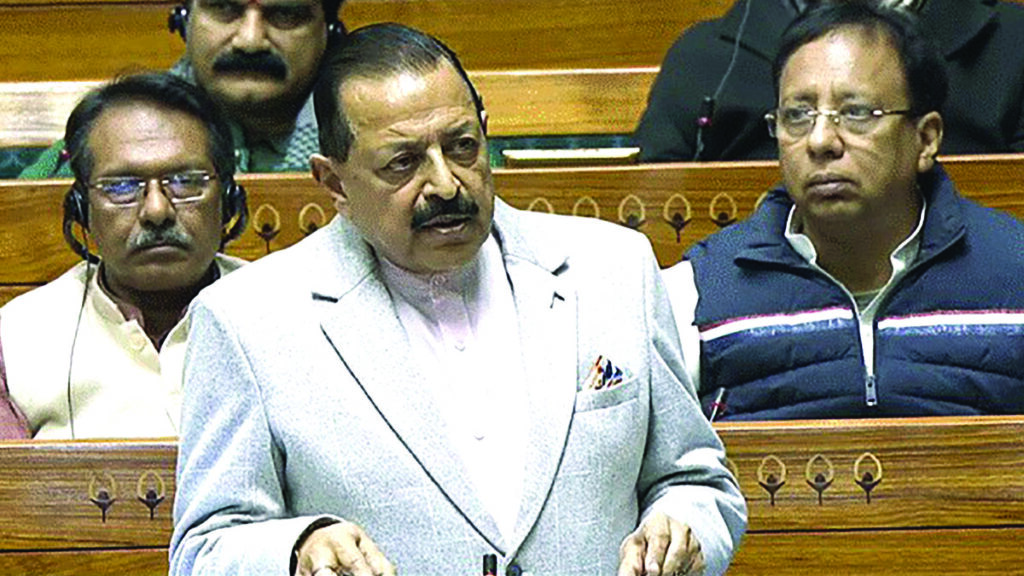
Image Courtesy: PIB
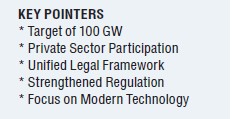
One of the Act’s most important contributions is the consolidation of nuclear governance into a single, coherent legal framework. Fragmented regulations often create ambiguity across the nuclear lifecycle from site approval and construction to operation, waste management, and decommissioning. The SHANTI Act introduces clarity by explicitly defining institutional roles, technical responsibilities, and compliance mechanisms at each stage. For long duration infrastructure projects with high safety margins, such predictability is not merely administrative convenience, it is a scientific necessity. Clear governance reduces systemic risk, improves accountability, and facilitates long term planning grounded in engineering realities.
OPENING UP NUCLEAR SECTOR FOR PRIVATE PARTICIPATION
A transformative element of the SHANTI Act is the conditional opening of nuclear power generation to Indian private entities. This reform reflects a growing global consensus that complex technological systems benefit from diversified expertise, capital infusion, and competitive efficiency. Importantly, the Act maintains strict state control over strategically sensitive domains such as uranium enrichment, fuel fabrication, reprocessing, and strategic materials. Private participation is permitted only in non-sensitive areas, under rigorous licensing, inspection, and safety oversight. This hybrid model balances national security with scalability. It allows India to accelerate nuclear deployment without compromising sovereign control, while also fostering innovation, project management efficiency, and financial sustainability.
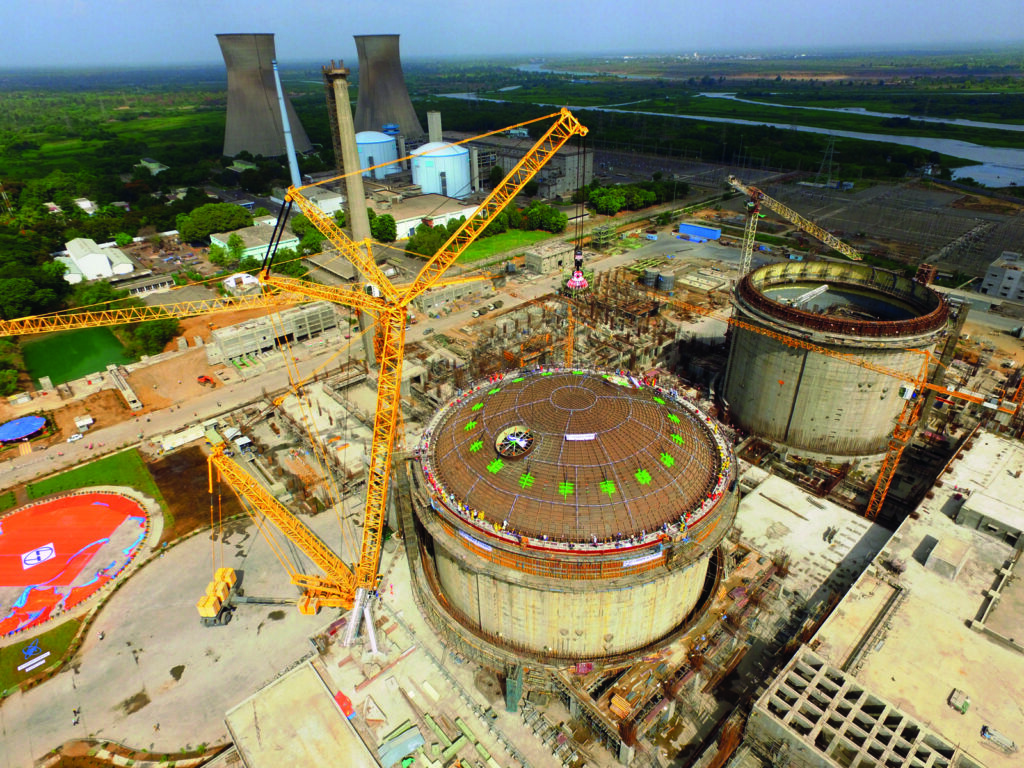
Image Courtesy: Wikimedia Commons
Safety is the cornerstone of nuclear science. Public trust in nuclear energy depends not on assurances, but on institutions capable of enforcing rigorous, independent oversight. Recognising this, the SHANTI Act enhances the statutory authority and autonomy of the Atomic Energy Regulatory Board (AERB). Under the new framework, the AERB is empowered to conduct legally binding inspections, mandate safety upgrades, enforce emergency preparedness protocols, and operate independently of nuclear operators. Parliamentary accountability mechanisms further strengthen transparency. From a scientific governance perspective, this institutional separation between promotion and regulation aligns India with international best practices. It ensures that safety assessments are driven by data, peer-reviewed standards, and risk analysis rather than administrative or commercial pressures.
PUBLIC INTEREST V/S PROJECT VIABILITY
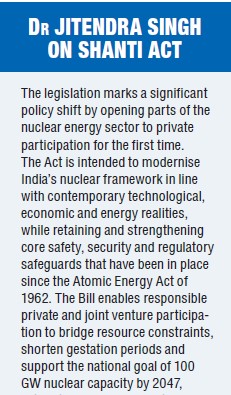
The question of liability has historically constrained India’s nuclear expansion. The SHANTI Act introduces a balanced liability regime that protects public interest while ensuring project viability. Operator liability is clearly defined and capped, mandatory insurance mechanisms are enforced, and government liability applies beyond prescribed limits. Crucially, the Bill removes open-ended supplier liability, bringing India closer to international conventions and facilitating global technology collaboration. This approach does not dilute accountability. Instead, it embeds compensation within a framework informed by actuarial science, probabilistic risk assessment, and international legal norms ensuring both justice for victims and feasibility for operators.
From a lifecycle perspective, nuclear power ranks among the lowest carbon electricity sources. Its greenhouse gas emissions, when measured across construction, operation, and decommissioning, are comparable to wind and significantly lower than coal or gas. The SHANTI Act explicitly recognises nuclear energy as a climate solution. In a grid increasingly dominated by renewables, nuclear power provides frequency stability, inertia, and continuous output, functions that are critical for avoiding fossil fuel backup. By integrating nuclear energy into India’s net-zero pathway, the Bill reinforces a science-based approach to decarbonisation.
The SHANTI Act also creates regulatory space for advanced reactors and Small Modular Reactors (SMRs). These next generation systems incorporate passive safety, modular construction, and improved fuel efficiency. SMRs are particularly well suited for remote regions, industrial hubs, desalination plants, and hydrogen production facilities. Their smaller size, lower capital risk, and enhanced safety features make them attractive for diverse applications beyond conventional grid electricity. By enabling these technologies, the Act signals India’s intent to remain aligned with global nuclear innovation rather than confined to legacy systems.
Expansion of nuclear energy under the SHANTI framework is expected to generate significant economic benefits. High-skill employment will be created across reactor engineering, materials science, radiation safety, construction, and operations. Domestic manufacturing will receive a boost under the ‘Make in India’ initiative, particularly in high precision components, control systems, and instrumentation. These capabilities have spillover benefits for other advanced sectors, including aerospace, defense, and medical technology.
A modernised nuclear sector strengthens India’s position in international climate and technology forums. Nuclear cooperation enhances scientific diplomacy, enabling collaboration in safety research, fuel cycles, waste management, and advanced reactor design. By aligning nuclear policy with climate commitments, India reinforces its credibility as a responsible technological power contributing to global decarbonisation.
Modern nuclear plants occupy relatively small land footprints and produce negligible air pollution. The SHANTI Act emphasises lifecycle responsibility, including waste management, long term storage, and decommissioning. This approach reflects an important scientific ethic that green energy must be environmentally accountable from inception to closure. Embedding sustainability into regulation, the Bill aligns nuclear science with ecological responsibility.
Despite its promise, the success of the SHANTI Act will depend on effective implementation. Public concerns about radiation, waste, and accidents must be addressed through transparent communication, data driven risk explanation, and institutional trust. Investment in human resources, regulatory science, emergency preparedness, and public scientific literacy will be essential.
*The writer is Professor, Department of Physics, University of Lucknow.