




TECH TALK / PHOTO-CAPACITOR
In a significant scientific development, researchers from the Centre for Nano and Soft Matter Sciences (CeNS) in Bengaluru, operating under the Department of Science and Technology (DST), Government of India, have engineered a photo-rechargeable energy storage device that eliminates the need for separate solar panels and batteries. This integrated system simultaneously captures sunlight and stores electrical energy, marking a leap forward in self-sustaining energy technology.
Traditional solar power configurations require multiple components: photovoltaic panels to harness sunlight, storage units such as batteries or supercapacitors to retain energy, and power management electronics to balance the system. These setups not only add to cost and complexity but also result in energy losses during conversion and storage. The newly developed device overcomes these limitations by merging the two functions into one compact, efficient architecture.
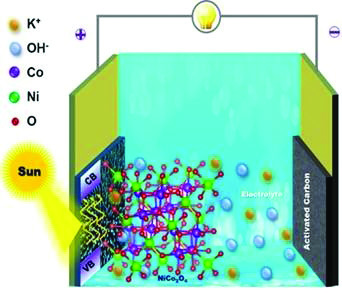
At the heart of this innovation lies a specially designed photo-rechargeable supercapacitor. Scientists crafted this device using binder-free nickel-cobalt oxide (NiCo₂O₄) nanowires grown directly onto a nickel foam substrate through an in-situ hydrothermal method. These nanowires assemble into a highly porous, three-dimensional conductive network that not only absorbs sunlight effectively but also facilitates rapid charge storage. The result is a material that acts both as a light harvester and as an energy storage electrode.
Testing of the integrated device revealed notable performance enhancements. Under illumination, the system showed a marked increase in capacitance, a key indicator of energy storage capability, compared to its performance in darkness. Such improvements underscore the promise of this design for real-world energy applications, where varying lighting conditions are common.
Beyond its efficient energy conversion and storage, the new technology also boasts durability and stability. Initial experiments demonstrated that the device retained a high proportion of its storage capacity even after numerous charging cycles, indicating long-term operational reliability—a crucial criterion for practical deployment in consumer electronics and sustainable power systems.
A key scientific insight behind this innovation lies in the material’s electronic properties. By substituting nickel within the cobalt oxide framework, researchers were able to narrow the material’s energy band gap and induce what is known as half-metallic behaviour, where the material behaves as a conductor for one type of electron spin and as a semiconductor for another. This unique characteristic enables faster charge transport and higher electrical conductivity, making the device especially suitable for photo-assisted energy storage applications.
The successful integration of light absorption and storage mechanisms in a single device heralds a new class of “smart” energy systems. Such photo-rechargeable energy storage devices could transform how renewable energy is harnessed and used, particularly in remote areas lacking access to grid electricity. Their potential applications span wearable and portable electronics, off-grid power supplies, and environment friendly energy solutions that reduce reliance on fossil fuels and conventional batteries.
Published in the Royal Society of Chemistry journal Sustainable Energy & Fuels, this research showcases how combining experimental and theoretical approaches can yield transformative results in materials science. Theoretical simulations helped uncover the atomic-level mechanisms behind the device’s efficiency, while laboratory testing validated its enhanced performance and durability, offering a holistic understanding of how such systems can be optimised for real-world use. Looking ahead, continued refinement and development of this technology could help India meet its clean energy goals and stimulate further innovations worldwide. By streamlining energy capture and storage, self-charging devices like this could play a pivotal role in reducing carbon footprints, democratising access to power, and driving the global transition toward more sustainable and resilient energy ecosystems.