

Image Courtesy: NASA
Group Captain Shubhanshu Shukla—affectionately known as Shux—returned to the Earth on July 15 aboard SpaceX’s Dragon Grace, concluding an 18‑day mission aboard the International Space Station (ISS) under the Axiom Mission 4 (Ax‑4). The capsule splashed down in the Pacific Ocean off California at approximately 3:01 pm IST (2:31 a.m. PDT), completing a 22‑hour re-entry journey from undocking on July 14.
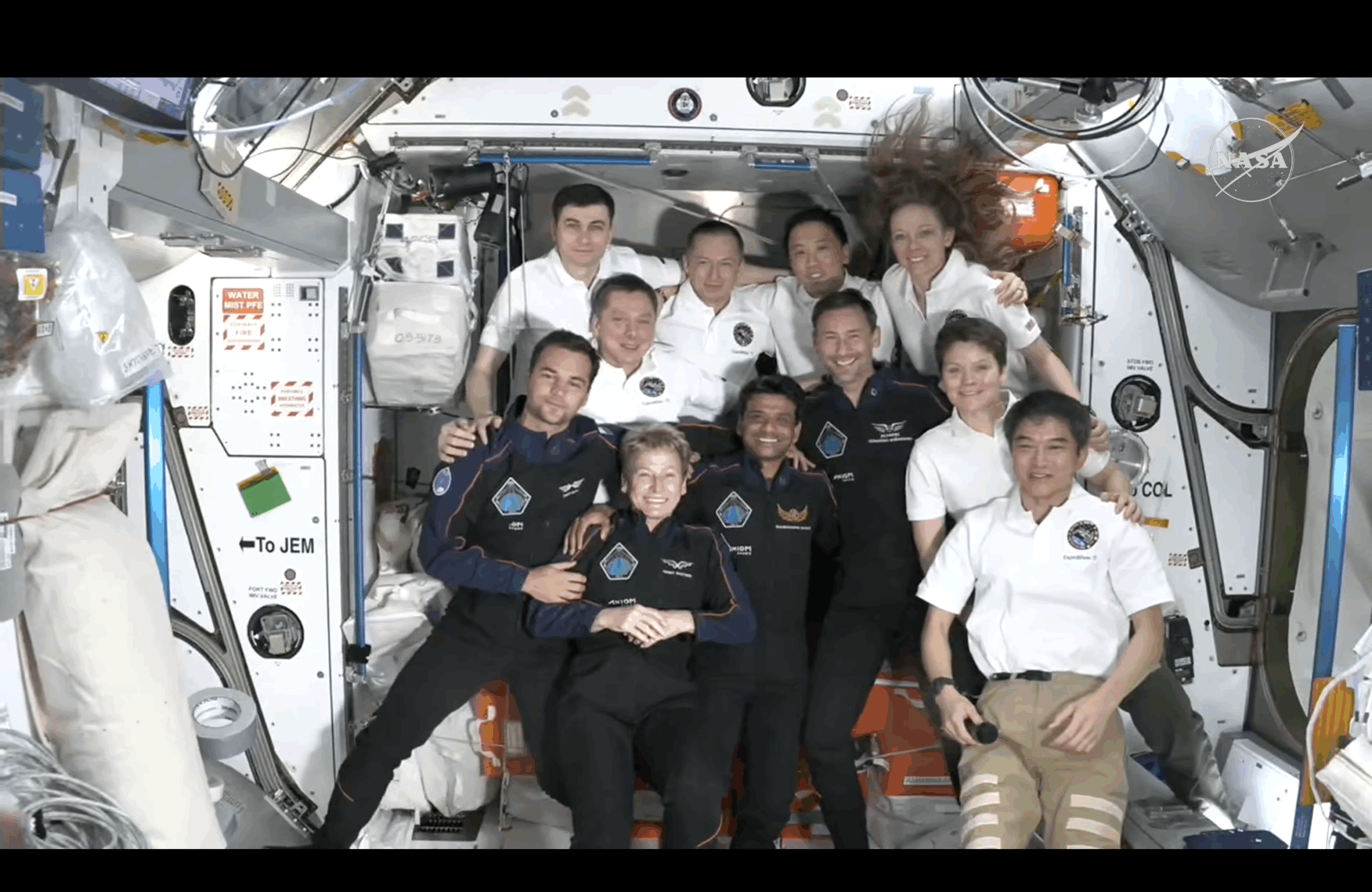
The Ax‑4 crew, led by veteran US astronaut Peggy Whitson and accompanied by Poland’s Sławosz Uznanski‑Wisniewski and Hungary’s Tibor Kapu, conducted more than 60 scientific experiments during its stay, representing contributions from 31 countries. Shukla’s mission included seven experiments designated and overseen by ISRO, spanning fields such as plant biology, cellular health, muscle degeneration, and artificial intelligence. About 580 lb (260 kg) of hardware and research material was brought back aboard Dragon Grace.
Shukla is now the first Indian astronaut to live and work aboard the ISS and only the second Indian ever in space, following Rakesh Sharma in 1984. His participation is regarded as a pivotal milestone in India’s human spaceflight programme and an essential stepping stone toward its upcoming Gaganyaan mission, planned for 2027.
The return involved a precise deorbit burn, timed for early morning IST, followed by a fiery descent as the capsule re-entered Earth’s atmosphere at speeds exceeding 27,000 km/h, with exterior temperatures soaring near 1,600°C (around 3,500 °F). Once through the blackout phase, a sequence of drogue and main parachutes were deployed to slow the descent, culminating in a gentle splashdown.
Recovery forces aboard the Shannon retrieval vessel swiftly secured the capsule, and first responders administered medical checks. Shukla and his crewmates were then transferred to land for further evaluations and began a standard seven‑day rehabilitation protocol to readjust to the Earth’s gravity.
Shukla guided India’s contribution to experiments such as the Sprouts Project, which studies plant growth in microgravity—a vital component of future sustainable space farming. His mission also included tests on autonomous robotics and materials science, with implications for Earth-bound applications and long-term space habitation.
Indian leadership echoed national pride and support: Prime Minister Narendra Modi hailed Shukla’s achievements on social media, emphasising that he “has inspired a billion dreams through his dedication, courage and pioneering” efforts.
ISRO invested approximately Rs 550 crore (roughly US $65 million) to send Shukla on Ax‑4, a cost justified by the mission’s insights into crew health monitoring, in-orbit workflows, emergency protocols, and support systems to guide the Gaganyaan programme. With a flawless splashdown and a trove of international scientific data safely aboard Dragon Grace, Shubhanshu Shukla’s return concludes a defining chapter in commercial and international spaceflight—and firmly positions India on the path to future crewed missions.