



Image Courtesy: NASA
News
30 July 2025; 5.40 pm
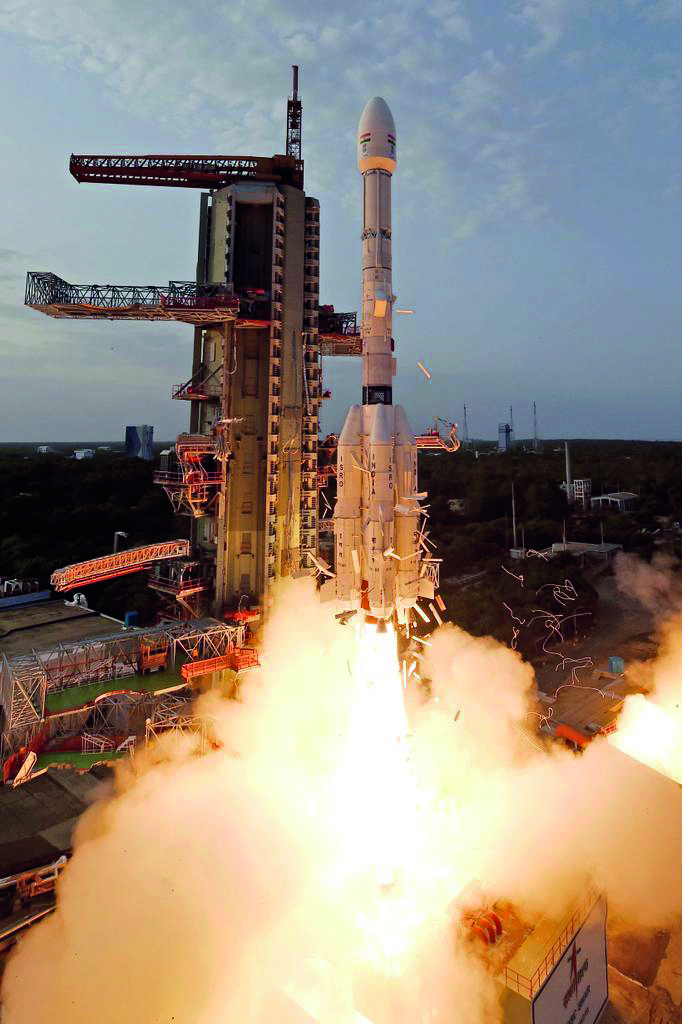
The NASA-ISRO Synthetic Aperture Radar (NISAR) satellite was successfully launched from the Satish Dhawan Space Centre at Sriharikota in Andhra Pradesh.
The Geosynchronous Satellite Launch Vehicle (GSLV)-F16 rocket carrying the earth observation satellite lifted off from the second launch pad of the space centre at 5.40 p.m. Eighteen minutes later, it injected the satellite into a sun-synchronous orbit.
“The GSLV-F16 vehicle has successfully and precisely injected the NISAR satellite weighing 2,392 kg into its intended orbit,” Indian Space Research Organisation (ISRO) Chairman V Narayanan said after the launch.
FIRST JOINT VENTURE OF ISRO AND NASA
The NISAR is the first satellite jointly developed by the ISRO and the United States’ National Aeronautics and Space Administration (NASA).
According to the ISRO’s official website, NISAR is the first of its kind mission, jointly developed by ISRO and NASA, which is an L and S-band, global, microwave imaging mission, with capability to acquire fully polarimetric and interferometric data.
The unique dual-band Synthetic Aperture Radar of NISAR employs advanced, novel SweepSAR technique, which provides high resolution and large swath imagery. NISAR will image the global land and ice-covered surfaces, including islands, sea-ice and selected oceans every 12 days.
NISAR mission’s primary objectives are to study land & ice deformation, land ecosystems, and oceanic regions in areas of common interest to the US and Indian science communities.
NISAR’S MISSION & FUNCTION
The NISAR mission is broadly classified into different phases—launch, deployment, commissioning and science phases.
The launch phase has been accomplished with the launch of the GSLV-F16 rocket.
During the deployment phase, a 12-metre reflector antenna will be deployed in orbit nine metres away from the satellite by a complex multistage deployable boom. The deployment process will begin on the 10th day after the launch. This will be followed by the commissioning phase.
The NISAR satellite will scan the earth and provide all-weather, day-and-night data at 12-day intervals, and enable a wide range of applications.
NISAR mission will help to measure the woody biomass and its changes; track changes in the extent of active crops; understand the changes in wetlands’ extent; map Greenland’s & Antarctica’s ice sheets, dynamics of sea ice and mountain glaciers; and characterize land surface deformation related to seismicity, volcanism, landslides, and subsidence & uplift associated with changes in subsurface aquifers, hydrocarbon reservoirs, etc.
SPACECRAFT CONFIGURATION
The spacecraft is built around ISRO’s I-3K Structure. It carries two major Payloads viz., L & S- Band Synthetic Aperture Radar (SAR). The S-band Radar system, data handling & high-speed downlink system, the spacecraft and the launch system are developed by ISRO. The L-band Radar system, high speed downlink system, the Solid-State Recorder, GPS receiver, the 9m Boom hoisting the 12m reflector are delivered by NASA. Further, ISRO takes care of the satellite commanding and operations, while NASA will provide the orbit manoeuvre plan and RADAR operations plan. NISAR mission will be aided with ground station support of both ISRO and NASA for downloading of the acquired images, which after necessary processing will be disseminated to the user community
The data acquired through S-band and L-band SAR from a single platform will help the scientists understand the changes occurring on Planet Earth.
Courtesy: ISRO, news websites and agencies.