





TECH TALK /POCKET SENSOR FOR SO2
In a significant breakthrough for environmental safety and public health, a team of scientists from the Centre for Nano and Soft Matter Sciences (CeNS), Bengaluru, has developed a pocket-sized sensor capable of detecting sulfur dioxide (SO2)—a silent but dangerous air pollutant—at extremely low concentrations.
Sulfur dioxide, a toxic gas commonly released from vehicular emissions, industrial processes, and power plants, is notorious for triggering respiratory problems such as asthma attacks, irritation of the airways, and long-term lung damage. Due to its colourless nature and the delay between exposure and visible symptoms, SO2 often escapes detection until it causes serious harm. Conventional gas detection technologies are often bulky, costly, energy-intensive, or lack the sensitivity required for early-stage detection—posing a challenge for widespread monitoring.
A SMART SOLUTION FROM INDIAN SCIENTISTS
To address this issue, the CeNS team, under the guidance of Dr S Angappane, developed a novel, low-cost sensor using a clever combination of materials—nickel oxide (NiO) and neodymium nickelate (NdNiO3). The NiO component serves as the gas receptor, effectively attracting SO2 molecules, while NdNiO3 acts as the signal transducer, converting the gas interaction into measurable data.
Thanks to this dual-material design, the sensor is capable of detecting SO2 concentrations as low as 320 parts per billion (ppb), a sensitivity level that outperforms many existing commercial sensors. This technological advancement marks a significant step toward real-time, ultra-sensitive air monitoring in both public and private settings.
FOR REAL-WORLD APPLICATION
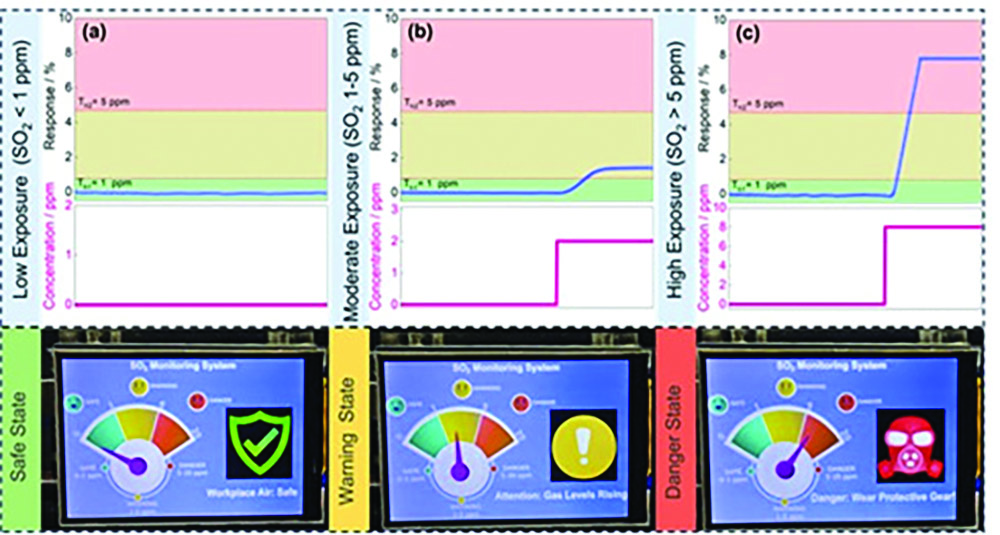
To demonstrate the real-world potential of their innovation, the researchers created a portable prototype incorporating the sensor. Designed for ease of use, the device features a simple traffic-light-style alert system:
- Green indicates safe levels of SO2
- Yellow signals a warning threshold
- Red warns of dangerous levels requiring immediate attention
This intuitive display enables even non-experts to interpret air quality status and respond accordingly. Its compact size, lightweight design, and low power requirements make it suitable for industrial zones, urban environments, indoor air quality monitoring, and even personal safety devices.
The sensor was designed by Vishnu G Nath, with key contributions from Dr Shalini Tomar, Nikhil N Rao, Dr Muhammed Safeer Naduvil Kovilakath, Dr Neena S John, Dr Satadeep Bhattacharjee, and Prof Seung-Cheol Lee. Their collaborative work has been published in the journal Small.
This sensor not only demonstrates the power of material science in addressing environmental challenges but also sets a precedent for developing accessible, real-world tools for air pollution monitoring. As India and the world grapple with rising pollution levels, especially in densely populated and industrialised regions, such cost-effective and user-friendly innovations could play a vital role in preventing health crises and improving air quality management. With this development, CeNS once again reinforces its position as a leading institute in the field of nano and soft matter technologies, translating high-end research into meaningful solutions for the society at large.