



Image Courtesy: PIB
11TH IISF
India, that is Bharat, is the land of festivals. From the snow-clad towering Himalayas to the sun-kissed maritime edge of Kanyakumari, and the kaleidoscopic deserts of Rann of Kutch to the verdant seven sister states of the Northeast, every region of the country celebrates countless festivals. Interestingly, festivals in India are not only confined to rituals or religions; they express the vibrant spirit of participation and togetherness that defines our nation. While each festival reflects the social, cultural, and geographical diversity, it infuses unity through community participation, economic vibrancy, and cultural expression. They connect people to nature, to their environment, to each other, and to self.
In this land where knowledge has been celebrated as a sacred pursuit, it is only fitting that science too has its own festival—a festival that celebrates curiosity, discovery, and innovation. That festival is the India International Science Festival (IISF). Established in 2015, IISF was jointly conceived with a bold and inclusive vision, science for all and science for society, by the Ministry of Science and Technology, the Ministry of Earth Sciences, and Vijnana Bharati (VIBHA), a scientific social organisation leading the science movement with a Swadeshi spirit. It seeks to make science accessible, engaging, and socially relevant, bridging the gap between scientists and citizens.
IISF ROOTED IN CONSTITUTIONAL MANDATE
India holds a unique distinction in the world as it is the first and only country whose Constitution explicitly recognises the importance of developing a scientific temper as a fundamental duty. Article 51A(h) of the Constitution states that every citizen must “develop the scientific temper, humanism, and the spirit of inquiry and reform.” This vision reflects the foresight of the framers of the Constitution, who understood that a strong democracy requires citizens who think critically, reason logically, and question constructively. To inculcate scientific temper among the masses, India has long invested in science outreach programmes such as National Children’s Science Congress, National Science Day, Science Express, State Science Fairs, etc. Internationally too, science festivals are designed to popularise science— the Edinburgh Science Festival in Scotland, the Cheltenham Science Festival in the UK, the World Science Festival in New York, the Cambridge Science Festival in the USA and Science Festival Leiden, Netherlands, are some of the most prominent examples. These events combine exhibitions, public lectures, performances and interactive activities, contributing immensely to making science approachable and fun. Yet, most of these national and international initiatives are region-specific, urban-centric, discipline-oriented and limited in linguistic or cultural diversity. IISF fills the crucial gap to make science a people’s movement, attracting participants from all sections of society that earlier outreach efforts could not fully bridge.
WHAT MAKES IISF UNIQUE
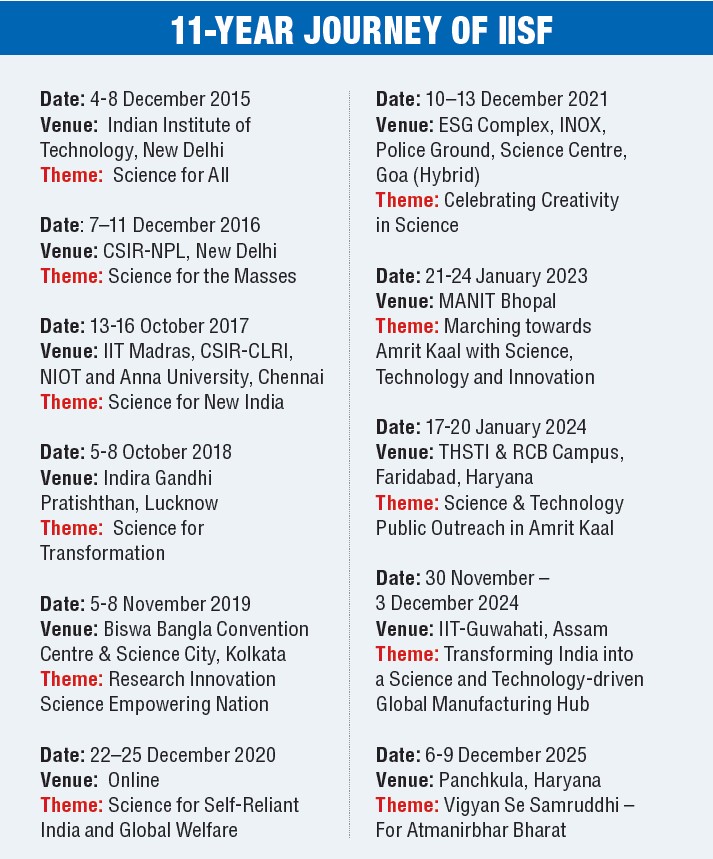
Since its inception, IISF has become one of the world’s largest platforms for science outreach, engaging scientists, technocrats, innovators, entrepreneurs, school students, educators, artisans, policymakers, and the general public. IISF 2020, which was held online, was registered in the Guinness Book of World Records for the largest attendance for a virtual science conference in one week. IISF has a pan-India character as every year its venue rotates across different states—from Delhi and Chennai to Goa and Guwahati, thus ensuring that no region is left behind. Every year, the festival revolves around a progressive theme that reflects India’s evolving scientific and developmental priorities. With each passing year, the annual themes of the IISF have indeed become more focused, transitioning from general promotion of science to specific national goals and the role of science and technology in achieving them.
Distinct from conventional scientific outreach programmes, IISF does not adhere to fixed categories or disciplines. It features a wide array of dynamic and inclusive events that bring science closer to people from all walks of life. IISF events evolve each year in tune with the festival’s annual theme. The number, nature, and nomenclature of its events are flexible, allowing the festival to remain relevant to emerging scientific priorities and societal needs. By weaving together science, technology, innovation, and traditional knowledge, IISF showcases how these diverse strands work collectively to address real-world challenges and inspire national development.
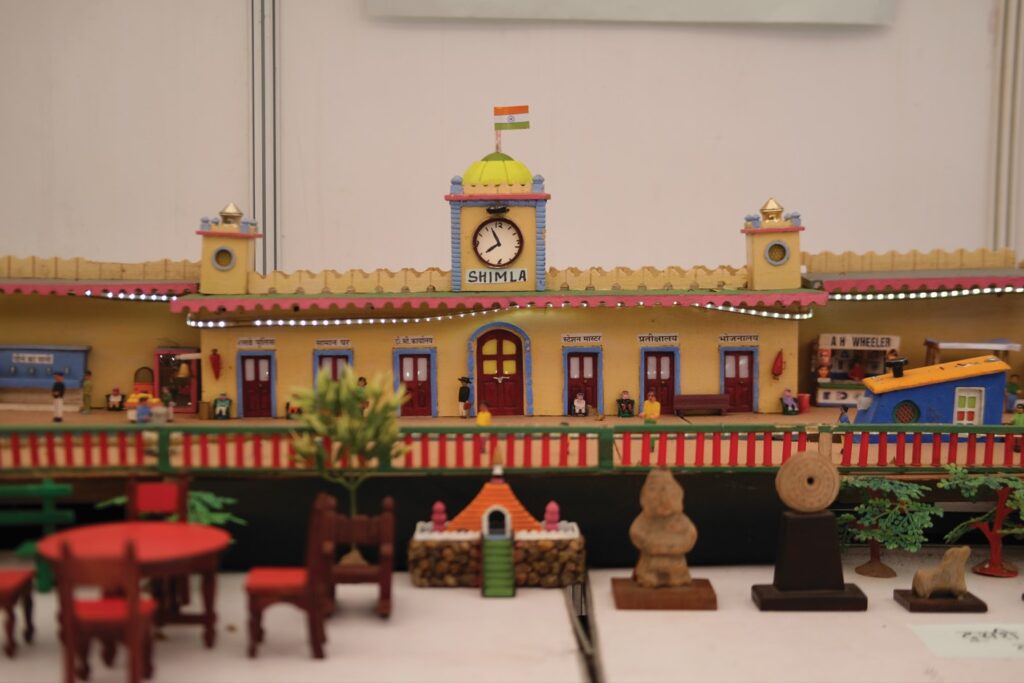
One such event is ‘Games and Toys’, introduced at IISF 2020, inspired by the August 2020 edition of Mann Ki Baat, in which Prime Minister Narendra Modi urged the nation’s innovators and craftsmen to “team up for toys” and revive India’s rich heritage of indigenous playthings. He emphasised the immense potential of local toy clusters and the need to promote high-quality, creative, and environment-friendly toys. Since then, an event around this theme has become a vital component of the festival, drawing large numbers of innovators and entrepreneurs from across the country. This event not only sparked curiosity among young children and inspired students to explore the science behind traditional toys and games, but also gave a strong boost to Indian toy and gaming industry by providing a vibrant platform for game developers, app creators, and science enthusiasts. On the trade front, independent studies indicate a decline of over 50% in toy imports and a rise of more than 200% in exports in recent years, making India self-reliant in global toy manufacturing This convergence of policy direction, innovation platforms like IISF, and industrial momentum underscores how the Games and Toys event has evolved beyond a slogan.
DIVERSITY AND INCLUSION
Diversity and inclusion have been at the core of the India International Science Festival (IISF) since its inception. The Students Science Village, an event designed especially for students from rural and remote areas, has been one of the most inspiring initiatives under IISF. Each year, thousands of rural students are hosted as special invitees, giving them first-hand exposure to cutting-edge science, live demonstrations, and interactions with eminent scientists. For many, it is their first visit to a major city or scientific institution—a transformative experience that sparks curiosity, confidence, and aspirations for higher education in science and technology. The Students Science Village thus serves as a bridge between rural talent and the mainstream scientific community.
The festival also fosters grassroots innovation and social entrepreneurship. Events like ‘National Social Organisations and Institutions Meet’, ‘Waste to Wealth’, ‘Mission Startup’ highlight the contributions of NGOs, community-based groups, and rural innovators who apply scientific principles to solve local problems—be it in clean energy, agriculture, healthcare, or waste management. By providing visibility to these changemakers, IISF promotes a bottom-up model of scientific development, where innovation is both locally rooted and socially relevant.
Recognising that women scientists and innovators play a vital role in nation-building, IISF organises a dedicated event Nari Shakti that celebrates their achievements and discusses strategies to enhance women’s participation in STEM fields. This event not only showcases successful role models but also provides mentorship opportunities, policy dialogues, and networking platforms that encourage women researchers, entrepreneurs, and students to pursue their scientific dreams. This inclusive vision aligns with India’s broader goal of empowering women as leaders and change-makers in science and innovation.
MAINSTREAMING SCIENCE COMMUNICATION
India has made remarkable strides in scientific research and technological innovation, yet critical scientific developments remain underrepresented in mainstream media, be it electronic, print or digital. Moreover, science communication in India faces several structural barriers. India is home to one of the richest linguistic and cultural diversities in the world, yet most science communication continues to take place in English in a formal scientific format, limiting accessibility for large sections of society. This linguistic gap often prevents rural and non-English-speaking communities from engaging meaningfully with scientific ideas and opportunities. Culturally rooted strong formats such as literature, poetry, theatre, puppetry, folk media, and local storytelling traditions are often overlooked as effective mediums for communicating science. Recognising these gaps, the IISF has dedicated initiatives like the S&T Media Conclave and Vigyanika. The S&T Media Conclave brings together science journalists, communicators, educators, policymakers, and media professionals to discuss the challenges of science reporting, explore innovative methods of dissemination of science in multiple languages, and strengthen the bridge between scientific communities and the public. It serves as a forum for dialogue on ethical reporting, accuracy, and relevance, while highlighting success stories of science communication from across India and the world. Vigyanika, on the other hand, brings science to life through creative expression—using folk theatre, poetry, storytelling, puppetry, exhibitions, and workshops to make complex ideas engaging and easy to grasp.
Among the most popular and dynamic components of the IISF is the Science Expo, a grand showcase of India’s scientific and technological advancements. The Expo brings together cutting-edge innovations from national laboratories, research institutions, start-ups, and industries. Every year, lakhs of students, teachers, and science enthusiasts visit the Expo, engaging directly with scientists, witnessing live demonstrations, and discovering how the nation is progressing in science in diverse sectors.
In the past decade, IISF has grown remarkably from an initial collaboration of three partners into a dynamic national platform. It has expanded its partnerships to include premier organisations such as Departments of Atomic Energy and Space, and numerous academic institutions. It demonstrates the festival’s unique capacity to bring together India’s diverse scientific ecosystem to foster a vibrant culture of innovation, curiosity, and scientific temper. In many ways, IISF transforms the abstract idea of “scientific temper” into a living, collective experience by taking science beyond laboratories and into communities.
*The writer is Outstanding Scientist, CSIR and former Director, CSIR-National Institute of Science Communication and Policy Research, New Delhi.