





COVER STORY
All space and time and everything that exists is part of the universe. All matter, energy with the seen structures (like stars and galaxies) along with their invisible counterparts are a matter of study in modern cosmology which is the study of the universe as a whole. However, there are some conceptual parallels of unseen aspects of reality in spiritual context, which exist in ancient Indian scripts like Bhagavad Gita and Sankhya philosophy, where the notion of Avyakata (meaning the unmanifest or unseen) may resemble the modern genesis of dark matter and dark energy, both of which are invisible. As we understand the cosmos today, dark matter and dark energy are the major components of our universe as compared to visible matter which is about four percent of the total energy matter budget.
DARK MATTER: THE INVISIBLE GLUE
Astronomers like Vera Rubin found in the 1970s that stars in outer regions of spiral galaxies orbit the galactic centre at surprisingly fast velocities. Newtonian physics states that if only observable matter—stars, gas, and dust—were present, stars would travel more slowly and many galaxies would not have enough mass to stop their outer portions from drifting into space. Instead, galaxies appear to rotate as if they contain far more mass than what telescopes can detect. This discrepancy led to the conclusion that an unseen form of matter, i.e., dark matter must dominate galactic mass. Galaxies in the universe are held together by dark matter, which provides the unseen gravitational structure that keeps these enormous cosmic systems stable for billions of years. Dark matter does not emit, absorb, or reflect light, making it invisible, but its gravitational influence is unmistakable.
According to current observations, dark matter can make up as much as 85% of a galaxy’s total mass. This dark matter is organized into a large, roughly spherical ‘halo’ that extends well beyond the galaxy’s apparent boundaries. As a gravitational glue, this halo creates the extra force needed to keep stars attached to the galaxy even when they orbit at high speeds. In the absence of dark matter, spiral arms would unravel and star populations would scatter because the bright components of galaxies would not be adequate to preserve their structural integrity. Thus, one of the most compelling arguments for the presence of dark matter is the stability of galaxies across billions of years.
This theory is further supported by computer simulations of the birth and evolution of galaxies. Galaxies do not form as we see them now, when astrophysicists model the early cosmos using only ordinary matter. But when dark matter is added, it naturally forms dense regions where regular matter may build up, cool, and finally ignite into stars due to its inherent gravity. The web-like clusters and filaments of galaxies that make up the universe’s large-scale structure, which astronomers trace using observations, are replicated in these simulations. The idea that dark matter’s gravitational influence is crucial from the beginning of galaxies, is supported by this congruence between simulation and reality.
Furthermore, research on cosmic microwave background, gravitational lensing, and galaxy clusters suggests that dark matter accounts for the majority of gravitational mass in the universe. Gravitational lensing, in which light from background galaxies is bent by gravity, reveals enormous amounts of matter in galaxy clusters that are substantially greater than what is observable. It is impossible to explain these observations without referring to a vast reserve of invisible material.
Therefore, the idea that dark matter holds galaxies together is a basic reality of contemporary astrophysics. Although dark matter has not yet been directly detected in laboratories, its gravitational fingerprints are imprinted on every scale of cosmic structure. Dark matter serves as the unseen framework of galaxies by providing the mass needed to link stars and gas into coherent, long-lasting systems. Its presence ensures that galaxies remain intact, rotate as observed, and evolve into the diverse and majestic systems we see across the universe.
DARK ENERGY: THE PUSH OF THE INVISIBLE
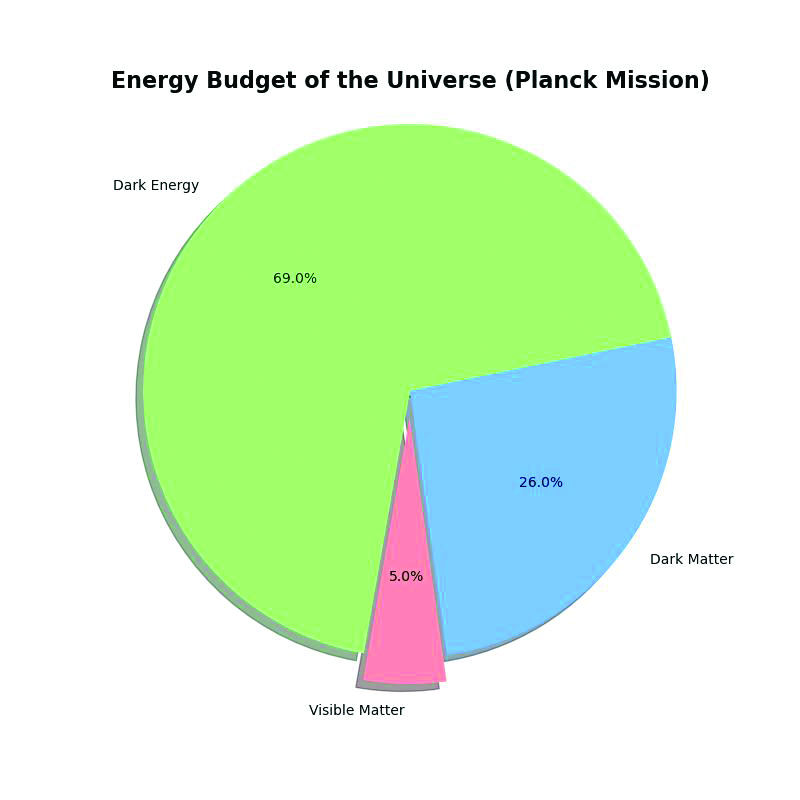
By operating as a mysterious, repulsive force that opposes matter’s gravitational attraction and causes the cosmos to expand more quickly throughout time, an unseen energy (popularly known as dark energy) speeds up cosmic expansion. The discovery of dark energy emerged in the late 1990s, when two independent teams studying distant Type Ia supernovae found that these stellar explosions appeared dimmer than expected. This meant that they were farther away than predicted, implying that the expansion of the universe has been speeding up rather than slowing down under gravity. To explain this unexpected acceleration, cosmologists introduced the concept of dark energy—an unseen, uniform energy component that fills all of space and exerts negative pressure, causing space itself to stretch at an ever-increasing rate. Unlike matter, which clumps together, dark energy remains smoothly distributed throughout the cosmos, influencing the universe only through its gravitational effect. Current measurements suggest that dark energy makes up about 69% of the total energy budget of the universe, making it the dominant driver of cosmic evolution today (see figure 3).
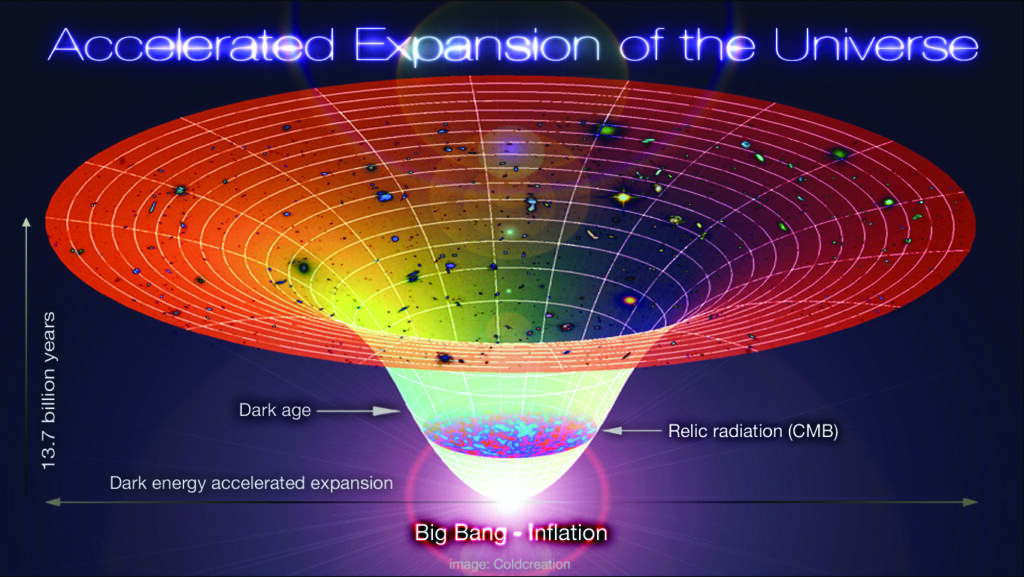
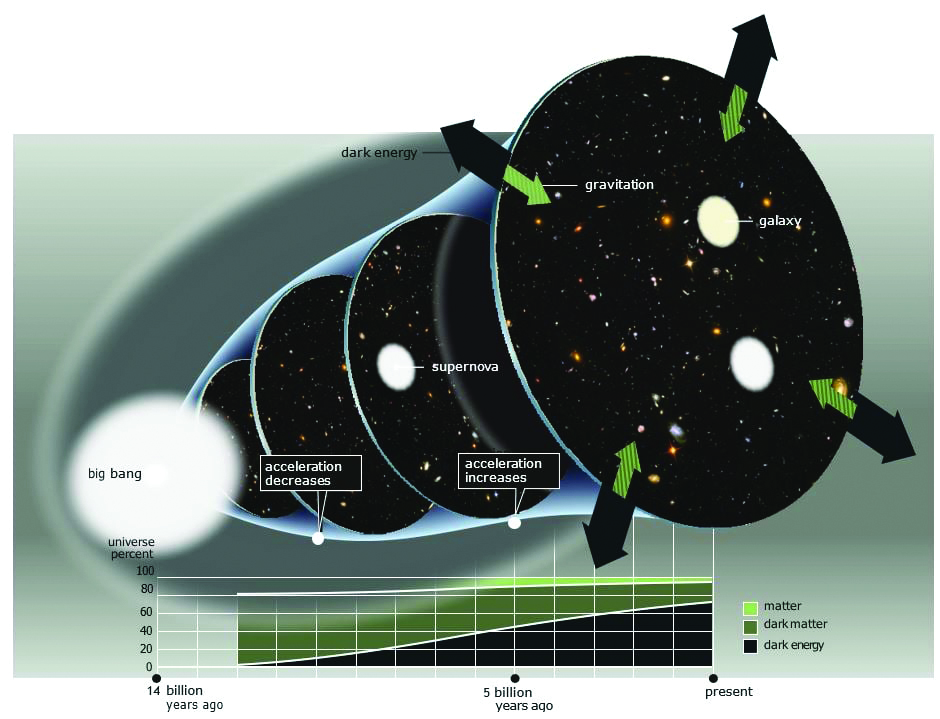
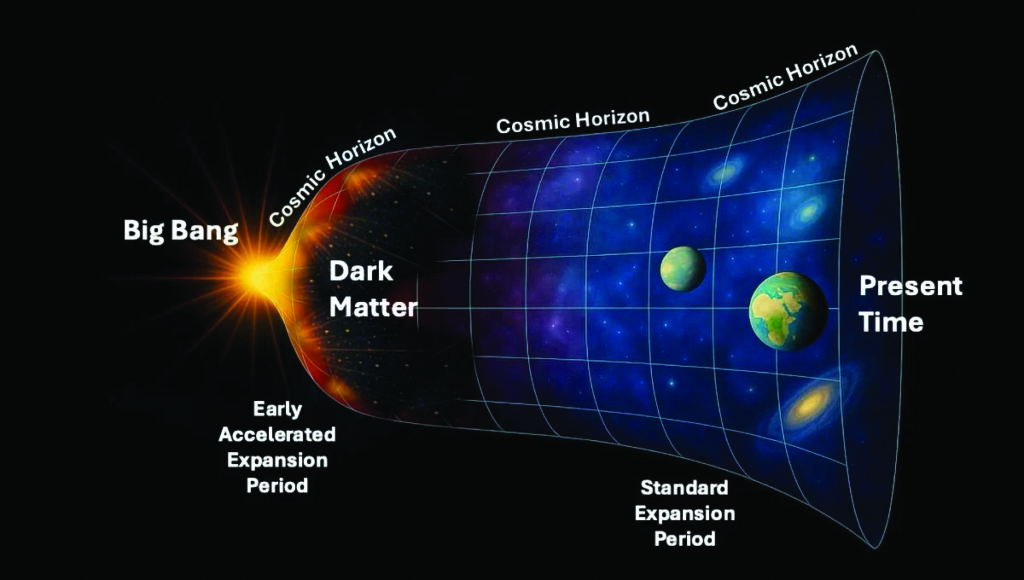
Theoretical explanations for dark energy remain uncertain. One probable candidate for the same is the cosmological constant, originally proposed by Albert Einstein, which represents a constant energy density inherent to empty space. In this model, vacuum energy pushes space apart uniformly, naturally producing accelerated expansion. Quintessence, a dynamical energy field that fluctuates over time and space and is comparable to fields in particle physics, is proposed by another set of theories. More radical theories involve modifications to general relativity itself, implying that the rules of gravity might act differently at the largest scales. Despite these theoretical possibilities, observational evidence overwhelmingly confirms that some form of dark energy is real. Data from the cosmic microwave background, baryon acoustic oscillations, and large-scale galaxy surveys all indicate that the universe transitioned from a matter-dominated, decelerating phase to a dark-energy-dominated, accelerating phase roughly five billion years ago.
As the universe expands, dark energy’s influence increases. Matter and radiation were so dense in the early cosmos that cosmic dynamics were governed by their gravity. However, the constant or slowly changing density of dark energy gained importance as space grew and matter diluted (see figure 2). These days, it influences both the rate of expansion and the development of cosmic structures. Dark energy slows the expansion of large-scale filaments and galaxy clusters by pushing galaxies apart. Using next-generation telescopes and missions like Euclid, the Nancy Grace Roman Space Telescope, and the Vera C Rubin Observatory, future observations seek to map this influence more precisely. These will help to differentiate between rival ideas by measuring how structures form and how the growth rate varies over time.
In essence, cosmic expansion due to dark energy acceleration captures one of the most profound mysteries in modern cosmology. Although its nature remains unclear, dark energy determines the ultimate fate of the universe. If its influence continues to increase, galaxies will drift farther apart, star formation will decline, and the universe will approach a cold, diffuse, and increasingly isolated future. Understanding dark energy is therefore essential not only for explaining the present behaviour of the cosmos but also for uncovering its long-term fate.
INVISIBLE TO LIGHT, ESSENTIAL TO THE COSMOS
Telescopes that detect electromagnetic radiation cannot detect dark matter or dark energy because they do not interact with light. Despite making up roughly 26% of the universe, dark matter cannot be directly observed since it does not emit, absorb, or reflect light. Its existence is deduced only from gravity, as evidenced by its effects on star motion, galaxy rotation, gravitational lensing, light bending, and cluster dynamics. Astronomers would find some electromagnetic signal if dark matter interacted with light, even if it did so only slightly. Instead, dark matter stays entirely “dark”, only coming to light through its gravitational pull.
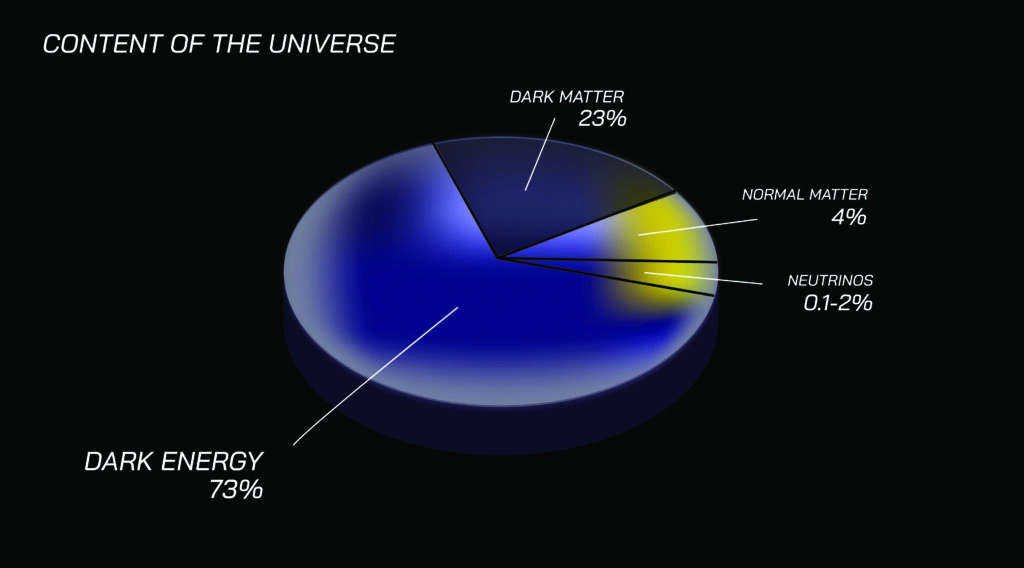
Dark energy, which comprises roughly 69% of the universe, is even more elusive. It is not a form of matter at all but a property of space itself, responsible for the accelerating expansion of the universe. Dark energy cannot be detected using any conventional light-based astronomical techniques since it does not cluster, radiate, or react to electromagnetic forces. Instead, scientists detect its influence indirectly by measuring changes in the universe’s large-scale expansion and the evolution of cosmic structures.
The fact that neither dark matter nor dark energy interacts with light highlights a profound gap in our understanding of the cosmos: the vast majority of the universe is made of components completely invisible to our most advanced instruments. Because of this invisibility, astronomers must rely on indirect evidence to analyse them, such as gravity, cosmic expansion, and galaxy dispersion. In the end, one of the biggest problems facing contemporary physics is the non-interaction of dark matter and dark energy with light, which forces scientists to create new hypotheses, tools, and experiments in order to understand the true nature of these enigmatic cosmic components.
UNSEEN, YET DETECTED THROUGH GRAVITATIONAL EFFECTS
Astronomers study invisible cosmic components such as dark matter and, indirectly, dark energy through gravitational effects. Telescopes cannot directly observe these materials since they do not emit, absorb, or reflect light. Instead, their gravitational influence on visible matter, radiation, and the universe’s large-scale structure is how scientists find them. This discovery is particularly obvious for dark matter. Galaxies would disintegrate in the absence of additional hidden mass because stars in galaxies orbit considerably more quickly than the visible mass alone can explain. A significant store of hidden matter is also revealed via gravitational lensing, which occurs when big objects distort the course of light from far-off galaxies. The temperature of hot gas and the movements of galaxies in galaxy clusters demand significantly more gravity than bright matter can supply. Cosmic structures are shaped by the gravitational pull of invisible material, according to all these measurements.
Dark energy, although not matter, is also detected through gravity, but in a different way. It affects the expansion of space itself instead of drawing things together. The cosmos is expanding at an accelerated rate, as evidenced by observations of far-off supernovae, necessitating a repulsive type of gravitational force. This accelerated expansion is further supported by measurements of the cosmic microwave background and large-scale galaxy distributions, which identify dark energy as the primary cosmic force. The fundamental reality that most of the universe cannot be examined with light alone is reflected in the discovery of dark matter and dark energy through gravitational effects. Uncovering the invisible elements that shape the history, present, and future of the cosmos is made possible by gravity, the smallest yet most powerful force.
AN ENERGY BEYOND EXPLANATION
Dark energy remains science’s biggest problem because it challenges our most fundamental understanding of physics, cosmology, and the nature of the universe itself. Despite making up nearly 69% of the total energy content of cosmos, dark energy has never been directly detected, and its physical nature is unknown. It was introduced to explain the surprising discovery that the expansion of the universe is accelerating rather than slowing down under gravity. This acceleration implies the existence of a mysterious force or property of space that exerts negative pressure, pushing galaxies apart. However, none of our existing theories, whether in general relativity or particle physics, can fully explain why dark energy exists or why its strength has the particular value we observe.
The most straightforward explanation for dark energy, the cosmological constant, has additional challenges. The most severe discrepancy between theory and experiment in science is found in quantum physics, which predicts a vacuum energy density that is up to 120 orders of magnitude greater than what is observed. Other theories, such as alterations to gravity or developing scalar fields (quintessence), are likewise inconsistent or lack supporting data. As a result, there is a serious theoretical dilemma: our finest physics frameworks are unable to adequately explain the major component of the universe.
Deep concerns regarding the future of the universe are also raised by dark energy. Cosmic expansion may accelerate endlessly, slow down, or even reverse depending on its actual nature. Comprehending dark energy is crucial for forecasting the long-term history of the cosmos as well as for explaining current discoveries.
Dark energy is still the biggest unresolved issue in modern science because it compels researchers to re-evaluate the fundamentals of gravity, spacetime, and quantum theory—a riddle at the centre of cosmology that keeps pushing the limits of human understanding.
CONCLUSION
There are many problems in nature which are yet to be resolved and the issue of dark matter and dark energy is one among those. The gravitational effects due to this type of matter and energy govern the structure and evolution of galaxies or the universe in general. Amidst various theoretical models in cosmology indicating the presence of dark matter and energy, ongoing observations inspire new ideas time and again. With the technological advancements and progress in observations, one must hope to have deeper insights into the composition of the structure of the universe which will transform our understanding of the governing laws of nature in future.
*Dr Main Pal is an Assistant Professor at the Department of Physics, Sri Venkateshwara College, Delhi University, and can be reached at mainpal@svc.ac.in. Dr Hemwati Nandan is a Professor of Physics and Director, Research & Development Cell, HNBGU, Srinagar-Garhwal, Uttarakhand, and can be reached at hnandan@associates.iucaa.in.