



HERB HERITAGE: GOKSHURA
In contemporary wellness discourse, Tribulus terrestris—popularly known as Gokshura—has been widely marketed as a natural enhancer of testosterone and athletic performance. From sports supplements to men’s health formulations, its identity has been narrowly framed around reproductive vitality.
Adding to this trend, many nutraceutical brands today incorporate Gokshura either as a standalone extract or as part of multi-herb formulations, often positioned for vitality, endurance, or hormonal balance. While such formulations increase accessibility, they also tend to simplify its classical identity into a single functional claim.
However, classical Ayurveda presents a far more nuanced understanding. Gokshura is not merely a Vrishya (reproductive tonic), but a Mutrala, Balya, and Rasayana—a herb central to the management of urinary disorders, fluid balance and tissue nourishment.
Revisiting Gokshura through an Ayurvedic and translational lens reveals a broader therapeutic profile—one that integrates renal physiology, inflammation and systemic resilience. Its relevance today lies in moving beyond reductionist interpretations and restoring its classical context.
CLASSICAL IDENTITY AND SAMHITA REFERENCES
Gokshura finds extensive mention across classical Ayurvedic texts including the Charaka Samhita, Sushruta Samhita and Ashtanga Hridaya.
In the Charaka Samhita, it is included in the ‘Mutravirechaniya Mahakashaya’ (Sutra Sthana 4), which is essentially a group of drugs that promote urine flow and relieve urinary obstruction. This classification firmly establishes its primary therapeutic domain as the Mutravaha srotas.
The Sushruta Samhita discusses Gokshura in the management of Mutrakricchra (dysuria) and Ashmari (urinary calculi), highlighting its role in relieving pain, facilitating urine flow and reducing irritation in the urinary tract.
In Ashtanga Hridaya, Gokshura appears in formulations addressing urinary disorders and reproductive health, reflecting its dual role in elimination and nourishment.
Later texts such as the Bhavaprakasha Nighantu elaborate on its Vrishya, Balya and Mutrala properties, reinforcing its multi-system relevance.
Its pharmacodynamic profile is described as:
- Rasa: Madhura
- Guna: Guru, Snigdha
- Virya: Shita
- Vipaka: Madhura
- Dosha karma: Vata–Pitta shamana
This combination indicates a nourishing yet cooling herb that supports tissue integrity while facilitating elimination.
THE MEANING BEHIND THE NAME
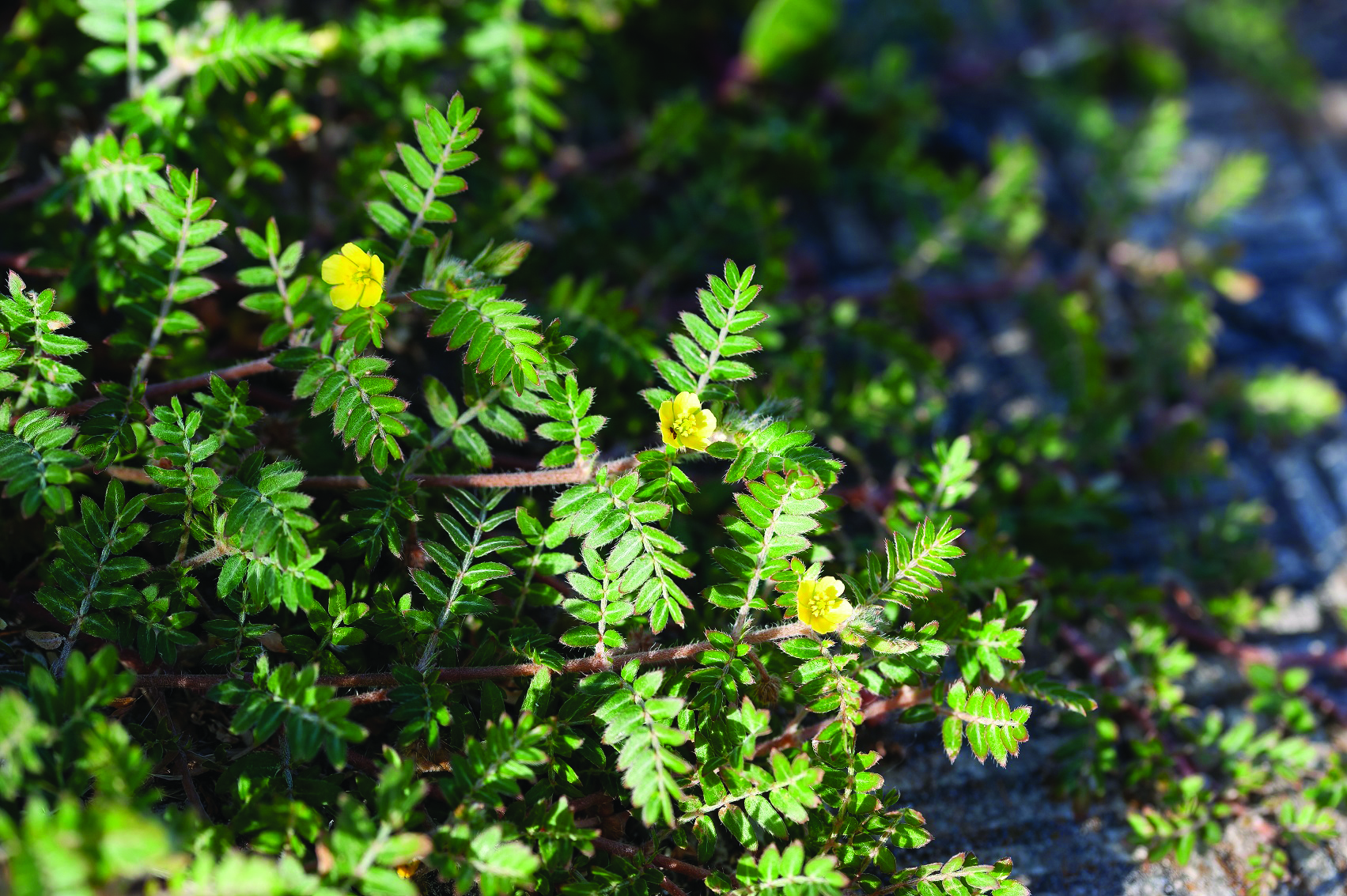
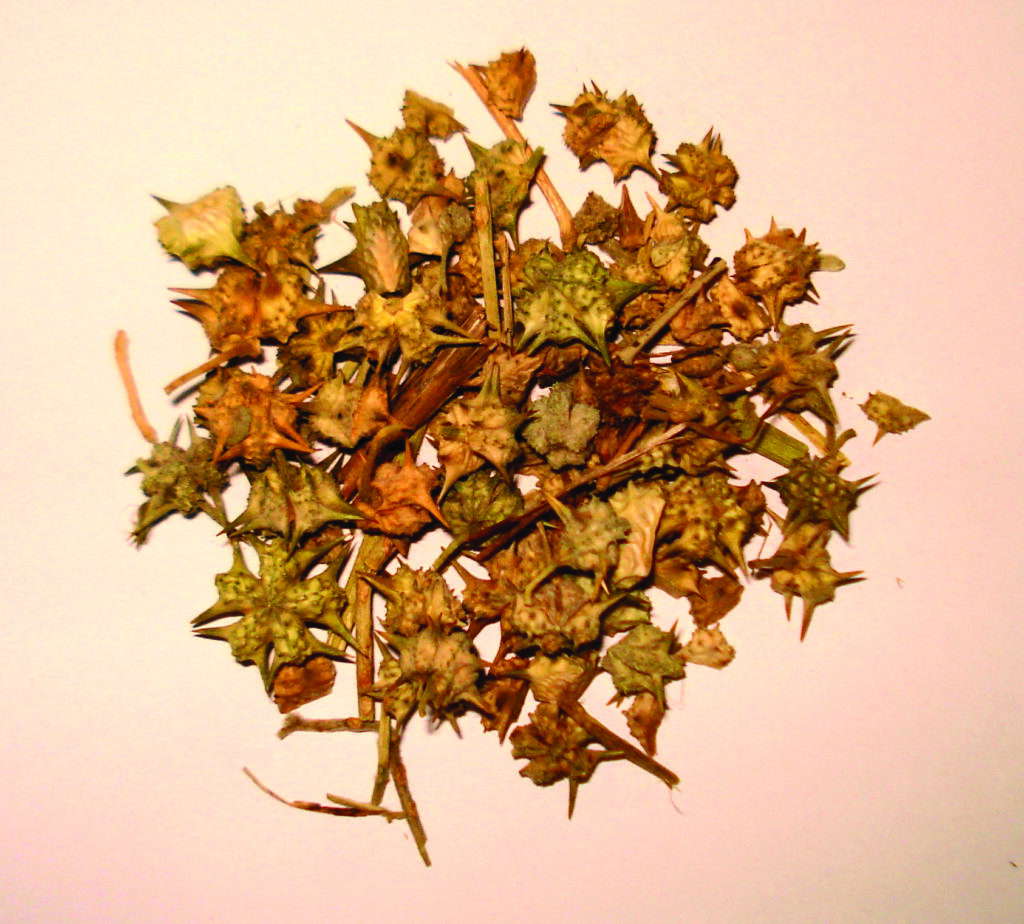
The name ‘Gokshura’ derives from go (cow) and kshura (hoof), referring to the thorny fruits that resemble a cow’s hoof and are commonly found in grazing landscapes.
FOLK AND PASTORAL ASSOCIATIONS
In traditional agrarian communities, Gokshura was closely associated with cattle pathways. Observations suggested that livestock grazing in regions abundant with this plant maintained strong urinary health and reproductive vitality.
This led to the belief that Gokshura embodies grounded resilience—a plant that sustains strength while navigating environmental stress. Such folk insights parallel its classical use in supporting both elimination and nourishment.
GOKSHURA AS MUTRALA: A CORE THERAPEUTIC ROLE
Among its many actions, Gokshura’s identity as a Mutrala dravya remains foundational. Ayurveda describes urinary disorders under Mutravaha srotas dushti, where obstruction, inflammation, or improper flow leads to conditions such as:
- Mutrakricchra (painful urination)
- Ashmari (urinary stones)
- Mutraghata (retention of urine)
In these contexts, Gokshura is repeatedly referenced in classical texts for its ability to:
- Promote smooth urine flow
- Reduce burning and irritation
- Support passage of small calculi
- Relieve associated pain
Its Shita virya helps counter Pitta-driven inflammation, while Snigdha guna provides a soothing effect on irritated mucosal linings. Modern investigations into Tribulus terrestris suggest diuretic and anti-inflammatory activity, offering a translational perspective that aligns with its classical designation.
BEYOND TESTOSTERONE: REFRAMING VRISHYA
Contemporary interpretations often reduce Gokshura to a testosterone-enhancing herb. However, Ayurvedic texts do not describe it in such isolated biochemical terms.
Its classification as Vrishya in texts like the Bhavaprakasha Nighantu refers to:
- Enhancement of Shukra dhatu quality
- Support of reproductive capacity
- Promotion of vitality through nourishment
This reflects a dhatu-centric understanding, where reproductive health is an outcome of overall systemic balance rather than direct hormonal stimulation.
In this context, reproductive health is seen as a reflection of systemic balance rather than isolated endocrine stimulation. Modern marketing often emphasises testosterone-boosting claims, which remain inconsistent across clinical studies. Ayurveda, in contrast, places Gokshura within a broader framework of nourishment and fluid balance. Thus, its Vrishya action is better understood as restorative rather than stimulatory. Hence, Gokshura’s action is best understood as restorative and stabilising, not stimulatory.
GOKSHURA AT HOME: SIMPLE AND SAFE USES
For readers interested in incorporating Gokshura into daily life, Ayurveda offers a few gentle, supportive applications suitable for general wellness.
- For Mild Burning Urination (Mutradaha)
A light decoction (kwatha) prepared by boiling crushed Gokshura in water may help soothe heat-induced urinary discomfort.
2. For Hydration and Heat Balance
A mild infusion (phanta) can support fluid balance during hot weather and reduce internal heat.
3. For General Urinary Comfort
Taken occasionally with coriander seed water, Gokshura reflects classical Pitta-pacifying combinations described in practice traditions.
4. For Post-Exertion Recovery
Its cooling and strength-promoting properties may support recovery after physical exertion.
5. For Reproductive Tissue Support
In traditional usage, Gokshura is administered with milk in small quantities to support Shukra dhatu, usually as part of compound formulations.
Safety note: These uses are mild and generally safe, but persistent symptoms, kidney disease or concurrent medication requires professional consultation.
FROM TEXT TO TABLE: GOKSHURA AT A GLANCE
- Mutrala action: Supports urine flow and urinary tract health
- Cooling effect: Useful in burning sensation and Pitta aggravation
- Vrishya role: Supports reproductive tissue nourishment
- Anti-inflammatory relevance: Helps in irritation and chronic discomfort
- Systemic Rasayana: Promotes balance rather than isolated stimulation
- Safe use: Best in mild preparations or classical formulations
INTEGRATING CLASSICAL WISDOM WITH MODERN UNDERSTANDING
Gokshura exemplifies Ayurveda’s systems-based approach. The interconnection between urinary health, reproductive vitality and tissue nourishment reflects a deeper understanding of physiology through dhatu and srotas.
Modern research continues to explore its pharmacological properties, but its full therapeutic scope cannot be captured through isolated parameters.
From a modern research perspective, studies on Tribulus terrestris have demonstrated diuretic and anti-inflammatory effects, with bioactive compounds such as saponins, flavonoids and alkaloids contributing to these actions.
Experimental evidence also suggests modulation of inflammatory mediators and cytokines, supporting its traditional use in inflammatory urinary conditions.
More recent research indicates potential benefits in renal protection and oxidative stress regulation, particularly in models of metabolic and kidney disorders.
These findings offer a translational bridge to the Ayurvedic concept of Mutravaha srotas shodhana—maintaining clarity and flow in urinary channels.
For scientific readers, Gokshura highlights how classical categorisations—such as Mutrala and Vrishya—encode layered physiological insights that remain relevant today.
A BROADER PERSPECTIVE
In revisiting Gokshura, we move beyond simplified narratives toward a more holistic appreciation of health.
It is an herb that:
- Supports elimination without depletion
- Nourishes without aggravating heat
- Strengthens without overstimulation
Such balance reflects the essence of Ayurveda.
For students, clinicians, and researchers, Gokshura serves as a reminder that traditional knowledge systems approached health as an integrated whole—linking structure, function, and resilience.
Its relevance today lies not in its popularity, but in its contextual, disciplined, and evidence-aligned use.
*The writer is an Ayurveda physician, DST Woman Scientist A, AIIMS New Delhi, and founder of Pratha Ayurveda.