

Image Courtesy: PIB
YOUNG SCIENTIST / PROF MOHANASANKAR SIVAPRAKASAM
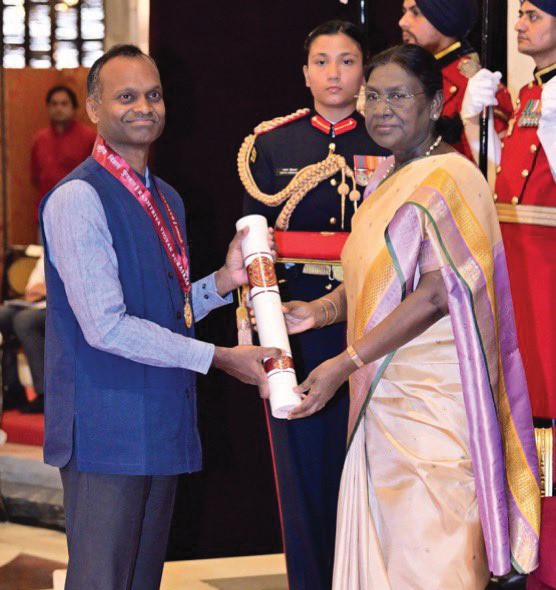
Professor Mohanasankar Sivaprakasam, a leading Indian engineer and innovator, has recently been honoured with the Rashtriya Vigyan Puraskar 2025 in the Vigyan Yuva-Shanti Swarup Bhatnagar category for Technology & Innovation, one of the nation’s most prestigious recognitions for scientific excellence.
Prof Sivaprakasam is a distinguished Professor of Electrical Engineering at the Indian Institute of Technology Madras (IIT Madras), where he leads extensive research and development at the intersection of engineering, medicine, and healthcare. At IIT Madras, he also heads the Healthcare Technology Innovation Centre (HTIC), a joint initiative with the Department of Biotechnology (DBT), Government of India, and the Sudha Gopalakrishnan Brain Centre, both of which have become hubs for affordable diagnostic technologies and translational biomedical research.
Prof Sivaprakasam’s academic journey began with foundational training in engineering in India and the United States. He completed his BTech in Instrumentation Engineering from Anna University, Chennai, in 2001, after which he pursued higher studies in the US, earning an MS in Electrical Engineering from North Carolina State University in 2003, and subsequently his PhD in Electrical Engineering from the University of California at Santa Cruz in 2006.
Early in his career, Prof Sivaprakasam gained valuable experience in biomedical research through eight years of graduate and post-doctoral work in the US. His projects focused on developing advanced biomedical devices aimed at restoring biological function in conditions such as blindness and paralysis. These efforts involved close collaboration with ophthalmologists, neurophysiologists, electrophysiologists and specialists in micro-electromechanical systems (MEMS), leading to technologies that were translated from laboratory prototypes to clinical use, including devices tested on humans.
Driven by a vision to make world-class medical technology accessible and affordable in India, he returned to his home country in 2009 and began establishing interdisciplinary research programmes.
This culminated in the creation of the Healthcare Technology Innovation Centre (HTIC) in 2011 at IIT Madras, where engineers, clinicians, industry experts and policymakers collaborate to design and translate low-cost healthcare inventions into scalable products.
Prof Sivaprakasam’s work has been particularly impactful in the realm of affordable medical devices and healthcare solutions designed for underserved populations. He has pioneered innovations that address critical healthcare challenges across ophthalmology, neurology, diagnostics and surgical interventions, that can reduce dependence on expensive imports and enable indigenous manufacturing.
Reports indicate that his innovations have benefited millions of patients through practical, low-cost interventions that integrate engineering excellence with clinical utility.
Under his leadership, the Sudha Gopalakrishnan Brain Centre has also achieved landmark outcomes in neuroscience and brain imaging. The centre has developed some of the most detailed three-dimensional high-resolution human brain imaging data, captured with advanced mapping technologies at a fraction of the cost of comparable global projects. This work places India among the leaders in brain research while prioritising affordability and clinical relevance. The Rashtriya Vigyan Puraskar awarded to Prof Sivaprakasam recognises not just his individual scientific contributions but also his role in cultivating collaborations across disciplines and sectors. In interviews, he has emphasised that meaningful research requires engagement with clinicians, industry partners, biologists and international collaborators, and that India’s research ecosystem is capable of producing world-class technologies that are both innovative and locally relevant.