



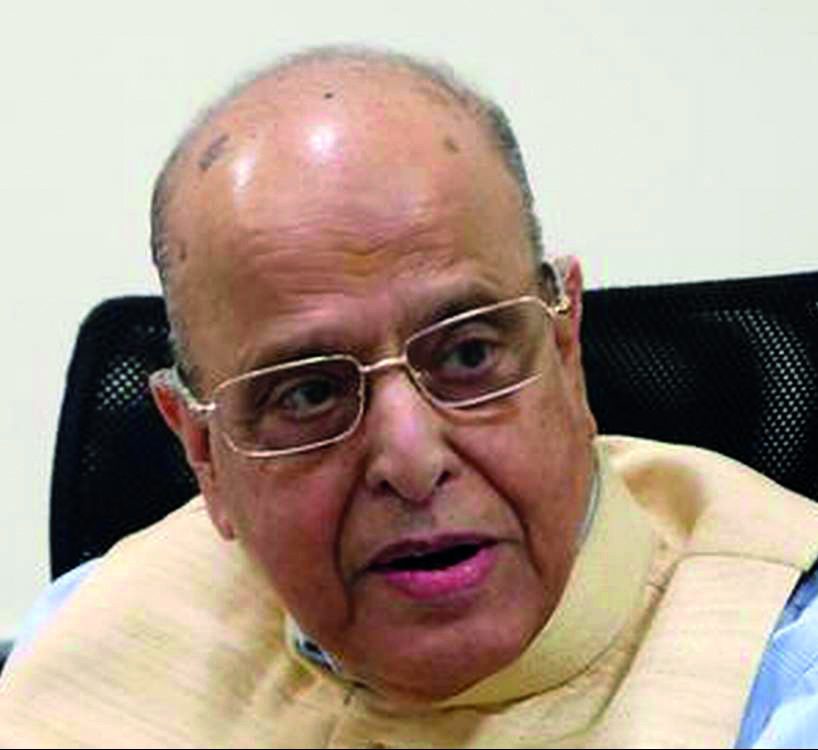
Visionary Indian space scientist and former chairman of Indian Space Research Organization (ISRO), Dr Krishnaswamy Kasturirangan passed away in Bengaluru on 25 April. He was 84.
Paying tribute on X, Prime Minister Narendra Modi said, “Two days ago, we lost the country’s great scientist, Dr K Kasturirangan ji. His contribution in lending newer heights to science, education, and India’s Space Program shall always be remembered. ISRO attained a new identity under his leadership”.
One of the architects of the modern Indian space programme and a stalwart of Indian science, Padma Vibhushan Dr Kasturirangan was a key figure behind India’s New Education Policy (NEP). Besides his career as a renowned astrophysicist, his most lasting contribution in recent years was in the field of education. He served as the Chairman of the committee that drafted the National Education Policy 2020, a major reform aimed at transforming India’s education system to make it more holistic, flexible, and multidisciplinary.
Dr Kasturirangan was the Chancellor of Jawaharlal Nehru University (JNU) and chaired the Karnataka Knowledge Commission, where he worked to improve higher education and research standards.
A multifaceted personality, Dr Kasturirangan was born on 24 October 1940, in Ernakulam. He did his graduation and post-graduation in Physics from the University of Mumbai and PhD in experimental high energy astronomy in 1971, while working at Physical Research Laboratory, Ahmedabad.
As the head of ISRO for nine years, he conceived India’s maiden outing outside the Earth’s orbit. It was under his leadership that Chandrayaan-1, then named Somayaan, was born.
As the director of ISRO Satellite Centre, he oversaw the activities related to the development of new generation spacecraft, Indian National Satellite (INSAT-2) and Indian Remote Sensing Satellites (IRS-1A & 1B) as well as scientific satellites. He was also the Project Director for India’s first two experimental earth observation satellites, BHASKARA-I & II and subsequently was responsible for overall direction of the first operational Indian Remote Sensing Satellite, IRS-1A.
Under his leadership as ISRO chief, the space programme witnessed several major milestones including the successful launching and operationalisation of India’s prestigious launch vehicle, the Polar Satellite Launch Vehicle (PSLV) and the first successful flight testing of the Geosynchronous Satellite Launch Vehicle (GSLV).
Dr Kasturirangan was Member of Planning Commission of India and a Rajya Sabha member (2003-09). His interests included research in high energy X-ray and gamma ray astronomy as well as optical astronomy. He made extensive and significant contributions to studies of Cosmic x-ray sources, celestial gamma-ray and effect of cosmic x-rays in the lower atmosphere. Besides heading several boards of scientific institutions, he also served as the Chairman of the Governing Board of the UN Centre for Space Science & Technology Education (UN-CSSTE).
In his lifetime, Dr Kasturirangan bagged several awards—from Shanti Swarup Bhatnagar Award to Dr MN Saha Birth Centenary Medal for outstanding contributions in the field of Space.