





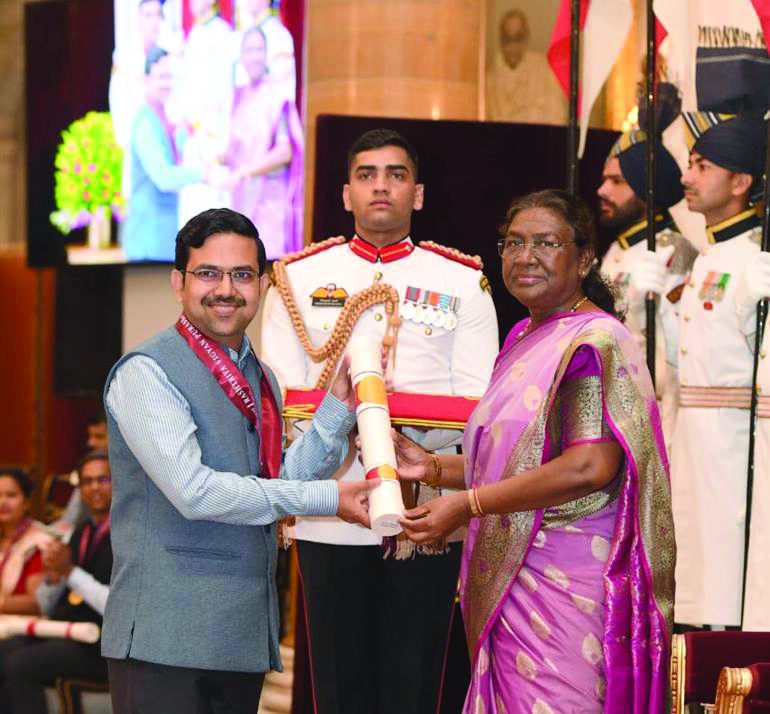
YOUNG SCIENTIST/ Dr JITENDRA K SAHU
In the vast and ever-evolving landscape of medical science, some individuals quietly transform the way we understand and address complex health conditions. One such name is Dr Jitendra K Sahu, a renowned child neurologist from PGIMER, Chandigarh, whose trailblazing work in the field of childhood epilepsy has earned him the prestigious Vigyan Yuva Shanti Swarup Bhatnagar Award 2024 in Medicine. Recognised globally for his research on infantile spasms and genetic epilepsy syndromes, Dr Sahu’s efforts are shaping the future of pediatric neurology not just in India, but across South Asia and beyond.
BRAINSTORMS OF INFANCY
Dr Sahu’s primary area of work lies in childhood epilepsy and neurological disorders. His work spans across the full spectrum of neurological research—epidemiology, diagnosis, treatment, and rehabilitation. With over 175 research publications and numerous national and international research grants to his name, he has emerged as a prominent voice in global pediatric neurology. But it is the clinical impact of his research that sets him apart.
Infantile spasms—a rare but severe form of epilepsy that typically strikes within the first year of life—is among the key conditions Dr Sahu investigates. These spasms, often misunderstood or misdiagnosed, can have devastating developmental consequences if not treated. Recognising the urgency of this condition, Dr Sahu founded the South Asia-allied Infantile Spasms Research Group, a consortium spanning nine countries, with the goal of fostering collaborative research and treatment strategies. Through this platform, his team has uncovered insights into the causes of treatment delays and formulated guidelines to bridge these gaps.
THE GENETIC CODE OF SEIZURES
A significant part of Dr Sahu’s research is dedicated to understanding the genetic underpinnings of early-onset epilepsies like infantile spasms and Dravet syndrome. These conditions are often refractory to conventional treatments, but insights into their genetic origins have opened new therapeutic doors. Dr Sahu’s team has made noteworthy strides in establishing in-house genetic testing protocols for Dravet syndrome—an innovation that not only makes testing more accessible but also reduces dependency on expensive foreign labs.
This commitment to affordable, indigenous diagnostic tools is particularly important for resource-constrained settings like India. His work exemplifies a model of translational research where findings from the lab directly impact patient care. By identifying specific mutations linked to epilepsy, clinicians can tailor treatment plans and offer families more informed prognoses.
BUSTING MYTHS
Another noteworthy contribution from Dr Sahu’s research has been in addressing vaccine hesitancy—an issue that continues to plague public health efforts. There has been a persistent belief in some circles that seizures following the DPT (Diphtheria, Pertussis, Tetanus) vaccine are caused by the vaccine itself. However, Dr Sahu’s team has debunked this myth by showing that such seizures often result from an underlying genetic predisposition, not the vaccine. This research provides much-needed scientific backing to vaccination campaigns and helps reassure parents about the safety of life-saving immunisations.
TELEMEDICINE FOR EPILEPSY CARE
In an age increasingly defined by digital healthcare, Dr. Sahu has also explored the potential of telemedicine in epilepsy management. For families living in remote or underserved regions, accessing a child neurologist can be an uphill battle. By leveraging telemedicine, Dr Sahu’s initiatives aim to bridge this gap, an approach that proved especially effective during the COVID-19 pandemic and is now being scaled further. Dr Sahu’s journey began with his MBBS from Pt JNM Medical College, Raipur, in 2003, followed by MD (Paediatrics) and DM (Paediatric Neurology) from the prestigious AIIMS, New Delhi. He joined PGIMER in 2011, and by 2021, had risen to the rank of professor. He continued to refine his clinical acumen through fellowships at globally reputed institutions such as the Great Ormond Street Hospital (London), Queensland Children’s Hospital (Brisbane), and Nationwide Children’s Hospital (USA).