

Image Courtesy: PIB
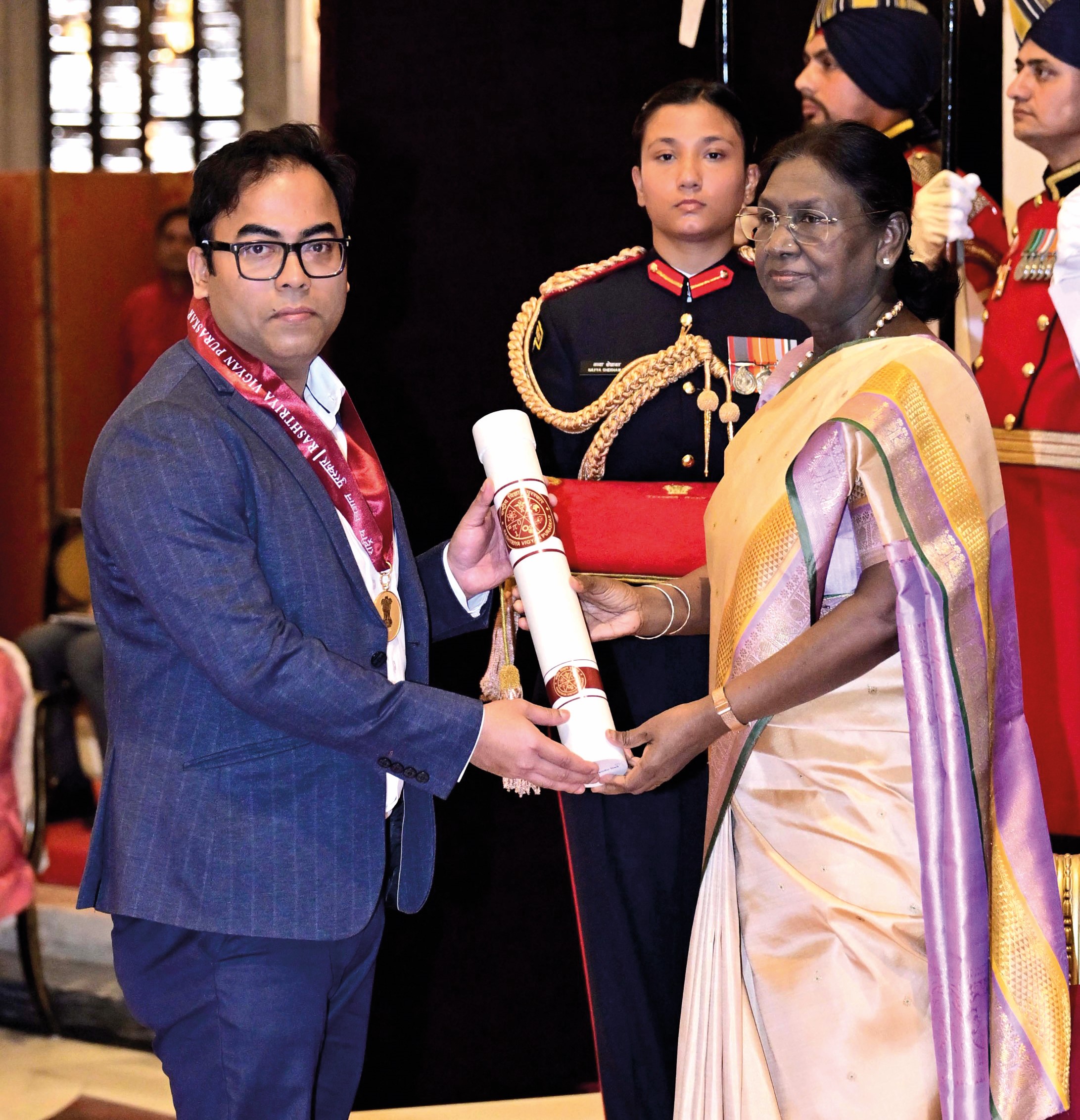
Dr Dibyendu Das, Associate Professor in the Department of Chemical Sciences at the Indian Institute of Science Education and Research (IISER) Kolkata, has been selected for the Vigyan Yuva Shanti Swarup Bhatnagar Award 2025. He is the sole recipient of the award in Chemistry, under the Rashtriya Vigyan Puraskar (RVP) scheme. This honour, among the nation’s highest recognitions for scientific achievement, acknowledges his pioneering research and global impact in the rapidly growing field of systems chemistry.
Trained as an organic and supramolecular chemist with a deep interest in molecular self-organisation, Dr Das has established an internationally visible research programme aimed at understanding how life-like properties can emerge from simple chemical systems. His work interrogates fundamental questions concerning the chemical origins of life, the emergence of catalytic networks, and the possibility of constructing ‘Life 2.0’; synthetic matter that exhibits the fundamental characteristics of living systems.
Dr Das is widely regarded as a leading figure in systems chemistry, particularly for elucidating how non-equilibrium chemical self-assembly processes give rise to emergent functions. His laboratory has also demonstrated how short peptide-based assemblies can form amyloid structures that catalyse multiple reaction pathways, offering a plausible mechanism for primitive enzymatic evolution under early-Earth conditions. These studies have influenced origin-of-life research by introducing chemically robust, experimentally tractable models of early enzymes and protometabolic emergence.
A hallmark of his work is the creation of synthetic non-equilibrium assemblies that mimic key features of living matter, adaptation, transient behaviour, chemotaxis, and signal response. His group has engineered chemical systems capable of spatiotemporal control over structure and function, where materials grow, transform, and dissipate only when supplied with energy. This far-from-equilibrium design strategy is redefining how dynamic functional materials are conceptualised within chemistry.
Dr Das’s contributions extend beyond fundamental science to translational innovation. His laboratory is developing self-destructing catalytic systems for security applications, oscillatory hydrogels for dermal drug patches, adaptive diagnostic kits, and programmable non-equilibrium materials with real-time decision-making capabilities. This interdisciplinary approach positions his group at the cutting edge of chemistry, materials science, and bioinspired engineering.
His leadership and international standing are reflected in several major honours. He was featured in ‘75 Under 50 Scientists Shaping Today’s India’ (Vigyan Prasar, 2021), recognised for his role in shaping the trajectory of modern Indian science. He has been elected Vice Chair (2026) and Chair (2028) of the Gordon Research Conference on Systems Chemistry; an exceptional distinction for an India-based scientist. He served as a mentor at the 2024 Gordon Research Seminar, guiding early-career researchers on the scientific and societal impact of systems chemistry. His earlier recognitions include the prestigious Swarnajayanti Fellowship (2020) and election as an INSA Associate Fellow (2025).
Dr Das’s long-term vision is to create synthetic matter that blurs the boundary between inanimate and living systems, uncovering the origins of biological complexity while developing future-ready adaptive materials. His laboratory aims to construct autonomous chemical networks, evolve primitive catalytic pathways, and engineer life-inspired materials with transformative applications spanning healthcare, diagnostics, energy, and security. Through his exceptional scientific contributions, visionary leadership, and sustained excellence, Dr Dibyendu Das has positioned his laboratory as a global leader in systems chemistry. The Vigyan Yuva Shanti Swarup Bhatnagar Award 2025 stands as a recognition of his pioneering role in advancing one of the most dynamic frontiers of contemporary chemical science.