




Image Courtesy: Wikimedia Commons
Throughout the extensive history of human inquiry, no question has been more enduring than this: How does life convert the inanimate into the animate? Ancient civilisations contemplated this enigma through philosophy, mythology, and nascent forms of natural inquiry. The aspiration of alchemists to achieve transmutation, along with contemporary molecular biologists’ endeavours to engineer biological systems, has shaped humanity’s pursuit of comprehending the bioalchemy of matter, fundamentally influencing the progress of science.
Currently, the term ‘bioalchemy’ has transcended the domain of magical tales. It delineates an innovative paradigm wherein life serves as a blueprint for technology, sustainability, and creativity. It is the central element of contemporary study spanning various fields: biotechnology, materials science, synthetic biology, and artificial intelligence.
Contemporary scholars—whether consciously or unconsciously—perpetuate a legacy that originates from Ayurveda, Rasashastra, and the metallurgical marvels of ancient India. As our instruments advance and our microscopes delve deeper into the molecular complexities of life, we are reaffirming the insights of ancient philosophers—that nature, through aeons of experimentation, has already refined the most intricate technologies. The new horizon of research is not merely to comprehend fundamental biological principles, but to replicate them.
THE EVOLUTION OF BIOALCHEMY FROM RASASHASTRA TO CRISPR
Rasashastra, the ancient Indian discipline known as the ‘science of mercury’, is one of the earliest organised endeavours to comprehend matter and its transformation. Conducted from the 8th to the 13th centuries CE, it aimed to not only convert base metals into noble ones but also to create medical concoctions capable of revitalising life. Texts like Rasarnava and Rasaratna Samuccaya delineate techniques for purifying, alloying, and calcination, which closely resemble contemporary metallurgical and pharmacological technologies. The objective was not solely material transformation; it was the spiritual and biological enhancement of the body—elevating human existence to its most essential and unadulterated state.

Image Courtesy: Shutterstock
This concept of metamorphosis profoundly resonates with contemporary genetic scientists who edit DNA using CRISPR-Cas9 technology. The gene-editing technique, enabling exact modification of DNA sequences, is a contemporary iteration of the pursuit to alter life, rectify its imperfections, and augment its vigour. The accomplishments of the Rasavadi in metallurgy and plant alchemy are paralleled by the 21st-century biologist’s achievements in molecular biology. With CRISPR, humanity has crossed a threshold once reserved for gods and poets—the power to alter the blueprint of existence. Genes responsible for disease, drought resistance, or metabolism can now be switched on or off like digital commands.
This ability to transform life’s raw material—to convert genetic ‘lead’ into biological ‘gold’—has profound implications for medicine, agriculture, and ethics alike. We are, in a sense, modern alchemists wielding molecular wands.
Yet, as with all alchemy, there are moral questions. Should we edit embryos? Should we resurrect extinct species? Can we design humans without unintended consequences? The philosopher’s stone of the 21st century may not turn metal into gold, but it can turn possibility into peril if guided by hubris instead of wisdom.
THE INDIAN HERITAGE OF BIOALCHEMY
Long before the advent of synthetic biology or nanotechnology, India’s intellectual traditions had already accepted the bioalchemy inherent in nature. Ancient Ayurvedic teachings elucidate the metamorphosis of matter within the human body, framing health as a dynamic equilibrium between biological and elemental forces. Rasayana, the Ayurvedic discipline of rejuvenation, literally translates to ‘path of essence’, reflecting the alchemists’ pursuit of change.
Ancient Indian metallurgists were early practitioners of material bioalchemy. The rust-resistant Iron Pillar of Delhi, remaining uncorroded for more than 1,600 years, demonstrates an advanced comprehension of phosphoric iron—a historic forerunner of contemporary corrosion-resistant alloys.
Although steel and iron receive romanticised recognition, India’s historical contributions to non-ferrous metallurgy are as enlightening. The Zawar mines in Rajasthan are the earliest well-documented case of zinc production using distillation during the mediaeval era. Zinc, due to its elevated vapour pressure at smelting temperatures, has a distinct technological challenge: it vaporises prior to melting, necessitating meticulous retorting and condensation techniques to extract metallic zinc. Zawar’s metallurgists constructed retorts and furnace configurations to condense zinc vapour and retrieve metal—an adept command of phase behaviour and process regulation that contemporary chemical engineers would readily acknowledge.
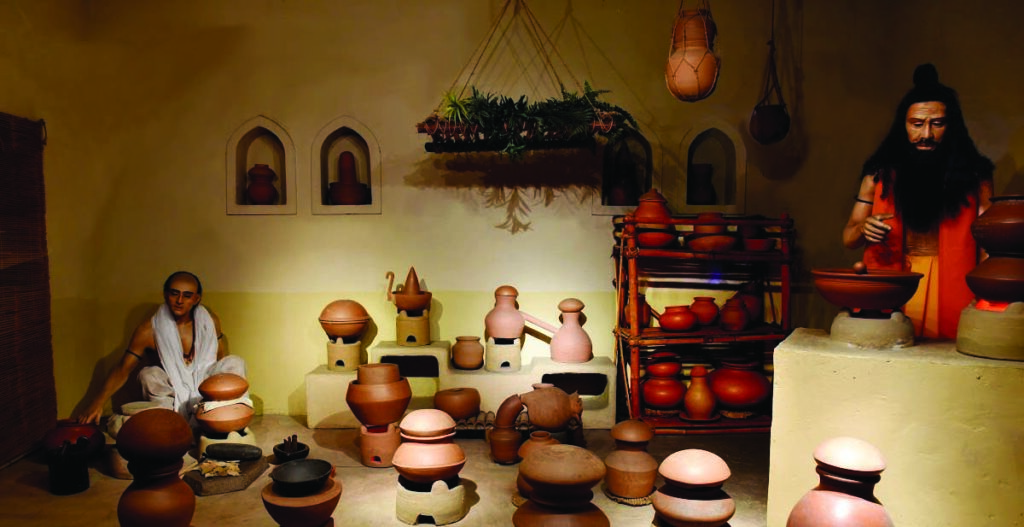
Image Courtesy: Dr Biju Dharmapalan
The ancient Wootz steel from South India is equally intriguing, renowned for its production of Damascus blades. The manufacturer incorporated features resembling carbon nanotubes, as revealed by contemporary electron microscope examinations. This ancient substance, created through regulated heating and rapid cooling, is now acknowledged as a proto-nanotechnology—a synthesis of fire, iron, and organic components like leaves and wood charcoal.
Even India’s revered mythology suggests biotransmutation. The Samudra Manthan story, depicting the churning of the cosmic ocean that produces both poison and nectar, serves as a metaphor for metamorphosis—the fundamental principle of bioalchemy. Currently, Indian researchers perpetuate that history in contemporary laboratories by generating bioinspired materials from silk fibroin, designing biodegradable plastics derived from seaweed, and employing plant extracts for nanoparticle production. This continuity between ancient wisdom and contemporary science highlights a distinctly Indian perspective on sustainable innovation, wherein nature and knowledge coexist as partners rather than adversaries.
BIOMIMICRY: THE ENGINEERING OF NATURE
The revolution in materials research has been spurred by the capacity of nature to design with elegance and efficiency. The lotus leaf, due to its microscopic texture that repels water and grime, has inspired the development of hydrophobic paints and self-cleaning surfaces. The synthetic adhesives that are based on van der Waals forces were inspired by the gecko’s foot, which is capable of adhering to glass without the use of glue. Bioengineered silks and composite materials for aerospace and medicine have been developed as a result of the humble spider web, which is stronger than steel by weight. These are not merely imitations; they are the conversion of biological principles into technological applications. Biomimicry is a novel form of alchemy that involves converting biological design into human utility.

Image Courtesy: Baro Art
For instance, the nacre (mother-of-pearl) found in seashells has inspired the development of layered composites that combine flexibility and durability, thereby revolutionising armour materials and ceramics. Similarly, sharkskin-inspired coatings are currently employed to mitigate biofouling on ship hulls and bacterial proliferation in hospitals. These innovations result from a profound realisation: energy is not a waste in life. Modern engineers are currently studying the principles of feedback, self-assembly, and adaptation, which biological systems employ to operate at the thermodynamic limits of efficiency. These principles serve as the foundation for sustainable design.
SYNTHETIC BIOLOGY AND BEYOND: BIOALCHEMY IN THE LABORATORY
Bioalchemists today endeavour to convert cells into factories, as classical alchemy endeavoured to transform lead into gold. Perhaps the most literal embodiment of bioalchemy in modern science is synthetic biology, which involves designing and constructing novel biological components.
Scientists can induce microorganisms to produce drugs, fuels, and building materials by reprogramming genetic codes. Yeast is capable of producing insulin in addition to beer. Bacteria can be programmed to emanate light or digest plastic waste. Plants are being engineered to generate biodegradable polymers and even conduct electricity. Biological foundry is no longer a metaphor but a tangible reality.
For example, the development of laboratory-grown meat products. Scientists are utilising the principles of cellular self-organisation, which are the same as those that govern embryonic growth, to produce muscle tissue without the use of an animal. Alternatively, the emerging field of mycelium materials: fungal networks that develop into predetermined shapes, providing biodegradable alternatives to plastic packaging and construction materials. This is the new alchemy of sustainability, transforming biological processes into environmentally friendly technologies. Researchers are now enabling industry to adapt to nature’s chemistry rather than requiring nature to adapt to industry.
MOLECULAR MACHINES: THE NANOSCALE TRANSFORMATION
In 2016, the Nobel Prize in Chemistry was conferred upon scientists who developed the world’s first molecular machines—minute devices comprising interconnected molecules that execute movements and duties. The concept may appear avant-garde, although it is fundamentally derived from biological principles.
Molecular machineries, like kinesin, dynein, and ATP synthase, have functioned within every cell for billions of years. They traverse, rotate, and transport molecules with exceptional accuracy. The biological motor ATP synthase, for instance, revolves at 10,000 revolutions per minute, driven by a singular proton gradient.
Contemporary nanotechnology is fundamentally bioalchemy at the atomic level. Researchers are currently developing artificial systems that emulate these natural nanomotors, creating opportunities for targeted medication delivery, nanosurgery, and self-repairing intelligent materials. This integration of biology and materials science indicates a paradigm change. Matter is no longer inert; it is becoming programmable—responsive to stimuli, capable of self-organization, and infused with the principles of life itself.
FROM CELLS TO CIRCUITS:
THE EMERGENCE OF BIOLOGICAL ELECTRONICS
The demarcation between biology and electronics is eroding. In the nascent domain of bioelectronics, researchers are developing circuits capable of interfacing with biological tissues, responding to chemical signals, and exhibiting self-healing properties. Researchers at Stanford University have developed biological transistors composed of proteins that can toggle on and off in reaction to molecular signals, serving as the biological counterpart to silicon chips. Other teams are investigating bacterial colonies as computational entities, capable of information storage and logical operations via gene expression.
Simultaneously, the convergence of biology and computation has led to the emergence of neuromorphic engineering—hardware modelled after the brain’s structure. The human brain is the pinnacle of bioalchemical engineering: a configuration of carbon, hydrogen, oxygen, and nitrogen atoms that inexplicably generates awareness.
If alchemists pursued the elixir of life, contemporary scholars might assert they have discovered it—in information. The capacity of life to store, process, and convey information via DNA and brain networks constitutes the fundamental mechanism of all biological transformation.
THE ALCHEMY OF UNDERSTANDING
Transmuting metals is no longer the focus of bioalchemy of matter; rather, it is about transforming our understanding of life, intelligence, and sustainability. Using technologies like CRISPR and synthetic biology, as well as biomimetic materials and living electronics, we are gaining an understanding of the environment as a complex network of interconnected transformations.
Within the context of this large-scale experiment, humanity is at a crossroads. We have the option of using bioalchemy to either cure the earth by developing regenerative technologies that echo the harmony of nature or to exploit it further. There is a possibility that the genuine philosopher’s stone is not in our laboratories but rather in our collective wisdom.
As the lines between living and nonliving things become increasingly blurry, the scientific community has to rediscover its philosophical roots. In the beginning, alchemy was a scientific and spiritual pursuit in nature; it was an endeavour to bring together the material and the heavenly. To achieve this harmony, modern bioalchemy must also incorporate the concepts of inquiry and conscience, as well as reverence and knowledge. As a result, life itself is the most extraordinary alchemist, as it is the one who transforms the elements of sunlight, water, and earth into consciousness. It is not the scientist’s responsibility to surpass that miracle; rather, it is to comprehend it in great detail and use that comprehension to direct the development of new ideas in the future.
*Dr Biju Dharmapalan is the Dean-Academic Affairs, Garden City University, Bangalore and an adjunct faculty at the National Institute of Advanced Studies, Bangalore. He can be reached at bijudharmapalan@ gmail.com