

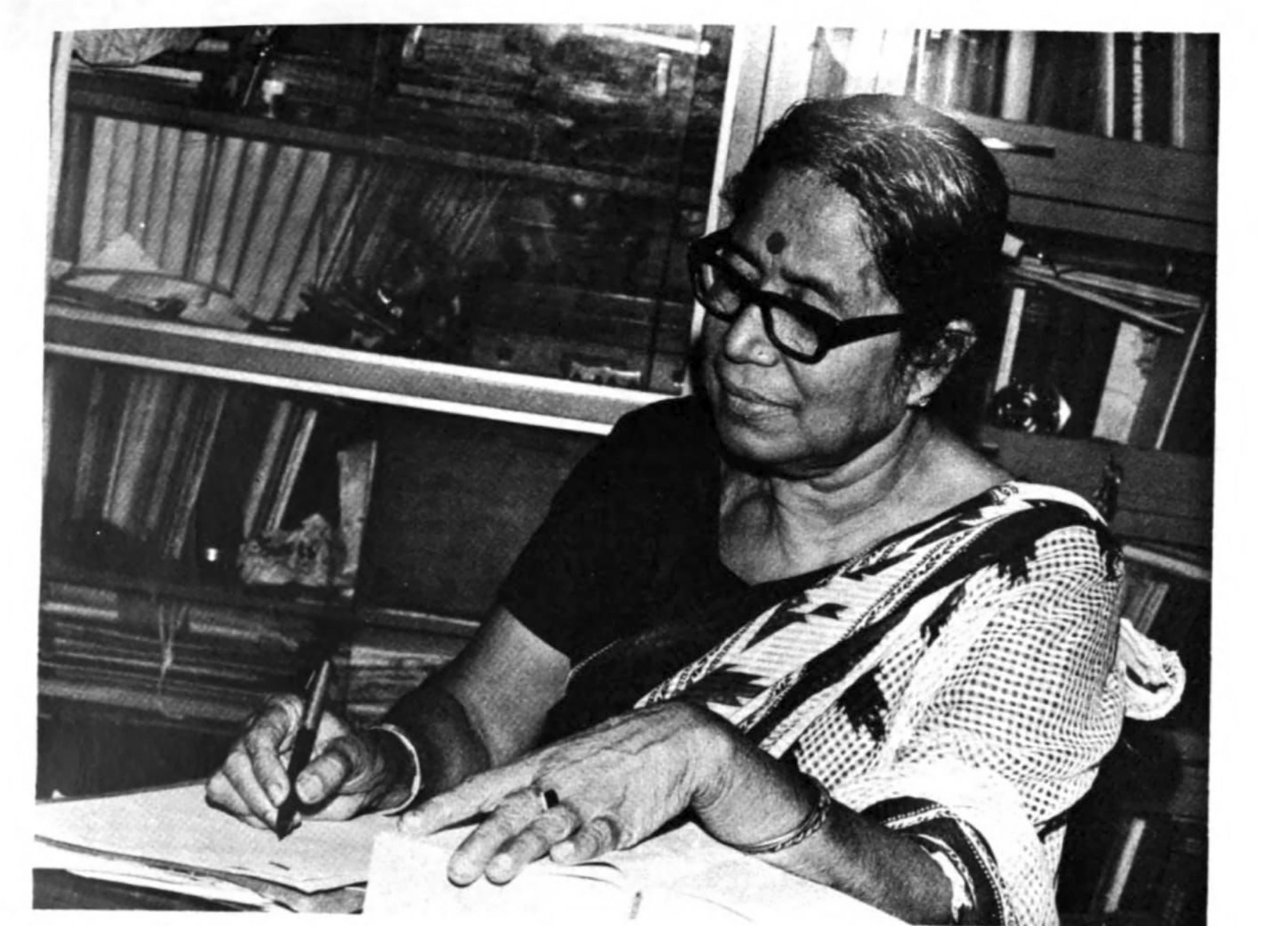
Image Courtesy: Internet
SPOTLIGHT: Dr DEBALA MITRA (14 DECEMBER 1925 – 2 DECEMBER 2003)
Too often, the dedicated scholars who painstakingly reclaimed India’s past fade into the background. Among such unsung heroes, the remarkable life of archaeologist Debala Mitra warrants a closer examination.
Born in pre-independence Bengal, she defied the constraints of a patriarchal society and entrenched feudal traditions to become a luminous figure in Indian archaeology. Mitra was a woman who made the crumbling stone speak. She rose to become the first woman Director General of the Archaeological Survey of India (ASI), shattering glass ceilings in a male-dominated field.
A century after her birth, it’s fitting that we pause to honour her monumental achievements, which continue to inspire a new generation of researchers, conservators, and historians.
Her story is at once historical irony and elegy. A woman in a field dominated by men, she became Director General of the Archaeological Survey of India. What she discovered in Ratnagiri, Tilaurakot, and through other excavations, her interpretations of Buddhist art and architecture were not only a reflection of the past but also a mirror through which we see our present more clearly. She was a gifted scholar, with patience, curiosity, and an impeccable analytical rigour.
EARLY LIFE AND EDUCATION IN BENGAL
Debala Mitra was born on 14 December 1925 in the Bengal Province, now part of Bangladesh, into a middle-class Kayastha household that prized learning and art. Her early schooling took place in Calcutta and Khulna, where she quickly distinguished herself through an inveterate thirst for knowledge and an uncommon precision of thought. The period into which she was born was marked by both intellectual ferment and nationalist agitation, yet the opportunities for women’s education remained circumscribed. Mitra overcame these limitations asserting that intelligence could occasionally surpass social expectations.

Images Courtesy: Wikimedia Commons
She demonstrated diligence and analytical acuity right away. By 1940, she had attained first place among all female students in the Bengal Presidency matriculation examination, securing star marks and five letters. She maintained her academic excellence and ranked 19th in merit on the Intermediate of Arts examination. Even within the competitive and factionalised environment of higher education, Mitra maintained an unswerving commitment to historical and linguistic studies, cultivating skills that would become indispensable in archaeological research.
She graduated from Ashutosh College in 1944 before completing her M.A. in Ancient Indian History and Culture from the University of Calcutta in 1946, winning the silver medal and the Rai Radhika Prasanna Mukherjee gold medal for exceptional scholarship. Her academic curiosity led her beyond the subcontinent. She studied French language courses in Paris and explored the Art of Cambodia at the École du Louvre. Her doctoral research on the temples of Telkupi in West Bengal earned her a PhD from the University of Calcutta in 1975. She learned to organize fragmented evidence chronologically, and to approach ideas analytically. These formative experiences and cultural sensitivity would facilitate her lifelong contributions to archaeology.
A TRAILBLAZING ENTRY INTO THE ARCHAEOLOGICAL SURVEY OF INDIA
In December 1952, she walked all the way into the corridors of the Archaeological Survey of India, taking her place in an institution that oscillated the weight of colonial legacy and nationalist promise. The ASI of that era was old, crumbling in parts, and desired galvanisation of a new approach to indigenous history. It had inherited Alexander Cunningham’s vision, but also the British bureaucracy.
She recognised the patriarchal dominance in her environment and proceeded with quiet competence rather than vociferous confrontation. From the outset, her work involved documentation, cataloguing ancient finds, and conducting field surveys. Colleagues recognised that she was a researcher capable of reading bones, potsherds, and crumbling frescos.
Through her tenure at ASI, she rose methodically through the ranks, serving first as Superintendent of the Eastern Circle and subsequently as Additional Director General, before ultimately assuming the office of Director General. She participated in excavations at Rupar, Nohar, Sothi, Maski, and Tamluk, and later undertook independent excavations at Jaugada, Udaygiri, Khandagiri, Ratnagiri, Tilaurakot, Kodan, and various sites in north-east India. Her responsibilities extended to conservation and preservation, including the mosques of Murshid Quli Khan at Murshidabad, tombs and mosques at Gaur and Panduas in West Bengal, temples at Bishnupur in Manipur, and earthquake-damaged temples in Assam.
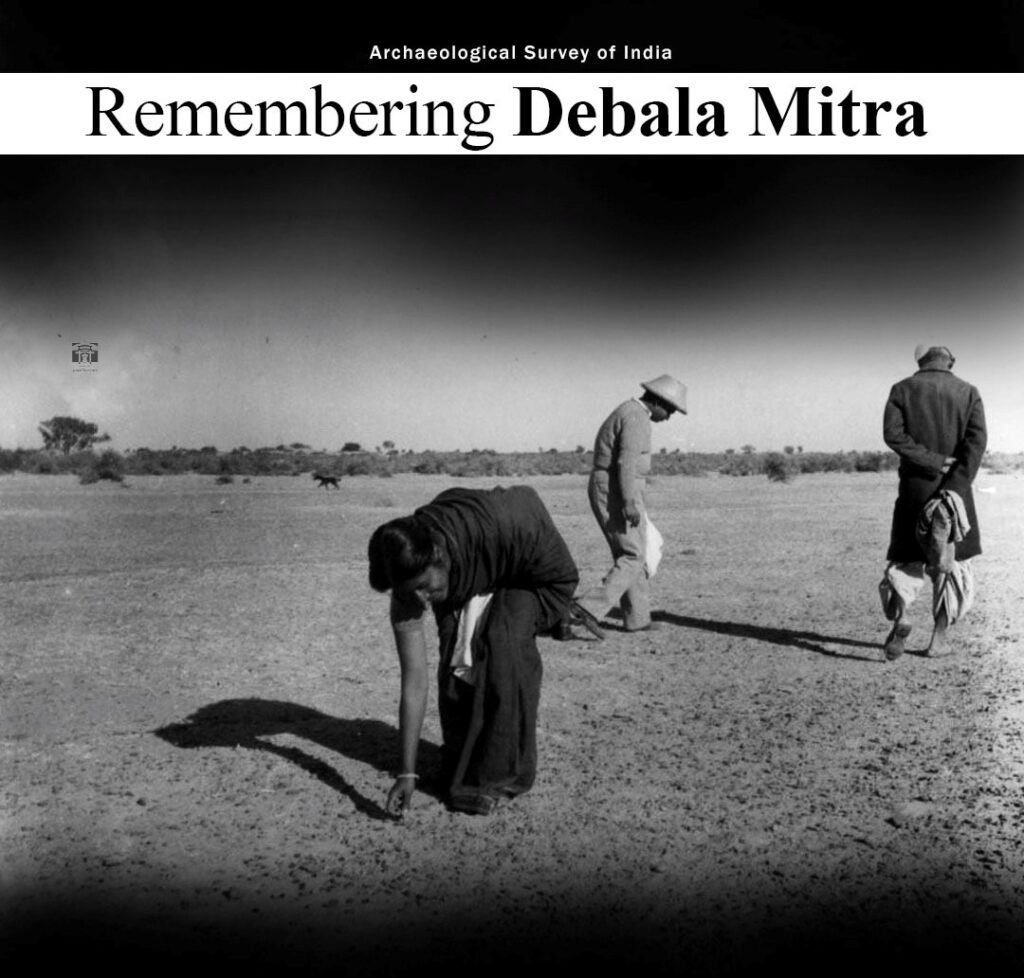
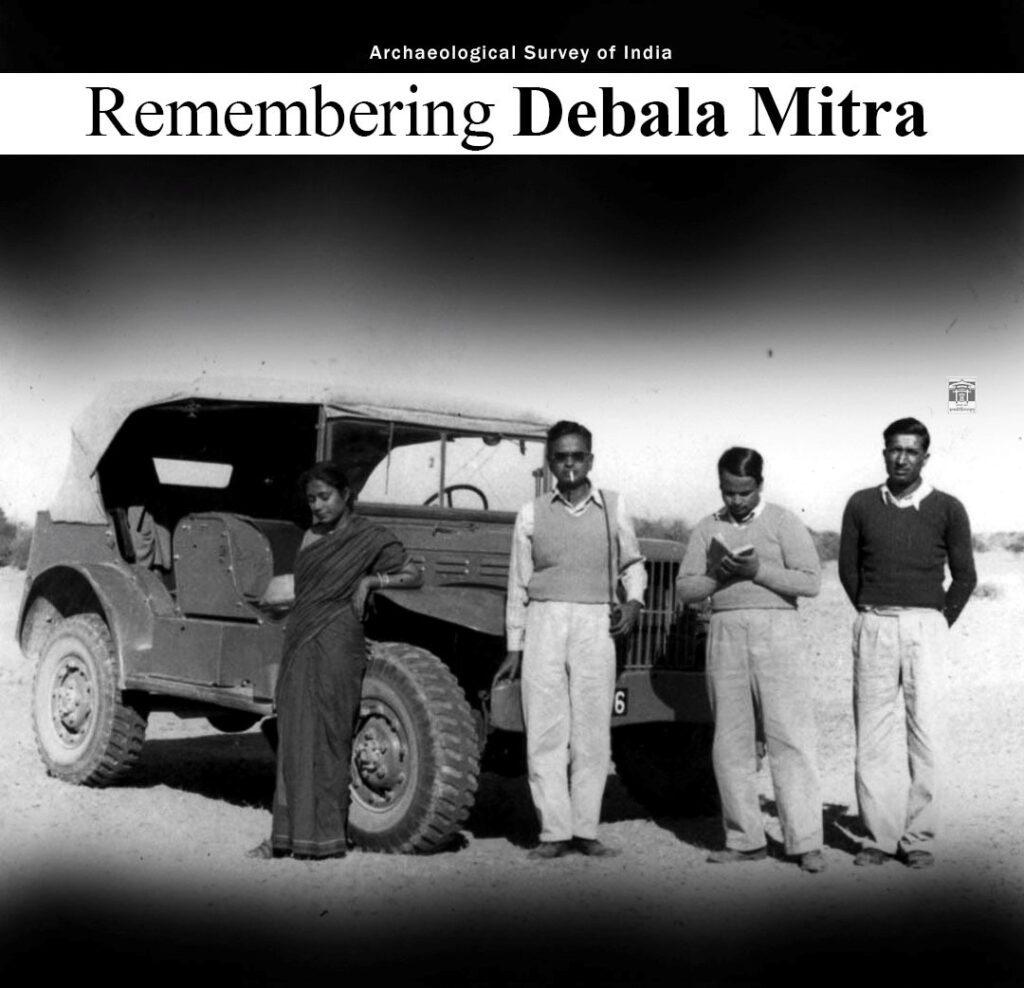
Dr Mitra made an enduring contribution to Indian archaeology through her extensive research and excavations at key Buddhist sites, including Ratnagiri, Jaugada and Udaygiri in Odisha, as well as Tilaurakot, Lumbini, Kodan and Nigali Sagar in Nepal, among others. Snapshots of her at work from archives.
Mitra’s administrative and advisory roles were extensive. She chaired the National Committee for the Lumbini Development Project and ICOMOS, served on the Central Advisory Board of Archaeology, the Asiatic Society, and the National Council for Science Museums. She represented the Indian government at international conferences and symposiums across multiple countries, and contributed as a consultant to the cultural triangle in Sri Lanka. In May 1986, she attended the international conference in Berlin on the development and chronology of Buddhist and Hindu sculptures in early medieval art.
EXCAVATIONS IN BUDDHIST SITES AND RECLAMATION
Debala Mitra’s most concrete contributions to Indian archaeology were her systematic excavations, which clarified longstanding questions about Buddhist religious practice, architectural evolution, and regional socio-cultural aspects. Among the sites she investigated, Ratnagiri in Odisha and Tilaurakot in Nepal were of peak importance. In her book Buddhist Monuments, Dr Mitra offers details on the development of stupas. She emphasises differences across regions and the symbolic meanings they hold. She also examines lesser-known monasteries, highlighting their distinctive architecture and situating them within their historical context. Her interpretations of inscriptions provided data on patronage and sociopolitical conditions, while comparative studies across multiple Buddhist centres illustrated the diffusion of artistic and ritual forms.
A notable episode occurred in Bodhgaya. In February 1987, she observed an eighth-century Buddha statue within the Maṭha complex. Upon returning in March 1989, she noted the statue was missing and learned that the Maṭha authorities had not reported the loss. Cross-referencing a published photograph from the Metropolitan Museum of Art, Dr Mitra confirmed that the missing Bodhgaya statue had appeared in the museum’s collection. She reported the matter to the Archaeological Survey of India in May 1990. Investigations traced the statue’s registration to Shri Shatanand Giri of the Bodhgaya Maṭha, dated 4 October 1976. Consultations between the ASI, the Indian Embassy in New York, and the Metropolitan Museum verified the identification, and the museum consented to return the statue without compensation. The object was formally repatriated on 23 March 1999.
One of the first recoveries of a stolen Bihar sculpture from a foreign collection happened during this episode. Dr. Mitra’s hard work and commitment to scholarly verification highlighted the practical and procedural needs to deal with art theft. This approach was much needed.
RECOGNITION FOR HER PIONEERING WORK AND SCHOLARSHIP
Debala Mitra oversaw the Archaeological Survey of India’s excavations at Ratnagiri, Odisha, between 1958 and 1961. Her team uncovered Monasteries No. 1 and No. 2, a colossal stupa, numerous smaller votive stupas, temples, and a profusion of sculptures, including Buddha heads and bronze artifacts. With its complex carved doorways and rows of cells encircling a central shrine, Monastery No. 1 was a prime example of the period’s artistic sophistication.
Dr Mitra’s meticulous documentation of these finds, published in the ASI’s Memoirs of the Archaeological Survey of India in Ratnagiri (1958-61), remains an essential research on the site. She measured pottery shards, traced stylistic and iconographic developments, and connected local artistic expressions to broader Buddhist centres across Asia. She demonstrated how monastic life, sanctuaries, and religious art evolved over the fifth to the thirteenth centuries, cultural exchange, and artistic cross-fertilisation that bound these monasteries together.
Early 2025 excavations have confirmed Dr Mitra’s groundbreaking research. Three enormous Buddha heads and a vast shrine complex were found by archaeologists, demonstrating Ratnagiri’s historical and cultural significance as a flourishing Buddhist centre. These discoveries expand on her initial interpretations and offer more context for the site’s artistic evolution and monastic traditions.
TILAURAKOT: IN SEARCH OF KAPILAVASTU
From the late 1960s through the 1970s, Debala Mitra led the Archaeological Survey of India in excavating Tilaurakot in Nepal. Many considered this site to be the ancient Kapilavastu, the childhood home of Prince Siddhartha. Her work focused on fortified urban structures, revealing defensive walls, gateways, residential areas, and artefacts that dated from the Maurya to Kushan periods. Although there was no clear evidence confirming Tilaurakot as Kapilavastu, her investigations significantly reduced the likelihood of such possibilities.
She employed careful stratigraphic analysis, meticulously recording details with precision, much like an ophthalmologist examines retinal information. Her thorough documentation created a framework that allowed later scholars to build on strong archaeological foundations. The excavations discovered material culture and urban planning that linked Nepal’s Terai region to the more expansive Gangetic plains. This offered insights into trade, rituals, and population movement during the early historical period.
Her work at Tilaurakot shows a careful balance of field skills and scholarly interpretation. While the exact location of Kapilavastu remains uncertain, Mitra’s efforts transformed the site from a place of doubt into a well-documented archaeological case study.
SCHOLARSHIP AND PUBLICATIONS: A PROLIFIC LEGACY IN PRINT
Dr Debala Mitra was a prolific archaeologist and scholar whose work extended beyond field excavations into rigorous documentation and analysis. Her major publications include Buddhist Monuments, Ajanta, Konarak, Telkupi: A Submerged Temple-Site in West Bengal, Ratnagiri: 1958-61, and numerous articles in Indian Archaeology – A Review and other journals. In Buddhist Monuments, Mitra examined Buddhist architecture, sculpture, and painting, covering sites from Ajanta and Ellora to Nalanda, Vikramashila, Sanchi, and Amaravati. She provided detailed descriptions of stupas, monasteries, sculptural iconography, and inscriptions, establishing chronological and stylistic frameworks. Her articles in Indian Archaeology – A Review documented new excavations, analysed artefacts, and interpreted epigraphic evidence. She combined field data with art-historical analysis, creating systematic records of significant sites.
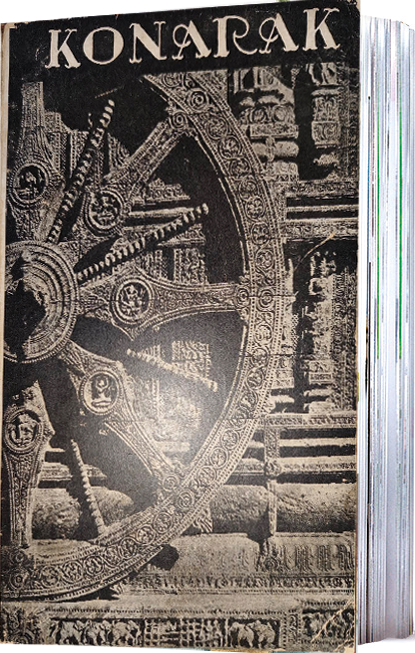
Mitra’s scholarship also included comprehensive studies of Ratnagiri, Telkupi, and other Buddhist and temple sites, thereby contributing to an understanding of the architecture, culture, and chronology.
AS DG OF THE ARCHAEOLOGICAL SURVEY OF INDIA: LEADING THE NATION’S HERITAGE
In 1981, she became the first woman to serve as the Director General of ASI, overseeing excavations, conservation, bureaucratic challenges, and national heritage. Many saw her appointment as a victory of merit over entrenched patriarchy. She transformed ASI from an institution of mere custodianship to one of interpretation and vision. Buddhist archaeology, under her guidance, ceased to be dry cataloguing and became a living history. When she retired on 31 December 1983 she left behind not only a strengthened organisation and an ethical legacy, she had also opened doors for other women, scholars, and those who dared question prejudice.
AWARDS AND RECOGNITION: A DULY HONOURED SCHOLAR
Dr Mitra’s contributions did not go unnoticed. She was awarded the Dr B C Law gold medal by the Asiatic Society for her work on art, architecture, iconography. She travelled widely: Rome, Athens, London, Cairo. She represented India at international symposia, sat on committees like Central Advisory Board of Archaeology and Asiatic Society.
As we honour her on her birth centenary we do more than remember dates. We celebrate a woman who showed us that intellect, courage, persistence can surmount obstacles. Her century-long legacy shows us that the past is not a fixed relic. It is fluid, contested, and alive. Her life encourages us to dig deeper, listen more closely, and question more boldly.
*Dr Navneet Kumar Gupta is a New Delhi-based freelancer, while Dr Biju Dharmapalan is the Dean-Academic Affairs, Garden City University, Bangalore. and an adjunct faculty at the National Institute of Advanced Studies, Bangalore.