





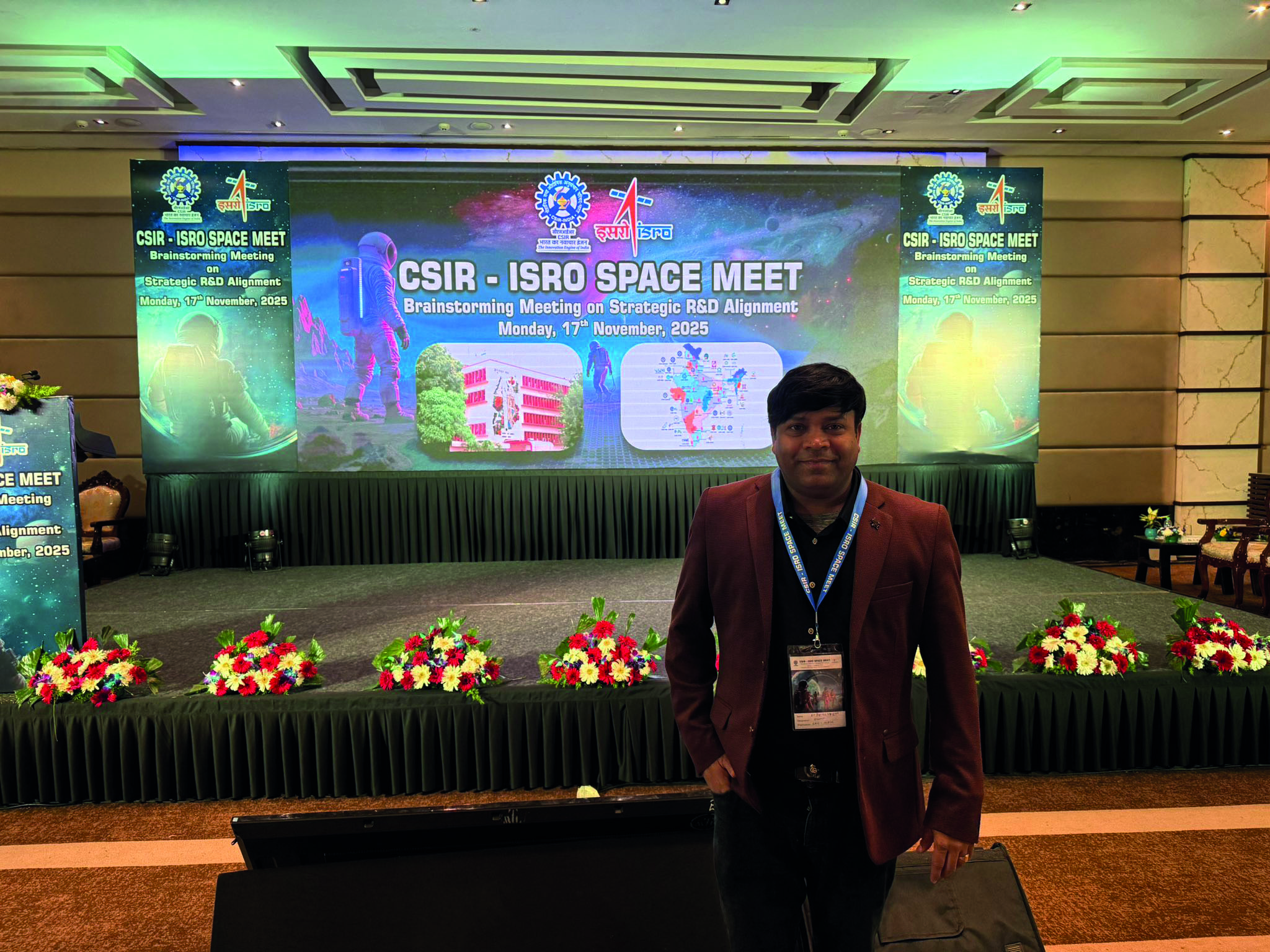
YOUNG SCIENTIST/ DR JAGADIS GUPTA KAPUGANTI
In a defining moment for Indian agricultural science, Dr Jagadis Gupta Kapuganti has been awarded the prestigious Vigyan Yuva–Shanti Swarup Bhatnagar Award (VY-SSB) under the Rashtriya Vigyan Puraskar 2025 for his outstanding contributions in Agricultural Sciences. Recognised as one of the nation’s most promising young researchers, Dr Kapuganti’s innovative work on enhancing nitrogen-use efficiency in crops marks a major stride towards sustainable farming and food security in India.
Dr Kapuganti serves as Scientist VI at the National Institute of Plant Genome Research (NIPGR) in New Delhi. He earned his PhD from the University of Würzburg, Germany. Before that, his early academic credentials include a BSc from Silver Jubilee College, SK University, Anantapur, and an MSc, followed by doctoral work abroad. He then undertook postdoctoral and visiting positions, including at the University of Oxford (UK), where he studied plant adaptive responses under stress. Over the years, Dr Kapuganti has also been elected as a Fellow of the National Academy of Sciences, India (FNASc) and of the Association of Biotechnology and Pharmacy (FABAP).
Dr Kapuganti’s core research centres on the challenge of Nitrogen Use Efficiency (NUE) in crops—a critical concern given the environmental impact of excessive fertiliser use and the need to boost productivity sustainably. His team at NIPGR uncovered a key mechanistic link between nitric oxide (NO) signalling in plant cells and the regulation of nitrate uptake. In simpler terms, too much NO suppresses high-affinity nitrate transporters, thereby reducing how effectively plants take up nitrogen under low-fertiliser conditions.
In a pivotal paper (2025) titled “Overexpression of Phytoglobin1 in Rice Leads to Enhanced Nitrogen Use Efficiency via Modulation of Nitric Oxide”, Dr Kapuganti and colleagues demonstrated that genetically enhancing phytoglobin (a natural NO-scavenger) in rice improved nitrate uptake, boosted amino-acid accumulation, and enhanced growth under low-nitrogen regimes. A broader industry statement from India’s Ministry of Science & Technology noted the potential of this research “to improve crop yield sustainably with less nitrogen application.”
Importantly, Dr Kapuganti’s work isn’t just confined to the laboratory. His team is also exploring pragmatic agricultural interventions, such as identifying soil bacteria that act as NO scavengers, to translate molecular insights into field-ready solutions.
His selection for the Vigyan Yuva award reflects not only his scientific achievements in elucidating molecular pathways of nitrogen uptake and stress adaptation in plants, but also the potential societal impact of his work— enhancing food security, reducing fertiliser dependency, and mitigating greenhouse emissions from agriculture.
With this award, Dr Kapuganti joins the ranks of India’s rising scientific talent. The implications of his work are significant: in a scenario where Indian agriculture must do “more with less”—less water, less fertiliser, less environmental damage, breakthroughs in nitrogen-use efficiency can reshape crop management and sustainability models.
His ongoing collaborations (including with the UK’s IBERS) position his research for wider global relevance. Dr Kapuganti’s story is inspiring: from a student in Anantapur to a globally connected scientist bridging molecular biology and field agriculture, culminating in national recognition.
Dr Kapuganti’s recognition through the Vigyan Yuva Award underscores the power of targeted scientific inquiry—connecting fundamental plant-molecular research with real-world agricultural outcomes. As India charts its path towards sustainable agriculture and climate-resilient farming, researchers like Dr Kapuganti exemplify how science can make that journey possible.