


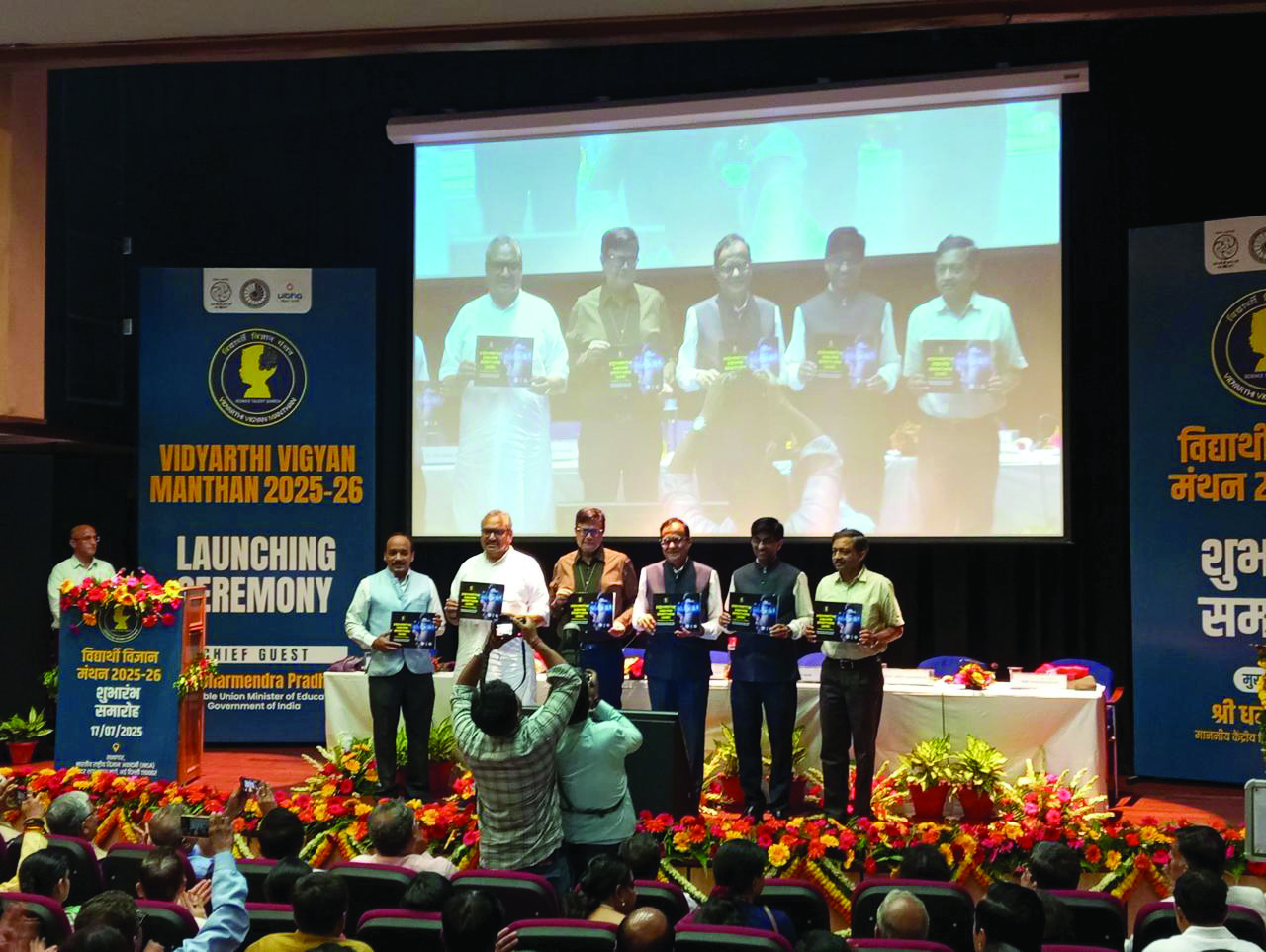
The brochure of Vidyarthi Vigyan Manthan (VVM), a flagship programme of the Vijnana Bharati (Vibha) was launched at the Indian National Science Academy, New Delhi on 17 July.
VVM is an initiative of Vibha, in collaboration with the National Council of Educational Research and Training and National Council of Science Museums. VVM is a national programme for popularising science among school students of standard VI to XI, conceptualised with the intent of identifying “ignited minds”, to use the words of former President of India and celebrated scientist Dr APJ Abdul Kalam, with a scientific aptitude from amongst the student community.
In a video address, Dharmendra Pradhan, Union Minister of Education said, “As our Prime Minister has said young minds are ignited minds, this VVM is exactly about ignited minds. VVM students are working in the footsteps of visionaries. I’m happy to know that 40% of the syllabus of VVM is from Indian Knowledge System”. The minister appealed to the principals and teachers of schools to encourage their students to participate actively in the VVM.
Advising the students, the Principal Scientific Adviser, GoI, Prof Ajay Kumar Sood said science did not mean acquiring PhD only. “It is actually a way of thinking; so, explore and experiment, which you do in these VVM camps”.
Citing PM Narendra Modi’s statement at the Indian Science Congress at Mumbai in 2015 that India must restore pride and prestige of its scientific heritage, Sood said, “We should see how all of us seamlessly align with the vision of the PM. Science should be a part of our DNA.”
Sharing PM’s recent statement that people from any discipline should visit any laboratory, university or college for a day and live as a scientist for a day, Sood added, “This can make science a movement. You should look for women scientists, unsung heroes. There should be a structured programme for school teachers (like VVM). Take teachers to national labs and incubation centres and in turn they will be your ambassadors.”
Sanjay Kumar, secretary, Department of School Education, emphasized that students must get to study science in a local college at the same place from where they did schooling, instead of having to go to a different city or a state.
“All children are born curious but often our education system in schools hampers curiosity among children. But now a good thing is that more students are doing science, especially girls,” he added.
Congratulating Vibha for its VVM initiative, which has reached 20 lakh students, Prof Abhay Karandikar, secretary, Department of Science & Technology (DST) said, “Science should grow organically among students.”
He advised students not to study science only for an examination or a degree; but to know ‘why’ and ‘what’ about science and enjoy it. “Vibha has a solid foundation in science, and it is extremely important to mentor young minds for future, so that we can have a high-quality manpower in science,” he added.
Vivekananda Pai, secretary general, Vibha, presented details about the VVM—its objective, structure and its growth. “The first camp started in Kerala in 1998 and a single exam was conducted. Today VVM is the only examination which is conducted in English and 13 vernacular languages. The international edition of VVM is conducted in the Middle Eastern countries,” he informed.
A few VVM winners were felicitated on the occasion.