


On a humid October afternoon in Hyderabad, a PhD student in the department of civil engineering was deeply focused on a PDF document that resembled a brick wall rather than a window through which she could see. This was the central document of her work on flood resistant infrastructure, but beyond 30 pages of hard to understand equations and very technical English, there were only two or three ideas she really needed. Somewhere else in the city, a school teacher was facing the same paper for quite different reasons. He wanted to explain his students the causes of floods and the engineers’ responses to them, but the language was just as a foreign script for him. A couple of years ago, they might have just given up or made a wild guess. But now, they are going to do something different: they copy the link and paste it into a made in India AI tool called ‘SARAL’ and then the paper is returned as a story that is understandable to them. That very small gesture is exactly how India’s new artificial intelligence ecosystem is slowly, and often silently, changing the rules of scientific research.
FROM SILENT PDFS TO SPEAKING PAPERS: SARAL’S NEW ROLE IN SCIENCE
For a long time now, India’s science system has been running along a certain script. Scientists come up with a plan for an experiment, do the experiment, write an article about it and get it printed in a scientific journal. They let the research community know about it by reading and citing their work. The public, including journalists, civil servants, and regular people around, usually get to know about that science from books, news or policy documents which come out after the original discovery. Artificial intelligence is causing that straight line to start bending into a loop, one where research is not only conducted differently but also read, reused and challenged by a lot more people.
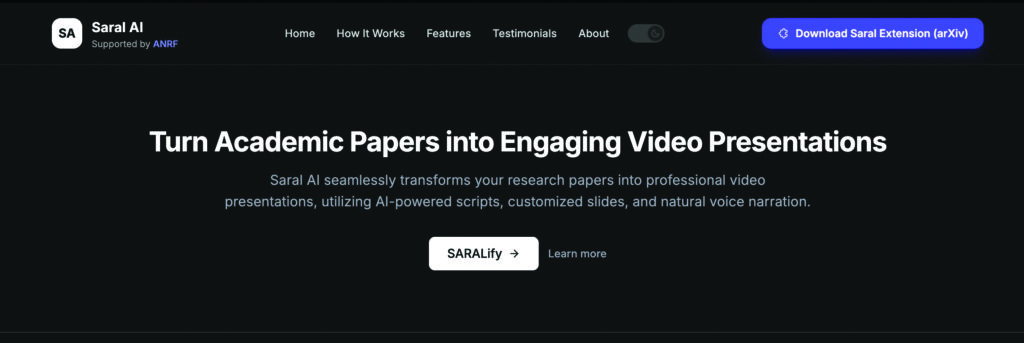
SARAL stands at the very point of change. Its full name, ‘Simplified and Automated Research Amplification and Learning,’ is quite a mouthful, but the underlying concept is disarmingly simple. Pick up a research paper or report. Employ AI to identify its key points. Paraphrase those ideas in common language. Then convert those descriptions into various formats—brief text, visuals, slide presentations, posters in infographic style, audios and videos that can reach people far beyond the university walls. SARAL has been created under the Anusandhan National Research Foundation (ANRF), India’s new main funding agency for research, with the technical side being done by IIIT Hyderabad (International Institute of Information Technology-Hyderabad) and collaborators who are experts in AI for education and communication. ANRF and government releases talk about it as a ‘scientific AI tool’ to make research papers easier to understand for students teachers civil servants and general public, and not only for the top researchers. The platform is hosted at Democratiseresearch.in, a domain name that literally includes their goal meant to be inside the URL: using AI for democratising knowledge rather than just producing more of it.
In official explainers, SARAL is shown taking a single scientific paper and generating a plainlanguage summary, a set of slides, a poster and scripts for short explainer videos or podcasts, all tailored to different audiences. A teacher can request a schoollevel explanation. A civil services aspirant can ask for a policyoriented brief. A researcher can quickly produce outreach material that would otherwise take hours to design. The AI handles the first draft; humans can then tweak and correct it.
WHEN AI BECOMES A SCIENCE COMMUNICATOR: INDIA’S BET ON SARAL
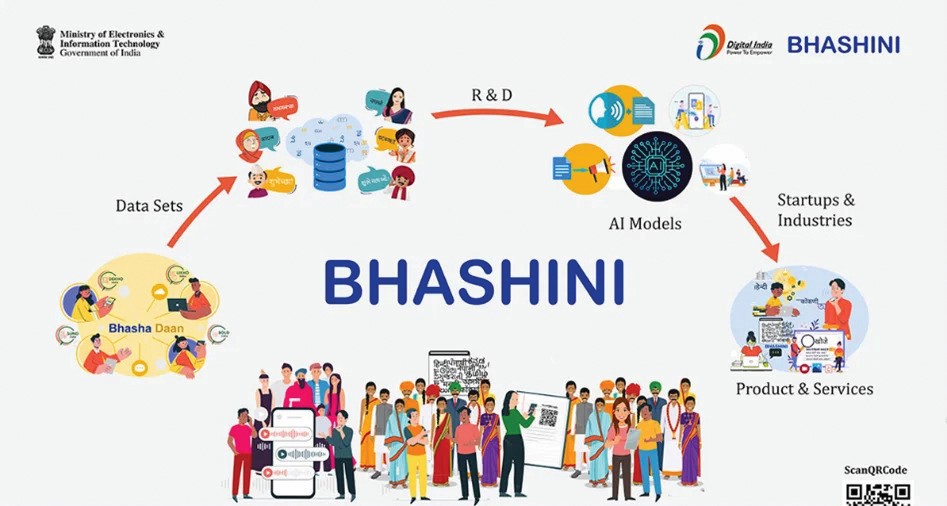
One of SARAL’s most important features, stressed again and again by ANRF and educationfocused briefings, is its multilingual design. India’s research output is dominated by English, but most Indians think, argue and decide in other languages. SARAL is being built to bridge that gap by presenting the same scientific idea in multiple Indian languages, in line with the broader National Language Translation Mission ethos embodied by the government’s Bhashini platform.
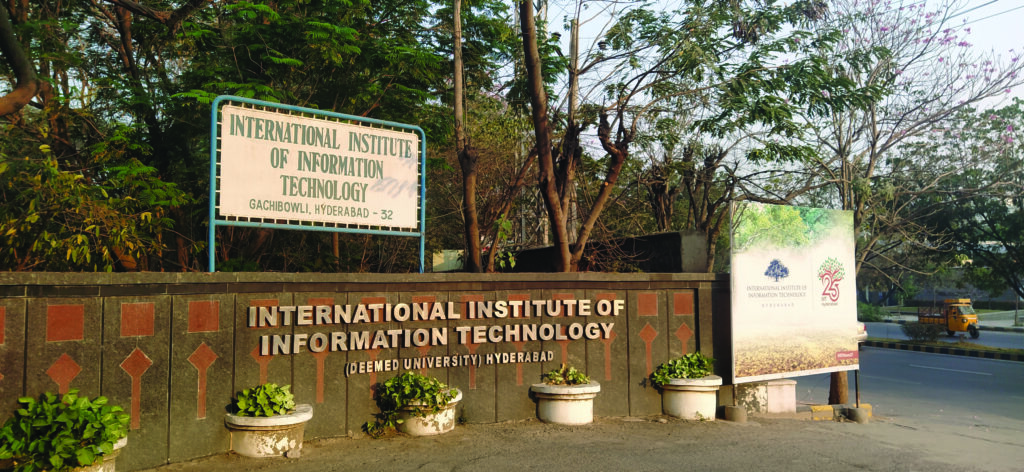
Image Courtesy: Wikimedia Commons
In practice, that means our school teacher can ask for a Hindi or Telugu summary geared to teenagers, while the PhD student can request a more technical explanation in English followed by a short list of possible applications she might build on. The same floodresilience study suddenly has many lives: as a classroom story, a civil services essay, a locallanguage newspaper explainer or a YouTube video that a village panchayat might watch on a shared smartphone.
ANRF’s own communication about SARAL hints at how far this could go. In social posts and public webinars, officials have showcased a browser extension that lets users click on an online paper and automatically generate an AIassisted video summary, complete with script, visuals and voiceover that can be shared on platforms like YouTube or X with minimal extra work from the researcher. Civil services prep sites now describe SARAL as a tool that can turn “complex scientific research papers into easytounderstand summaries and interactive content for students, teachers and competitive exam aspirants”.
India publishes a large amount of scientific work annually, but much of it stays out of reach for non-experts because it is written in complex language and behind subscription walls. SARALs developers say if public funds support research, then public tools should help people access and understand it. They aim to cut down the manual work of simplifying research so scientists and organisations can more easily share knowledge. But giving an AI system a major role in explaining science brings serious concerns. These models don’t truly grasp meaning like humans do; they guess what comes next based on patterns in training data. So they may misunderstand subtle points, skip important warnings, or create false details—this is commonly called hallucination. If such a model delivers summaries to thousands or millions of people, who takes responsibility when the information is inaccurate?
SARALs official plan includes keeping human oversight in place. Government and ANRF documents consistently stress that researchers must review and edit any AI-generated content before releasing it. In the best scenario, the tool acts as a helper, making drafts of slides, notes, or scripts that people then check and adjust, rather than being treated as final truth. It seems hard to ignore that trust still depends on human judgment. At least in theory, this setup reduces the risk of widespread errors.
Even in this bestcase vision, however, something deeper is happening. The act of summarising a paper is also an act of framing it. Which question is presented as central? Which explanation is called ‘main’ and which is tucked away? Which societal impacts are highlighted—economic growth, public health, environmental justice? As more of this initial framing is handled by AI models trained on particular datasets, India’s scientific conversation will inevitably be nudged by the values embedded in those systems.
That is why SARAL is such a revealing character in the story of India’s AI ecosystem. It shows that the country is not only interested in using AI inside laboratories, but also in reshaping the social life of science itself: who gets to read, who feels confident to ask questions, and how quickly new knowledge flows into classrooms, boardrooms and panchayat halls.
BEYOND ONE LAB, ONE LANGUAGE: INDIAN AI TOOLS IN CLASSROOMS, FIELDS AND CLINICS
Step back from that anxious PhD student and tired school teacher, and you find a landscape in which Indianbuilt AI tools are starting to accompany scientific research from the earliest idea to the final application.
At the policy level, this push is being woven together under the IndiaAI Mission, a national programme with a multithousandcrore outlay that explicitly aims to build “sovereign, indigenous AI capability” while “making AI in India and making AI work for India”. The mission is investing in shared computing infrastructure with tens of thousands of highend graphics processing units, national datasets and an innovation centre to develop Indian foundation models such as BharatGen AI. The goal is not just to buy AI tools from abroad, but to create models and platforms that understand Indian languages, data and constraints by design.
Language is one of the clearest examples. Through Bhashini, India has been constructing a public digital platform for AIbased translation and speech technologies that can support multiple Indian languages and dialects. The stated aim of Bhashini is to ensure that access to science, technology and digital services does not depend on proficiency in English, by enabling teaching and research materials to be available both in English and in Indian languages. In practice, this means a researcher in a regional university can increasingly search, annotate and even draft work using tools that know their mother tongue; a student can watch a lecture subtitled or dubbed automatically; a farmer can receive weather and crop advisories in their own language.
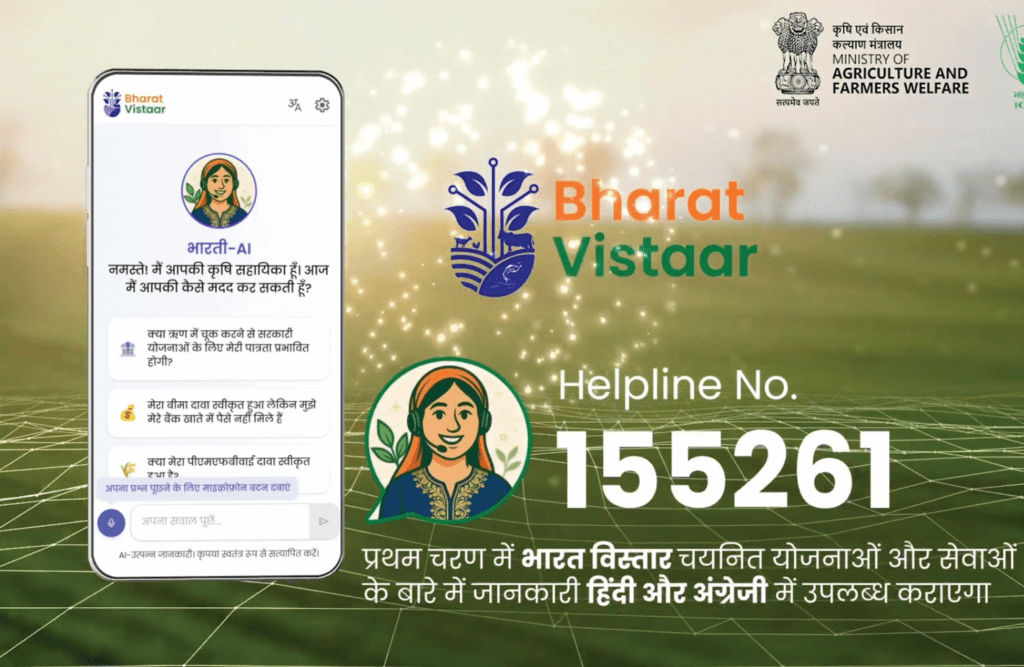
Agriculture is one area where Indian-made AI has already connected research with real-world use. In early 2026, the union agriculture ministry launched Bharat VISTAAR, a multilingual AI platform labelled as digital backbone for smart farming. It combines government-held AgriStack land and farmer data with science from the Indian Council of agricultural Research (ICAR) to offer crop-specific, location-specific guidance in real time, covering sowing dates, fertilizer use, pest control, and market prices. Farmers can call a special number and speak in their native language, and AI responds with clear, doable answers based on proven research. The basis of this straightforward phone call is a full chain of scientific work. Climatologists have created models for rainfall patterns, soil types, and how crops react. ICAR scientists have recorded local best practices for each crop and region. Engineers developed AI tools that pull together this knowledge with live inputs and reply in natural language. The outcome isn’t just a new farming tool, but a new way scientific findings move from journals to actual farms.
International partnerships are backing the domestic initiatives of countries to a great extent. For instance, in 2026, Google DeepMind announced that it was collaborating with government agencies and educational institutions in India to grant their scientists, among others, access to models such as Earth AI for climate science and AlphaGenome for biology, which are expected to enhance discovery by revealing patterns that humans may not perceive.
Meanwhile, DeepMind and Google are partnering with Indian education programmes to introduce generative AI and robotics in thousands of schools, thus transforming traditional STEM lessons into AI-assisted interactive explorations. Connect these dots, and you get a scenario. Firstly, in climate labs, scientists are turning to AI models for analysing satellite data and forecasting extreme weather events. Secondly, Indian made and modified AI systems are complementing the work of doctors in hospitals by helping them in the interpretation of medical images and prioritizing patients. Thirdly, in physics and chemistry, there are foundation models that have been trained on scientific data and therefore are capable of generating hypotheses and suggesting new experiments at a speed that is greater than human ability. In fact, in all situations, it is the scientists who remain the focal point but alongside their ‘brains’, or the means through which they think, are now AI systems that are capable of searching, synthesising, and simulating at a pace of a machine.
COPILOTS FOR DISCOVERY: HOW HOMEGROWN AI COULD SHAPE THE FUTURE OF INDIAN RESEARCH
What might all this mean for the future of scientific research in India?
One natural option that comes to mind is speed. In case AI systems become capable of performing the majority of routine tasks such as cleaning datasets, combing through literature, preparing preliminary versions of code, or analysis, researchers will have more time left for work related to conceptual questions and experimental design. Some initial pilot projects and worldwide studies indicate that this type of AI co-pilot can quite drastically increase the productivity of coding and writing. Moreover, India’s DeepMind partnerships and domestic model development are targeted at scientific reasoning and discovery, along with coding and writing.
Besides that, inclusion is another major benefit. Technologies like SARAL and Bhashini, along with Bharat VISTAAR platform, are designed with the express purpose of getting those who have been left out of scientific communication for different reasons: non-metro college students, farmers’ frontline health workers, civil servants in small town areas. These people if given an opportunity to access scientific knowledge in their own languages and formats, might change scientific discourse in India to a much less top down one.
Yet the same forces could well bring in new vulnerabilities. Reliance on AI models for literature search, data analysis or explanation may lead to young scientists losing out on developing deep reading and critical thinking, habits that older generations had no choice but to cultivate. Inaccurate or biased training data—such as those containing an over representation of certain regions, languages or problem types over others—might silently determine which questions are being raised and which ones are overlooked. Placing an overly trusting reliance on AI generated summaries might facilitate the circulation of flawed or even fraudulent research before anyone has even read the original work.
These are not reasons to exclude AI from research altogether. On the contrary, they are reasons why we should treat these tools in the same way that good scientists treat every instrument: with curiosity, rigour and a willingness to calibrate. Microscopes transformed the things biologists could see, but they also led to artefacts which had to be learned and corrected. Similarly, AI will probably bring about changes, but what really changes most by a large extent is the mindset.
The student who has understood a scientific paper with the help of a clear verbal explanation in her own language is not going to see a new scientific paper in PDF format and think that the only problem is her lack of intelligence anymore. They will probably feel that the writing might be the problem. The policymaker who has already got what a new climate model is about through an AI summary will most likely agree that it is worth his time to read the entire document. The farmer who has got a helpful AI-generated piece of advice connected directly to ICAR’s research will think that agricultural science is something which talks to him and not at him. Therefore, the new AI ecosystem in India is not only about machines that think faster but also about millions of humans who might, for the first time, experience science as if it were speaking their language.
*The writer is Senior Project Associate – Content Development, Science Media Communication Cell, CSIR-NIScPR.