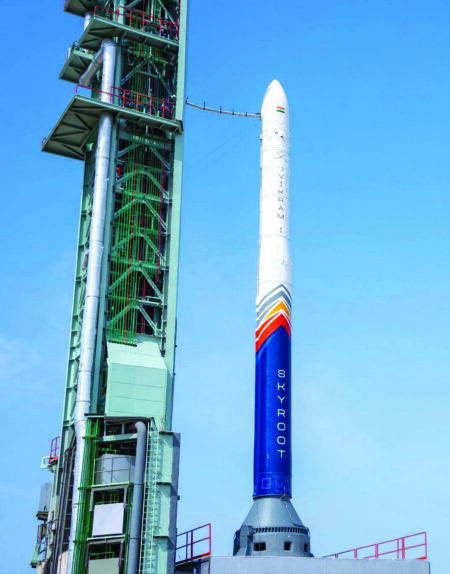




The recent India AI Summit held in New Delhi has generated widespread interest across the country, particularly among students and young professionals. The discussions around indigenous AI platforms, emerging applications, and future possibilities have created a strong sense of excitement. For many, it marks a shift in perception, with India moving from being largely a user of artificial intelligence to becoming an active contributor.
At the same time, this visibility has brought a new set of questions into homes, classrooms, and workplaces. Students are trying to understand what this means for their future. Parents are wondering how to guide their children. Educators are rethinking what they should teach and how learning should be evaluated. Job seekers are questioning whether the skills they possess today will remain relevant in the years ahead.
Alongside this curiosity, there is also confusion. A large amount of information about artificial intelligence is now circulating through social media, coaching platforms, and informal channels. Much of it is incomplete and sometimes misleading. Simplistic claims about AI-proof careers or guaranteed job paths are often made without clearly understanding how technology interacts with different types of work. This makes it difficult for individuals to take informed decisions about education, skills, and career choices.
Another important question is being asked. What are the opportunities within artificial intelligence itself? The rapid expansion of AI-related courses has created the impression that everyone must move into this field. This assumption needs to be examined carefully. Not every individual needs to become an AI specialist. What is needed instead is a clearer understanding of how AI interacts with different kinds of work and where meaningful opportunities lie. This article attempts to provide that clarity. It does so by looking at how work is actually changing.
UNDERSTANDING THE NATURE OF CHANGE
Discussions on AI and employment often move between two extremes. One view predicts large-scale job losses, while the other suggests that AI will create entirely new opportunities. Neither captures the full picture.
AI does not replace entire professions in most cases. It affects specific tasks within them. Almost every profession consists of a mix of activities. Some are routine and predictable, while others require judgment, creativity, and human interaction. AI is effective at handling structured tasks, but still struggles with context, uncertainty, and human situations.
Global studies have consistently shown that while many work activities can be automated, only a smaller proportion of occupations are likely to disappear completely. The future of work will therefore involve humans and machines working together rather than machines replacing humans.
Understanding which human capabilities remain difficult to automate is central to thinking about future careers.
The Scale and Direction of Change
While much of the discussion on artificial intelligence remains general, it is now clear that its impact is widespread. Almost every profession is likely to experience some degree of change, not because entire jobs will disappear, but because many of the tasks within them will be handled differently.
It is important to understand that this change is uneven. Work that involves routine processing of information, especially on computers, is being affected more rapidly. On the other hand, work that involves human interaction, physical activity, or decision-making in uncertain situations is changing more slowly. This explains why some professions appear more stable while others seem more vulnerable.
At the same time, the situation is not as alarming as it is sometimes portrayed. Most professions will continue to exist, but the way work is done within them will evolve. Skills that people already possess will not become irrelevant overnight. Instead, they will need to be applied differently, often with the support of AI tools.
There is also a positive side that is often overlooked. As certain types of work become automated, new kinds of roles are emerging. These may not always have familiar names, but they exist at the intersection of knowledge, technology, and application. This is particularly visible in science and engineering, where individuals are increasingly expected to combine domain knowledge with the ability to work with data and intelligent systems.
For students, teachers, and parents, the message is therefore balanced. The future is not about losing opportunities, but about understanding how they are changing. The real challenge is not to predict which jobs will disappear, but to prepare for a world where the nature of work itself is evolving.
A PRACTICAL CLASSIFICATION OF PROFESSIONS
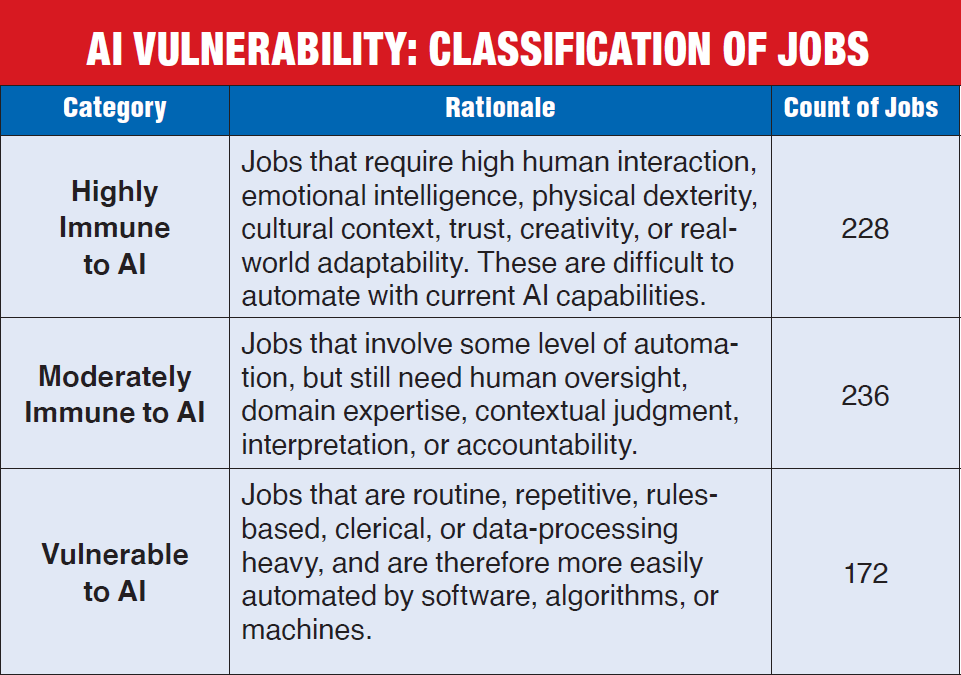
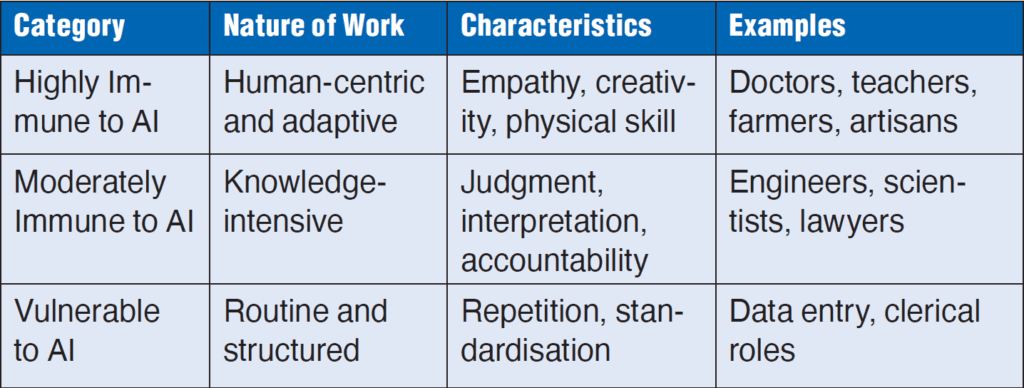
To understand these patterns more clearly, more than 600 professions were examined and classified into three broad categories based on how they are likely to respond to AI.
PROFESSIONS HIGHLY IMMUNE TO AI
Professions in this category depend on capabilities that are difficult to replicate through algorithms. These include empathy, trust, creativity, and physical skill in unpredictable environments.
Healthcare provides a clear example. Doctors, nurses, physiotherapists, and caregivers rely not only on knowledge but also on human interaction and trust. Decisions are often made with incomplete information and require professional judgment shaped by experience.
Education is another example. AI can assist in delivering content, but teaching involves motivating students, understanding individual differences, and shaping how they think.
Skilled trades such as electricians, plumbers, carpenters, and mechanics also fall into this category. Their work involves real-world problem-solving in constantly changing conditions.
Many occupations rooted in community life are equally resilient. Farmers, gardeners, chefs, artisans, musicians, and sports coaches rely heavily on creativity and human connection.
PROFESSIONS MODERATELY IMMUNE TO AI
This category includes professions where AI serves as a powerful tool but cannot replace human expertise.
Scientists, engineers, lawyers, accountants, and administrators fall into this group. AI can assist by analysing data, generating insights, or identifying patterns, but human reasoning and accountability remain essential.
In engineering, AI supports simulation and optimisation, but engineers make decisions about safety and design. In law, AI assists with research, but interpretation remains human. In finance, automation handles routine processes, while professionals focus on analysis and decision-making.
In research, AI accelerates data processing, but the formulation of questions and interpretation of results depend on human insight.
PROFESSIONS VULNERABLE TO AI
Jobs involving repetitive and rule-based processes are more susceptible to automation.
Data entry, clerical work, telemarketing, and routine transaction processing are typical examples. Activities such as maintaining records or handling standardised processes can increasingly be performed by automated systems.
In scientific environments, similar shifts are visible. Routine data logging, preliminary analysis, and standard reporting are being automated.
Consider a research assistant in a laboratory. Tasks that once required manual effort can now be performed by AI-enabled tools. However, the role evolves. The individual is expected to ensure data quality, interpret results, and contribute to improving experimental design.
Automation reduces routine work but creates opportunities for more meaningful roles.
WHAT MAKES A PROFESSION RESILIENT?
A clear pattern emerges. Professions that involve human interaction, creativity, adaptability, and complex decision-making are more resilient. Those based on repetition and predictability are more vulnerable.
This reflects a broader principle. Technology automates what is repetitive and enhances what is complex. Human capabilities such as empathy, creativity, and judgment therefore become more valuable.
The future will not reward those who do the same work faster, but those who understand their work more deeply.
IMPLICATIONS FOR EDUCATION
These changes require a shift in how education is approached.
Marks and grades capture only a small part of what matters. Skills such as problem-solving, communication, creativity, and adaptability are becoming increasingly important. Educational systems need to move towards project-based learning and real-world problem-solving.
Students must be encouraged to think independently rather than simply follow procedures. The ability to learn continuously and adapt will be a key determinant of success.
THE EMERGING LANDSCAPE OF AI CAREERS
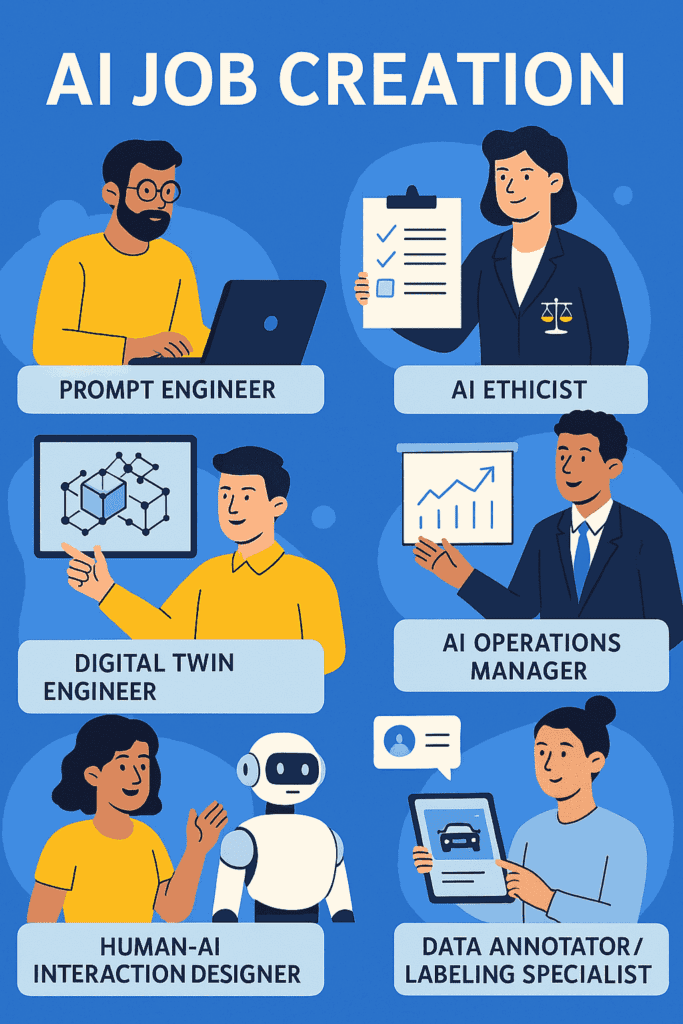
While much of the discussion focuses on how AI affects existing professions, it is equally important to recognise that it is also creating new roles.
There is a growing need for professionals who can work at the interface of domain knowledge and AI. In areas such as environmental science, materials research, and biotechnology, AI is being used for modelling and analysis.
Roles related to data quality, validation, and governance are also becoming important. AI systems depend heavily on data, and ensuring that datasets are accurate and unbiased is critical.
New roles are also emerging in areas such as AI ethics, policy, and system oversight. Professionals who can translate AI outputs into actionable decisions will play an important role.
The future is therefore not about choosing between traditional and AI careers, but about identifying opportunities at the intersection of disciplines.
PREPARING FOR THE FUTURE
The key question is not which career is safe, but how one prepares.
In scientific environments, AI tools can process data and identify patterns. The advantage now lies in asking meaningful questions, designing experiments, and interpreting results.
Students should be exposed to situations where they must make decisions rather than simply follow instructions. In engineering, the focus should shift from tools to understanding systems and evaluating outputs.
Interdisciplinary thinking is increasingly important. Many challenges require integration across domains. Professionals who can connect knowledge from different fields will be better positioned.
Another important aspect is intellectual independence. As AI tools become more powerful, there is a tendency to rely on them without scrutiny. The ability to question results and verify assumptions will remain essential.
Preparing for the future is therefore about developing the ability to think clearly, adapt continuously, and use technology responsibly.
A NOTE ON THE SPEED OF CHANGE
One aspect that deserves attention is the speed at which these changes are unfolding. Unlike earlier technological shifts, where transitions took decades, AI-driven changes are occurring within a few years. This makes it difficult for individuals and institutions to respond at the same pace. However, it also creates an opportunity. Those who recognise early signals, adapt their skills, and remain open to continuous learning will be better positioned than those who wait for certainty before acting.
CONCLUSION
As AI becomes more integrated into decision-making, issues of ethics, fairness, and accountability will become increasingly important. Professionals will be expected to ensure that these technologies are used responsibly.
The age of artificial intelligence is not an era of job loss. It is an era of transformation. The future of careers will not be decided by AI alone, but by how we respond to it.
Let us not worry about the future. Let us prepare for it with clarity and confidence.
*The writer is the ANRF Prime Minister Professor at COEP Technological University, Pune.