



A MESSAGE THAT MARKED A MOMENT
On 6 April 2026, a quiet scientific milestone found a powerful national voice. Reflecting on the achievement of Prototype Fast Breeder Reactor (PFBR) at Kalpakkam, Prime Minister Narendra Modi wrote:
“Today, India takes a defining step in its civil nuclear journey, advancing the second stage of its nuclear programme. The indigenously designed and built Prototype Fast Breeder Reactor at Kalpakkam has attained criticality. This advanced reactor, capable of producing more fuel than it consumes, reflects the depth of our scientific capability…A proud moment for India.”
These words do not merely celebrate an event; they crystallise a journey. What unfolded at Kalpakkam was not a sudden breakthrough, but the result of decades of disciplined scientific work, institutional continuity, and national commitment. Generations of scientists, engineers, technicians, and policymakers contributed to this moment—often away from public attention, but always aligned with a long-term vision.
In scientific terms, the reactor attained criticality—the point at which a sustained chain reaction begins. In strategic terms, India demonstrated that it has entered a phase where it can not only use nuclear fuel, but begin to multiply and extend it.
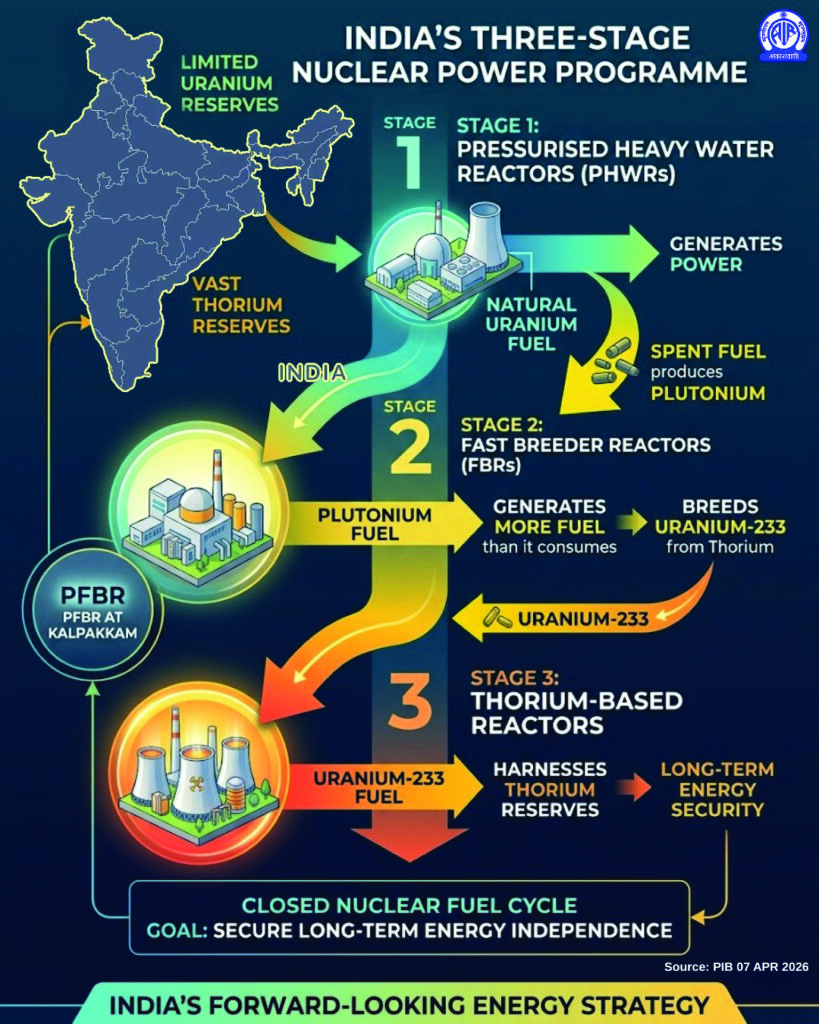
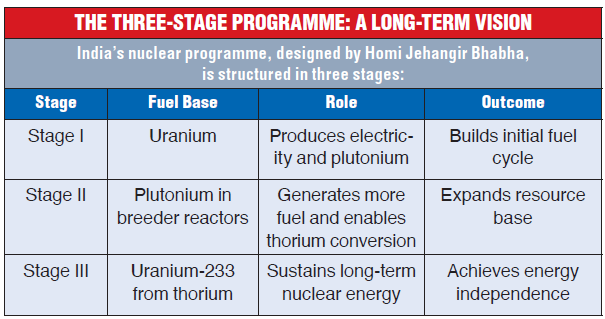
This milestone reflects the foresight of Homi Jehangir Bhabha, who envisioned a programme rooted in India’s unique resource profile. His approach was not reactive—it was anticipatory. It recognised that while India’s uranium reserves were modest, its thorium reserves were among the largest in the world.
The significance of this moment lies in what it enables. From using fuel, India moves to creating it. From resource limitation, India moves to resource expansion.
THE INVISIBLE FIRE AND THE
DISCIPLINE OF CONTROL
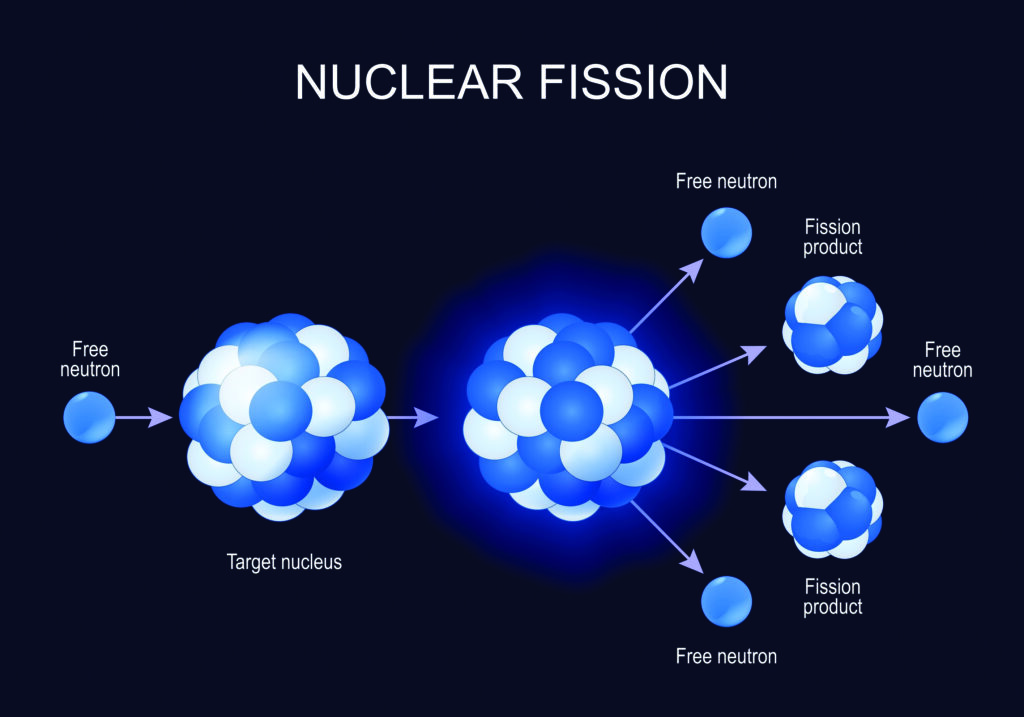
Nuclear energy is often described in terms of power, but its true essence lies in control. At its core is nuclear fission—the splitting of atomic nuclei, releasing heat and neutrons. Yet, the challenge is not in initiating this process, but in sustaining it safely over long periods.
Within a reactor system:
- Heat generated from fission is transferred to a coolant
- This heat produces steam in a secondary system
- Steam drives turbines connected to generators
- Electricity is transmitted to the grid
While the mechanical systems resemble conventional power plants, the source of energy is fundamentally different. Nuclear energy does not rely on combustion. It draws from the binding energy within atomic nuclei.
This results in several important characteristics:
- High energy density, allowing large-scale generation from minimal fuel
- Near-zero operational greenhouse gas emissions, supporting environmental sustainability
- Continuous operation, independent of weather conditions
In the context of India’s growing energy demand—driven by industrialisation, urbanisation, and digital expansion—such reliability is essential. Renewable energy sources are expanding rapidly, but their variability requires a stable counterpart. Nuclear energy provides that stability. It is not a replacement for renewables, but a complement that strengthens the entire energy system.
CRITICALITY: THE QUIET BEGINNING OF POWER
Criticality represents a state of balance. When a reactor reaches criticality, the nuclear chain reaction sustains itself. Each fission event produces just enough neutrons to maintain continuity. This balance ensures that the system operates steadily without external intervention. However, achieving criticality is only the first step. What follows is a carefully controlled progression:
- Reactor power is increased gradually
- Thermal and mechanical systems are activated step by step
- Continuous monitoring ensures operational stability
- Turbines begin to operate under controlled conditions
- Electricity generation stabilises before grid integration
This reflects the inherently controlled nature of nuclear reactor operations. Once connected to the grid, the reactor becomes part of the national energy system. Its operation is continuous, predictable, and largely invisible—yet it supports the visible growth of the economy.
FISSILE AND FERTILE MATERIALS: THE SCIENTIFIC FOUNDATION
At the core of nuclear energy lies an important distinction between fissile and fertile materials. Fissile materials, such as uranium-235 and plutonium-239, can directly sustain a nuclear chain reaction and produce energy. Fertile materials, like uranium-238 and thorium-232, cannot do so on their own, but can be converted into fissile isotopes through neutron absorption followed by radioactive decay within suitable reactor environments. This difference is central to how nuclear systems are designed.
India’s resource profile makes this distinction especially significant: Limited fissile uranium and Abundant fertile thorium. Instead of treating this as a limitation, India has built a strategy around it. The focus is on converting fertile material into usable fuel, thereby expanding the overall resource base. This approach requires advanced reactor environments and fuel cycle technologies, including reprocessing and recycling. Over time, it allows nuclear energy to move beyond a consumption model toward a more sustainable and progressively self-sustaining nuclear energy system. In this framework, thorium becomes more than a resource—it becomes the foundation for India’s long-term energy security.
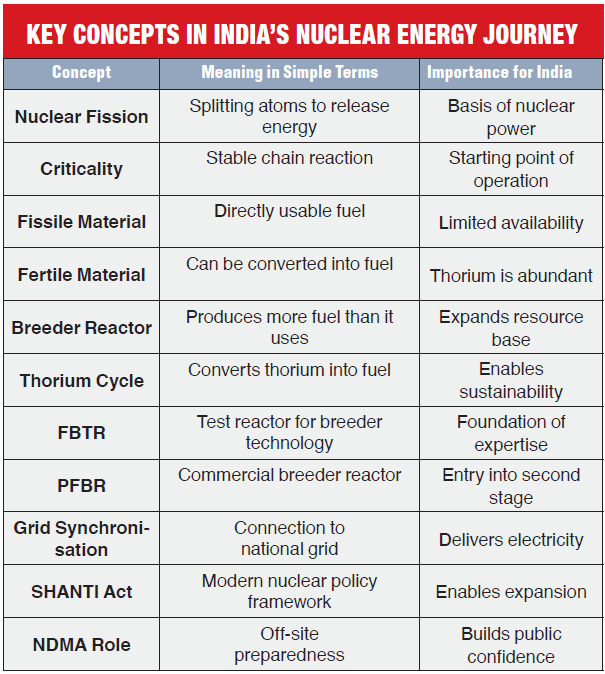
This programme follows a carefully sequenced, long-term strategy for sustainability. India’s breeder reactor journey began with the Fast Breeder Test Reactor (FBTR) at Kalpakkam, developed by the Indira Gandhi Centre for Atomic Research. Construction commenced in 1972, structural work was completed by 1977, and major components were installed by 1984. The reactor achieved first criticality on 18 October 1985, marking a key milestone in India’s indigenous nuclear energy programme.
For decades, FBTR served as a crucial experimental platform, validating theoretical models under real reactor conditions. It enabled scientists and engineers to study fast neutron behaviour, develop advanced mixed carbide fuels, a distinctive feature of India’s fast reactor programme, and gain hands-on experience with sodium-cooled reactor systems—requiring exceptional precision and stringent safety protocols due to sodium’s high reactivity with air and water.
Equally important, FBTR helped build long-term operational confidence, allowing teams to study system behaviour over extended periods. Building on this foundation, the Prototype Fast Breeder Reactor (PFBR) was developed by Bharatiya Nabhikiya Vidyut Nigam Limited (BHAVINI). PFBR represents the transition from experimentation to application. It demonstrates that breeder technology can operate safely and reliably at a commercial scale, producing significant electrical power while also expanding fuel resources.
This progression reflects a systematic and mature approach—learning first, validating next, and scaling with confidence.
BREEDER REACTORS: EXTENDING THE FUEL HORIZON
Breeder reactors are designed not just to generate energy, but to expand the available fuel base. Within these systems:
- Fissile material produces energy through fission
- Fertile material absorbs neutrons
- New fissile material is gradually formed
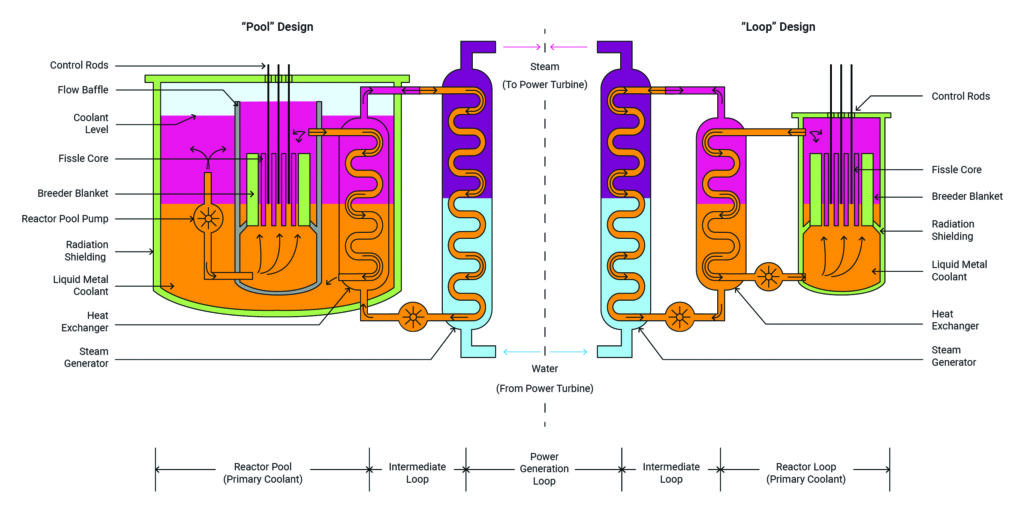
Image Courtesy: Wikimedia
This process increases the availability of nuclear fuel over time, effectively multiplying the resource base. It transforms nuclear energy from a finite system into one that can sustain itself over longer durations. For India, this capability is critical. It reduces dependence on fresh uranium supplies and ensures that energy generation is not constrained by initial resource limitations. Over time, it strengthens both energy security and strategic autonomy.
THORIUM: FROM RESOURCE TO RESPONSIBILITY
Thorium represents one of India’s most significant long-term energy assets. Although it cannot be used directly as fuel, it can be converted into uranium-233 within reactor systems. This transformation enables thorium to participate in sustained nuclear energy generation.
The implications are far-reaching: energy systems align closely with domestic resource availability, and planning horizons extend across generations rather than decades. Thorium thus moves beyond being a passive resource. It becomes a strategic responsibility—requiring sustained research, careful technological development, and long-term policy support to fully realise its potential.
FROM REACTOR TO GRID: THE FINAL TRANSFORMATION
The transition from reactor to grid represents the final and most visible step in the energy cycle. This process requires:
- Matching voltage and frequency with grid standards
- Ensuring stability under varying load conditions
- Synchronising with a large and complex national power network
Only after these conditions are met is the reactor connected to the grid.
Once integrated, nuclear energy begins to flow across the country, supporting multiple sectors—industry, agriculture, healthcare, and digital infrastructure. It provides steady and reliable electricity that underpins economic growth and societal development.
At this stage, the transformation is complete: energy released from atomic interactions becomes a continuous national resource, powering everyday life while remaining largely unseen.
SHANTI ACT: ALIGNING POLICY WITH POSSIBILITY
The SHANTI Act (Sustainable Harnessing and Advancement of Nuclear Energy for Transforming India Act, 2025) provides a modern and forward-looking framework for India’s nuclear development. It reflects an important realisation—that scientific capability must be supported by an equally robust institutional and legal structure.
The Act introduces several key enablers:
- It opens the sector to participation by capable Indian private entities, accelerating capacity addition while retaining sovereign control over sensitive areas
- It aligns liability frameworks with global standards, reducing uncertainty and encouraging investment
- It strengthens regulatory oversight by enhancing the role and independence of the nuclear regulator
- It supports the adoption of advanced technologies, including next-generation and modular reactors
- It streamlines project implementation by reducing procedural delays and creating a unified framework
Taken together, these measures create an ecosystem where innovation, investment, and safety can coexist. The SHANTI Act ensures that India’s nuclear ambitions—particularly the transition toward breeder and thorium-based systems—are supported by institutional readiness and policy clarity, enabling large-scale and sustained deployment.
NDMA: SAFETY AS PUBLIC CONFIDENCE
Beyond reactor design, nuclear safety extends to robust off-site emergency preparedness under the national nuclear emergency response framework. It must also be visible, understood, and trusted by society. The National Disaster Management Authority (NDMA) ensures preparedness beyond reactor boundaries through a structured approach to off-site emergency management. Its work includes:
• Developing coordinated response plans with state and district authorities
• Conducting regular mock drills involving local communities
• Establishing clear communication systems for timely information
• Building awareness and preparedness among the public
These efforts ensure that safety is not confined to the plant, but extends to the surrounding regions. In doing so, NDMA transforms safety from a technical feature into a societal assurance. Confidence in nuclear energy, therefore, is not only engineered—it is built through transparency, preparedness, and continuous engagement.
INDIA’S PATH IN A GLOBAL CONTEXT
India’s nuclear strategy stands apart in its long-term orientation. While many countries have built their programmes primarily around uranium-based fuel cycles, India has chosen to integrate thorium into its future pathway.
This approach reflects a deliberate alignment between resource availability and technological design. Globally:
- Advanced economies continue to rely largely on uranium
- Some nations are exploring breeder technologies, but at varying scales
- Interest in alternative fuel cycles is growing, but remains limited
India’s programme, by contrast, is structured to transition systematically from uranium to plutonium and eventually to thorium. This makes it not only distinct, but also forward-looking.
CHALLENGES THAT STRENGTHEN SYSTEMS
The pathway to a thorium-based nuclear system is complex and demanding. It requires sustained effort across multiple dimensions:
- Development of advanced reactor technologies and fuel cycles
- Long-term investment in infrastructure and research
- Continuous learning through experimentation and operation
- Strong regulatory and institutional frameworks
These challenges are not obstacles—they are part of the process that strengthens the system.
Institutions such as Bhabha Atomic Research Centre (BARC) have played a central role in building this capability over decades. Their work reflects continuity, discipline, and a commitment to long-term national goals.
In this sense, the journey contributes to strengthening technological and institutional capability.
FROM BREEDING TO BELONGING
India’s nuclear journey reflects a deeper transformation in thinking. Energy is no longer viewed as a limited resource to be consumed. It is understood as a system that can be created, expanded, and sustained through scientific design and technological capability.
Breeder reactors enable the creation of new fuel. Thorium enables long-term continuity. Together, they redefine the nature of energy systems.
Breeding represents the scientific process through which resources are expanded. Belonging represents the stage at which energy systems align fully with national resources and aspirations. This transition is not merely technical—it is conceptual. It reflects a movement from dependence toward self-sustained capability.
CONCLUSION: A FUTURE DEFINED BY CONTINUITY
The achievement at Kalpakkam demonstrates a strong alignment between scientific effort, policy direction, and national vision. From early reactor milestones to expanded fuel capabilities, and from research settings to large-scale power generation, India’s nuclear programme shows steady, purposeful progress. This evolution is driven by technical expertise, disciplined execution, institutional stability, and sustained policy support.
Together, these forces are shaping a future that is sustainable, secure, and self-reliant—one that is not only powered, but thoughtfully developed and firmly under the nation’s control.
*The writer is Member, National Disaster Management Authority (GoI) and Former Director, Healthy, Safety and Environment Group at BARC.