




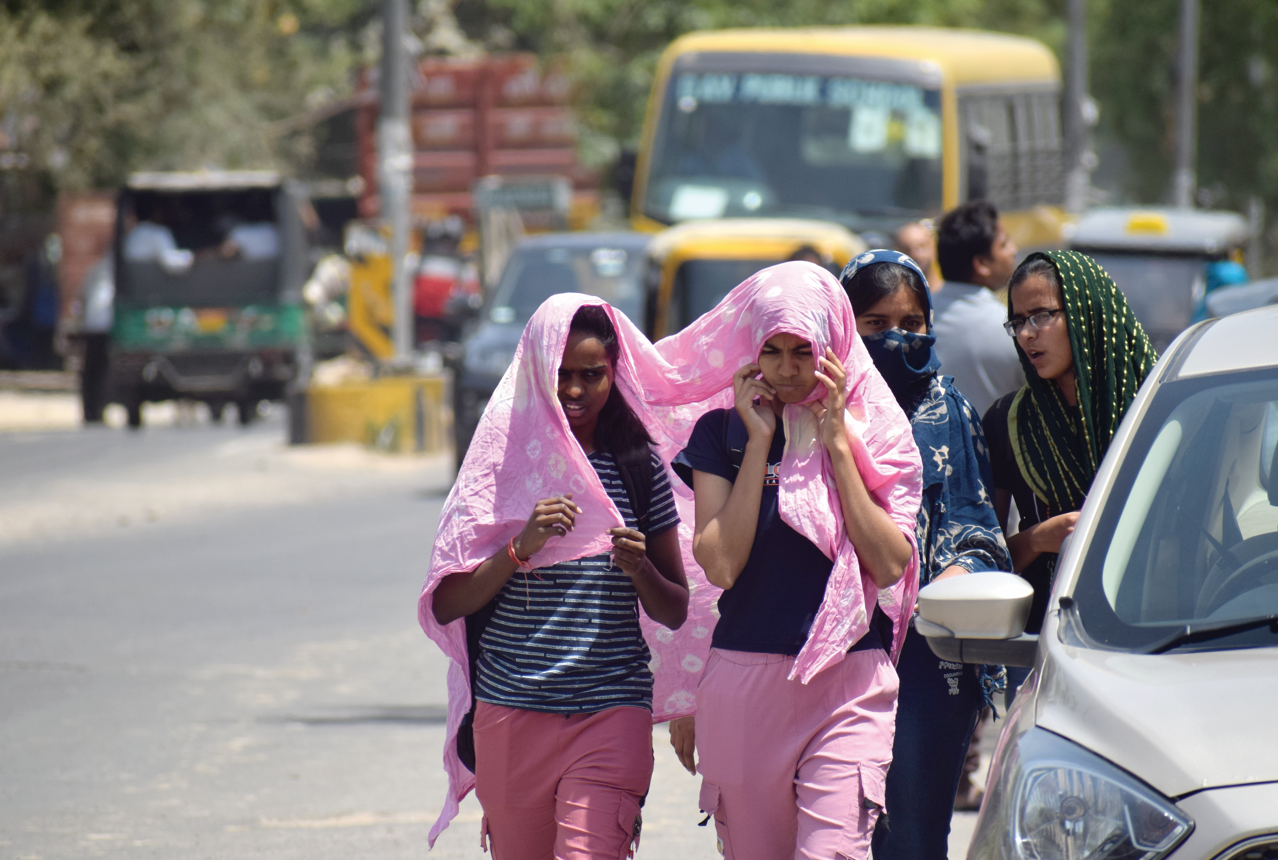
Deadly heat extremes kill 4,89,000 people annually, 45% of whom are from Asia (WHO). World Meteorological Organization (WMO) confirmed that the period from 2015 to 2025 witnessed the eleven (11) hottest years from the climatological records. Prolonged heatwave conditions in the year 2025 were observed across the world such as in Italy, Switzerland, Serbia, the Nordic regions and China. WMO statistics reveal that the heatwave duration was around 70 days in the year 2022 over China, and India’s heatwaves occurrence due to climate change increased to 30 times in 2022, and in the year 2018, more than 228 million people were exposed to heatwaves globally.
Banda of Bundelkhand region of India emerged as a manmade heat island with temperatures soaring above 47°C in the month of May 2026 and the National Capital Region of India (the Delhi NCR) is vulnerable to heatwave conditions and continues to receive heatwave alerts with temperatures more than 40°C frequently during summer.
The number of heatwave affected states in India increased to 23 by the year 2020 and the average heatwave occurrence days have reached around 32 in the year 2019 (National Disaster Management Authority (NDMA)). Global warming and climate change are resulting in increased annual warming across the globe, and this temperature rise has crossed 1.5°C in the year 2024. The general circulation models show a rise of 4 to 5°C by the end of the 21st century if no policies for the mitigation of climate change are adapted.
India is not an exception to the impacts of global warming and climate change, experiencing severe weather and climate extremes every year including heatwaves. Land locked regions affected with high temperatures leading to heatwave conditions while the coastal regions experience the combined effect of high temperature and humidity, which is another threat to the human environment. Despite the health effects due to heat waves and heat stress conditions, there will be a decline in the work performance of people up to 35% who are working in open areas such as construction laborers and agricultural people by the end of the 21st century.
The India Meteorological Department (IMD) defines heatwave as the minimum of two days with the maximum temperature more than 40°C over the plains and 30°C over hilly areas. Depending on the anomaly of the temperature from the maximum, the heatwaves are classified as heatwaves and severe heatwaves. The IMD also defines warm nights, and very warm nights based on the rise in minimum temperatures which are also considered as part of heatwave. The IMD predicts heatwaves based on the regional and global numerical weather prediction models, and analysis of meteorological parameters within 1000 to 2000 km scale. The indications of heat extremes are the hot humid conditions where the relative humidity also plays a role in enhancing the heat stress and warm nights.
The health impacts of heatwaves include heat cramps, fatigue, dizziness and heat strokes. In India, the IMD issues daily impact-based heatwave warnings, extended forecasts for two weeks and monthly heatwave outlooks for the benefit of people. The Ministry of Earth Sciences (MoES), Govt of India, established an institute, the National Centre for Medium Range Weather Forecasting (NCMRWF) located in Noida, Delhi NCR, which provides a deterministic prediction of heat index for Indian region using high-resolution global climate simulations. One can find these predictions based on different categories of heat index such as caution, extreme caution, danger and extreme danger over different areas of India. The Indian Space Research Organization (ISRO) has also developed experimental methodologies for heatwave prediction using regional forecasting models and is providing its forecast through the website of Meteorological and Oceanographic Satellite Data Archival Centre (MOSDAC). Many researchers in India are working on heat wave research and finding hotspots of heatwaves, future heatwave occurrences and their impact on human health using general circulation models.
Heatwave guidance is made available to the public in order to bring awareness on heatwaves and to beat heatwaves efficiently. A few points worth noting in this context are:
(i) Avoid roaming outside from 12 noon to 4 pm during heatwave conditions. This is because the Earth receives intense solar radiation during mid-noon and records its maximum temperature between 1 pm to 3 pm due to its outgoing longwave radiation.
(ii) People must take proper rest while doing heavy and very heavy work, particularly if working in open environments, and indoor environments without any thermal neutralities, the research shows that an additional 15 minutes of rest is required per hour for those who work outside
(iii) People should follow authenticated forecast on heatwaves as many unauthorised agencies may mislead the actual information
(iv) People should wear loose clothes, preferably cotton to get more ventilation for the air, which can reduce physiological stress
(v) Hydrate the body frequently, and
(vi) Carry the kit containing the water bottle, umbrella, and a cap while going outside. If there are any symptoms of unconsciousness or above, it is recommended to consult a doctor and follow their advice.
As India has rich traditional knowledge roots spanning millennia in the fields of Ayurveda, Yoga, etc., there are a few traditional practices that can be carried out at home to help face the dangerous conditions of heatwaves, particularly while consuming daily food. With great efforts and research, the Ministry of Ayush issued the heatwave advisory in terms of dietary practices. The advisory includes:
(i) Eat light, easy-to-digest meals before leaving for outside and avoid oily foods.
(ii) Consume beverages such as buttermilk, coconut water, lemon mixed drinks
(iii) Use of khus (vetiver), sariva (Indian sarsaparilla), jeera (cumin), and dhanyaka(coriander seeds) as ingredients that can cool the body
(iv) Use sattu based refreshments added with the jaggery
(v) Include bael sharbat, cucumber, and watermelon in daily routine.
(vi) Sheetali pranayama, one of the breathing techniques of Yoga is advised for the thermal comfort of body.
A nap during the peak hours of heat can also increase the energy levels of body. Applying medicinal pastes made from sandalwood and vetriver on the skin can help safeguard from the hot Sun. It is also reported that during the summer months, the amlapitta becomes more common and hence to balance this, Ayurveda advises food that cools the body but this does not include chilled drinks. It is also advised not to consume spicy tea, sour curd, too much of garlic and chillis during the summers.
Overall, the occurrence of heatwave will continue to increase in future as an impact of climate change. Measures to protect humans, livestock and environment ought to be adapted. Onus also lies on us to discover and invent solutions that can mitigate the impact of climate change which will eventually lead to minimum occurrence of extreme hot situations.
*Lakshmi Kumar T V is Associate Professor, School of Environmental Sciences, Jawaharlal Nehru University (JNU), New Delhi; Manish K Kashyap is Professor, School of Physical Sciences, JNU; Atul Kumar is Professor, Centre for the Study of the World Economy, School of International Studies, JNU; and Sumit Kumar Mishra is Principal Scientist, CSIR-National Physical Laboratory, New Delhi.