


Image Courtesy: NASA
INTERNATIONAL ASTEROID DAY/ 30 JUNE
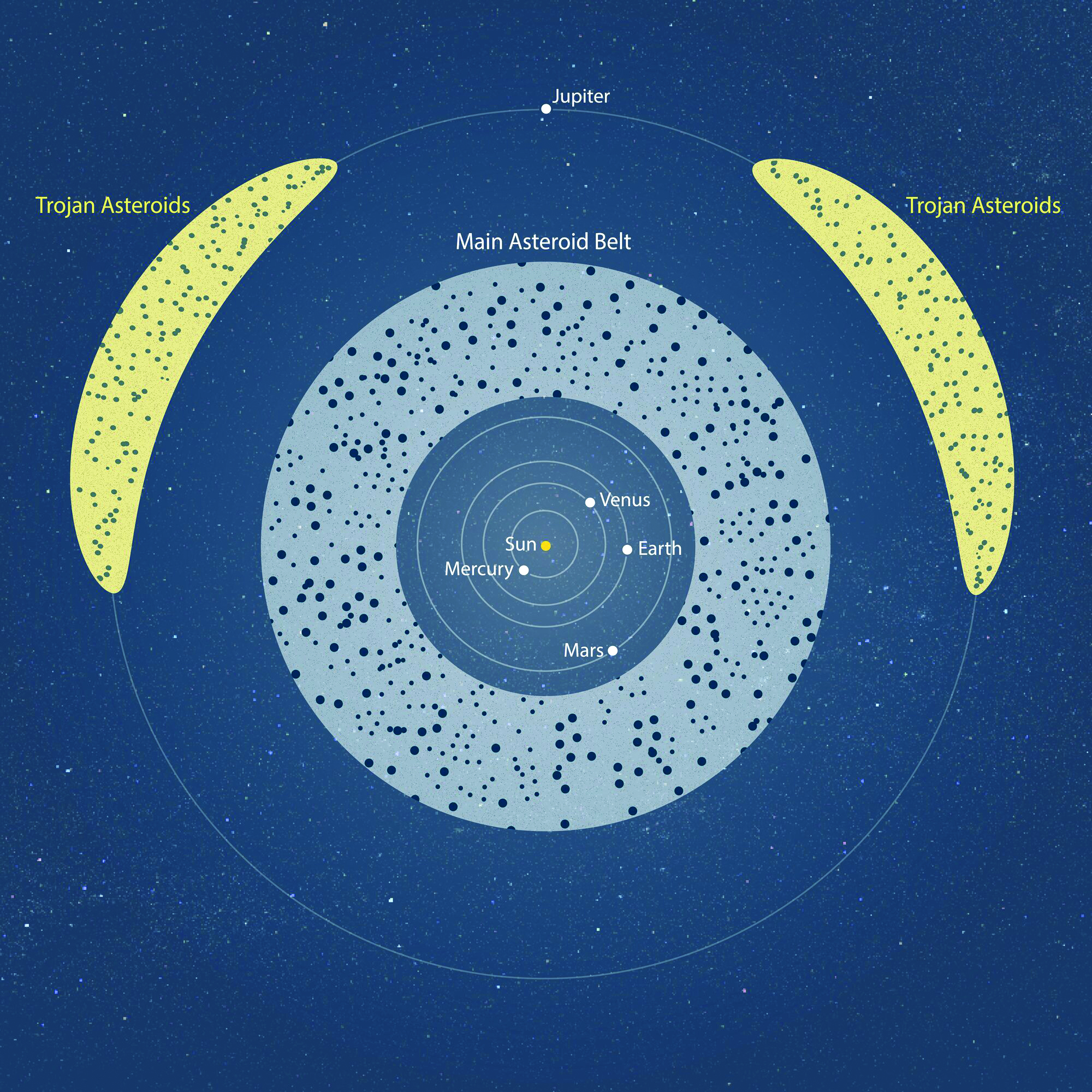
There are many fascinating objects in the sky, viz., comets, stars, galaxies, supernovae, etc., and asteroids are among them in our solar system. Asteroids are small in size compared to planets in our solar system. They are rocky and metallic, and orbit the Sun like our planets. Their sizes range from a few meters to kilometers, and most asteroids are irregularly shaped, unlike the planets. They are mostly populated in the torus-shaped space between the orbits of Jupiter and Mars.
Asteroids are remnants of the solar system’s formation and are important for understanding its history and evolution. Asteroids formed after the Sun through accretion. The Sun was surrounded by dust, gases, small particles, and larger chunks of material, forming a large disk known as a protoplanetary disk. The material in the disk served as the building blocks for planet formation. The particles in the disk began colliding and sticking together under gravitational attraction, and this process, i.e., accretion, continued, attracting more and more material until larger bodies formed. These larger bodies, termed planetesimals, could potentially become the planets of our solar system. However, the strong gravitational pull of planets like Jupiter disrupted some planetesimals, growing them into full-sized planets, and they became the small, rocky bodies now known as asteroids. They are found in an asteroid belt between Jupiter and Mars and normally vary in size and composition, while a few remain primitive since their formation.
DISCOVERY OF ASTEROIDS AND THEREAFTER
The first asteroid identified was Ceres by Italian astronomer-cum-priest Giuseppe Piazzi on the eve of the new year on January 1, 1801, at the Palermo Astronomical Observatory in Sicily, Italy, where Mount Etna, an active volcano, had erupted recently. Initially, Piazzi thought that he had discovered a new planet, but later it was revealed through observations that Ceres, without any moon (a natural satellite) in the asteroid belt, is a much smaller body than the planets observed earlier, and therefore led to its classification as an asteroid or, more recently, referred to as a dwarf planet. Some asteroids also have moons, and asteroid 87 Sylvia, with two moons, is the first known triplet asteroid system.
Asteroids are classified into three types based on their composition and location. The first type is C-type, or Carbonaceous, asteroids, which are dark and rich in carbon. They account for about 75% of the total population of asteroids and are the most primitive objects in our solar system. The second type is S-type, or Silicaceous asteroids, which are mainly composed of silicate rocks with metal-bearing minerals (Iron-Nickel). They are moderately bright as compared to C-type asteroids and are placed in the inner asteroid belt. The third type is M-type or metallic asteroids, which are mainly composed of Iron and Nickel and are rare. In addition to that, there are other less common types of asteroids, D, V, and E-types. The D-type asteroids are dark and rich in organic material; the V-types are made of volcanic rocks; and the E-types contain minerals rich in iron-free silicates.
The asteroids should not be confused with comets, since their compositions are completely different. On the one hand, the asteroids are rocky and metallic, while the comets are icy in nature. The volatile ice, such as water, carbon dioxide, with dust and organic compounds, while near the Sun, sublimates and creates a glowing coma, which often has a tail extending even up to a few kilometers. However, the asteroids in the absence of volatile material never make a tail. Further, the smaller fragments of rock, known as meteoroids or shooting stars, originate from asteroids and comets ranging in size from a few millimeters to meters, producing a bright streak of light as they enter Earth’s atmosphere.
THE TUNGUSKA EVENT, 1908
International Asteroid Day is on 30 June every year to commemorate the Tunguska event in 1908, the largest impact event in recorded human history. It occurred near the Podkamennaya river in Siberia, Russia, where a powerful explosion equivalent to more than 10 megatons of TNT took place, causing flattening of trees in a remote forest over an area of 2,000 square kilometers, with few human deaths. One of the interesting aspects of this event was the absence of an impact crater. There are various stories about this event, but the most widely believed one is that a small asteroid or comet entered Earth’s atmosphere at high speed and exploded due to intense heat and extremely high pressure. This event has a significant impact on scientific theories about near-Earth objects and the dangers they may pose to our planet. It is worth noting that a small object in space can pose a potential danger to us as it enters the Earth’s atmosphere. Over the years, various theories to explain this event have been proposed, such as a black hole impact, an alien spacecraft hitting, and a natural explosion, but none have scientific evidence.
Not only are asteroid impacts present, but we have examples of massive meteorite impacts more than 2 billion years ago. The Vredefort Dome, formed by this impact, is now a UNESCO World Heritage Site near Johannesburg, South Africa. Another such event occurred while the Chelyabinsk meteor exploded over Russia with enormous energy like nuclear bombs, resulting in shockwaves that shattered the doors and windows, injuring more than 1000 people.
There are many challenges in the scientific investigation of asteroids, such as understanding their origin and evolution, especially how planetesimals formed and why some remain primitive while others melted and differentiated. The first spacecraft to land on the surface of an asteroid, 422 Eros, was NEAR Shoemaker in 2001, and scientists use meteorites and various spacecraft missions, such as OSIRIS-REx and Hayabusa2, to study asteroids in diverse contexts. The OSIRIS-REx collected samples from the asteroid 101955 Bennu and returned with them to the Earth in September 2023, helping scientists understand the early solar system chemically. On the other hand, Hayabusa, a Japanese bullet experiment, fired into the asteroid 162173 Ryugu to create an artificial crater and then collected underground samples. To determine the internal structure and composition of asteroids, i.e., what materials, minerals, and volatiles they contain, is one of the other major challenges in this field.
The planetary defense to protect the Earth from asteroid impacts also remains one of the major global challenges, especially in detecting dangerous objects early and implementing an internal response system. It is remarkable that a planetary defense test conducted in 2022 made asteroid deflection possible, in which the orbit of asteroid moonlet Dimorphos was altered through a double-asteroid redirection test. Such a planetary defense mechanism is important, since the movements of asteroids towards the Earth may be hazardous in some parts of the world during an asteroid flyby, as in the case of the possible future flyby of asteroid 99942 Apophis extremely close to the Earth.
*The writer is Professor, Department of Physics, and Director, Research & Development Cell, HNB Garhwal University, Srinagar Garhwal, Uttarakhand.