





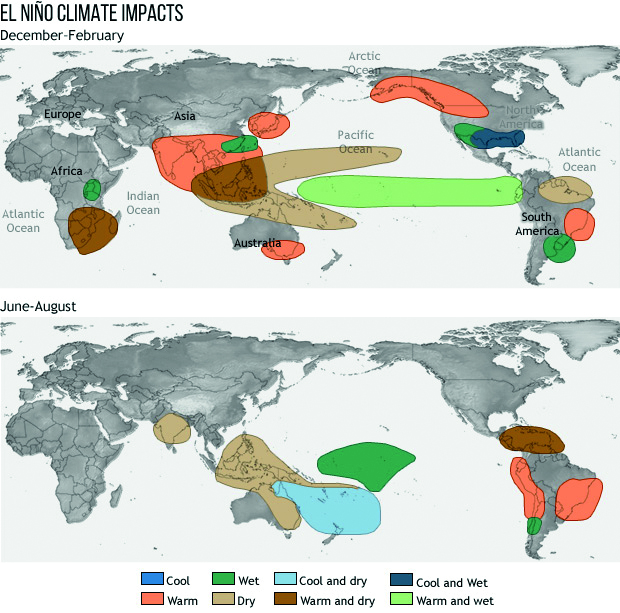
The India Meteorological Department (IMD) has forecast below-normal rainfall across most parts of India, as El Nino conditions continue to strengthen over the equatorial Pacific Ocean.
El Nino, the periodic warming of sea surface temperatures over the central and eastern Pacific Ocean, weakens the monsoon circulation by reducing the temperature contrast between land and ocean, often suppressing cloud formation and rainfall over the Indian subcontinent.
WHAT IS EL NINO?
The term ‘El Nino’ means ‘The Little Boy’ in Spanish. It was first noticed by fishermen near South America. It is part of a larger climate system called the El Nino-Southern Oscillation (ENSO), which also includes its opposite phase, La Nina.
El Nino is the warm phase of the ENSO which is one of the world’s most important natural climate patterns. It develops when sea surface temperatures in the central and eastern equatorial Pacific Ocean become unusually warm, changing global wind systems and rainfall patterns. It normally occurs every two to seven years, lasting about nine to twelve months. It influences agriculture, water resources, food security, energy demand and disaster risks.
EL NINO 2026
El Nino weather conditions strengthened during 2026, with global agencies warning of widespread weather disruptions, higher temperatures and changing rainfall patterns. The World Meteorological Organization (WMO) estimated an 80% probability of El Nino during June-August 2026, with the likelihood rising to 90% or more of continuing until at least November 2026.
EFFECTS ON INDIA
El Nino has a strong and often negative impact on the Indian monsoon, which is crucial for agriculture, water supply, and the overall economy.
It weakens the Southwest Monsoon by shifting the Walker Circulation eastward. During late June 2026, India’s cumulative monsoon rainfall remained around 42% below normal. It has resulted in reduced rainfall and prolonged heat increase with temperatures hovering above 45°C across many parts of India. Lower hydropower generation, combined with electricity demand exceeding 240 GW put additional pressure on thermal power generation and electricity prices.
According to the IMD’s probability forecast, below-normal rainfall is likely over most parts of the country, including large areas of central, western and northern India. However, some regions are expected to escape the widespread deficit. Parts of northwest India, east-central India and the eastern peninsular region are likely to receive normal to above-normal rainfall, offering some relief after a sluggish start to the monsoon. Northeast India is also expected to remain relatively wetter than the rest of the country.
Source: Various news reports and IMD report