




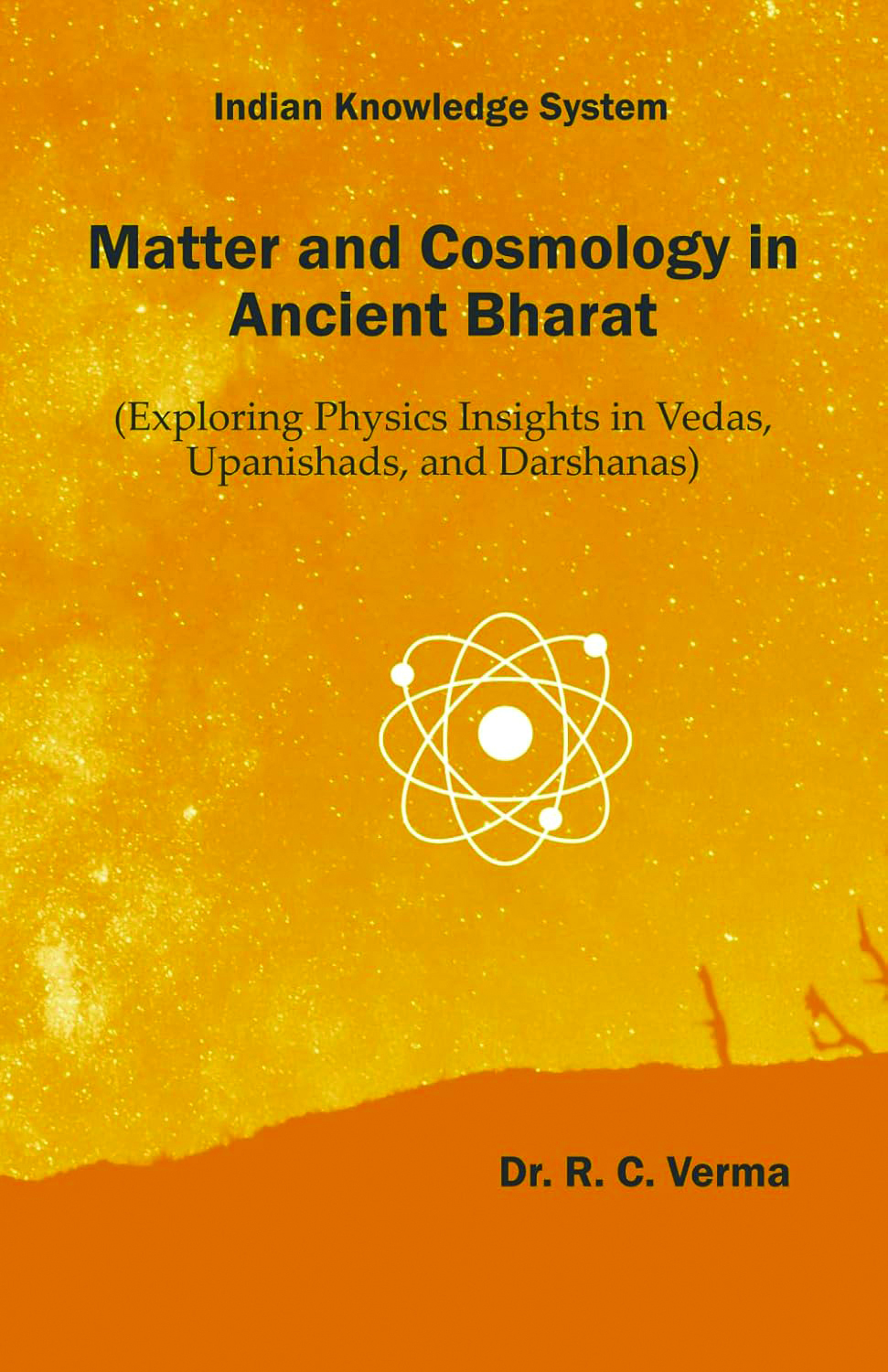
MATTER AND COSMOLOGY IN ANCIENT BHARAT
Dr R C Verma
Vyom Hans Publications, | 2026 |
Pages 108 | Rs 450
BOOK REVIEW
‘I go to the Upanishads to ask questions’— N. Bohr
Efforts in the last few years such as emphasis on Indian Knowledge System or IKS in the National Education Policy 2020, seminars, conferences and awareness programmes in the area and opening of a dedicated IKS division under the Ministry of Education, Govt of India, have given the domain of IKS the desirable fillip. It is now attracting much more attention than it did in the last several decades, consequently more research, academic writings, projects and books are exploring different dimensions of the domain bringing up newer ideas, opinions and interdisciplinary explorations. This is filling gaps in our knowledge and building bridges with myriad new perspectives allowing more and more readers to understand and take interest in IKS. This book is an attempt towards that direction.
The author has presented concepts of matter, space, time, causality and the universe as described in the Vedas, Upanishads, Vaisheshika, Nyaya, Samkhya, Yoga, Mimansa, Vedanta, Jaina, Buddhist, Tantra and Charvaka darshanas. Interesting parallels of various ideas of these schools with modern physics and metaphysics are also presented in the book.
In eleven short and crisp chapters, the author has been able to elucidate the pluralistic, dualistic and unitary representations of matter and the universe, each chapter in turn exploring the roots of the concept in the different Darshanas starting from Upanishadas to Charvaka and Tantra. Each chapter includes the Sanskrit reference along with its meaning with brief comments by the author, highlighting something striking or worth noticing. Otherwise, the reader is free to make his or her own derivation from the text and its meaning. This format gives the reader autonomy as ideas and opinions are not forced. Though, in my opinion, some handholding might have helped the new entrants into this landscape. The objective tone of the writing is especially appreciable as the author has stayed clear of the unnecessary glorification of all that is related to ancient Indian traditions, which many of the contemporary texts are prone to. The strength of the book is thus its focussed and unbiased evaluation of the tangible Indian contributions within the correct context.
The scientific organisation of the Indian cosmological thoughts gives the reader more clarity as they can compare their evolution and expansion both horizontally and vertically. This device also allows comprehending the development and continuity of thought and ‘conceptual consistency’ down the centuries and also on the continuum from the Vedas to non-Vedic darshanas. References from Kashmir Shaivism, Mahayana and Hinayana Buddhist darshanas and Jain darshana also find mention in the book. This is a specific and unique contribution of this book that it holds scope and potential by presenting a skeleton and a ready-made template for further elaborations, expansions and explorations by researchers who might wish to work in the area.
Of special interest is the chapter on the interesting parallels between Bharatiya Darshana and modern Physics. In this chapter too, the author is careful not to lead the readers into traps of unscientific misunderstandings. For example, the author states that ‘Issac Newton regarded causes as residing in nature itself, which are knowable and sufficient to account for all phenomena occurring in nature. Exactly similar views have been expressed by Kanada at least 2000 years before Newton. While describing the causality, he states matter is the inherent cause of all actions taking place in the world.’
There is no exaggeration or chauvinism here. It is a statement of fact. Nothing more, nothing less and the readers are free to draw inference of their own. Such statements about similarity between ‘Hiranyagarbha’ of the Vedas and the fireball of the Big Bang Cosmology, ‘Nada’ and ‘Bindu’ Tantric concepts and Wave and Particle quantum concepts, the idea of Brih (expansion) and the expanding nature of Universe, the idea of Universe originating from non-being given in Taittiriya Upanishad and the doctrine of creation from nothing- are some of the observations presented before the reader. As one goes through the list, one starts wondering whether it is just an amazing coincidence or we are witnessing the illuminated premonitions of the modern concepts by an ancient civilisation, whether the expressions used in the ancient scriptures did point towards something more profound than we have come to believe.
W Heisenberg’s statement, “After the conversation about Indian Philosophy, some of the ideas of Quantum Physics that had seemed so crazy suddenly made much more sense’ quoted in the book points to the claim by Indian thinkers that consciousness plays an indispensible role in the nature of physical reality and Quantum theory is the most convincing evidence of this. As Upanishadas have put forth that ‘the entire universe is one, interconnected and interpenetrated by the ultimate reality, which they named Brahman’, Quantum theory has also ‘thrown new light on the relationship of matter, vacuum and consciousness’. Writings on causality, atomism and consciousness in Indian philosophy allow it to have a dialogue with modern scientific epistemology and it is interesting to note that even science is looking for solutions which seem to be easier to find when we study the Darshanas in IKS. These readings present enough food for thought to the enquiring minds. The objective of the book to take the readers to that realisation where they are ready to initiate their journey in this realm seems to be achieved.
Dr RC Verma, a PhD in High Energy Physics and a post-doctoral fellow from the University of Alberta, Canada, has spent his life as a physicist collaborating with international academic institutions in various countries. However, a question posed by a student in his class on Particle Physics about the reason of taking cultural pride in contributions of ancient India in study of matter and the universe, put Professor Verma into a deeper quest in the area for almost a decade during which he sourced literature, attended sessions and had interactions with academicians/ scientists from varied disciplines like Hindi, Sanskrit, Physics, Engineering, Astrophysics as well as exponents of Bharatiya Darshan, Yoga, Vedanta, etc. This enabled him to explore Bharatiya Darshan from the perspective of physics. That the author explains the process through which he could navigate the two poles of Science and Philosophy gives credibility to his writing.
An annexure with prominent Sanskrit texts, names and terms in Roman and Devanagari scripts and more than a hundred references are sure to prove a rich resource for the interested reader. Researchers, Indologists and students of history of science, quantum physics and philosophy will definitely benefit from this short and pithy volume which can act as a ready reference for Physics with insights in Vedas, Upanishadas and Darshanas.
*The writer is a professor at Panjab University, Chandigarh, and Programme Director, UGC-Malaviya Mission Teacher Training Centre in the university.
