



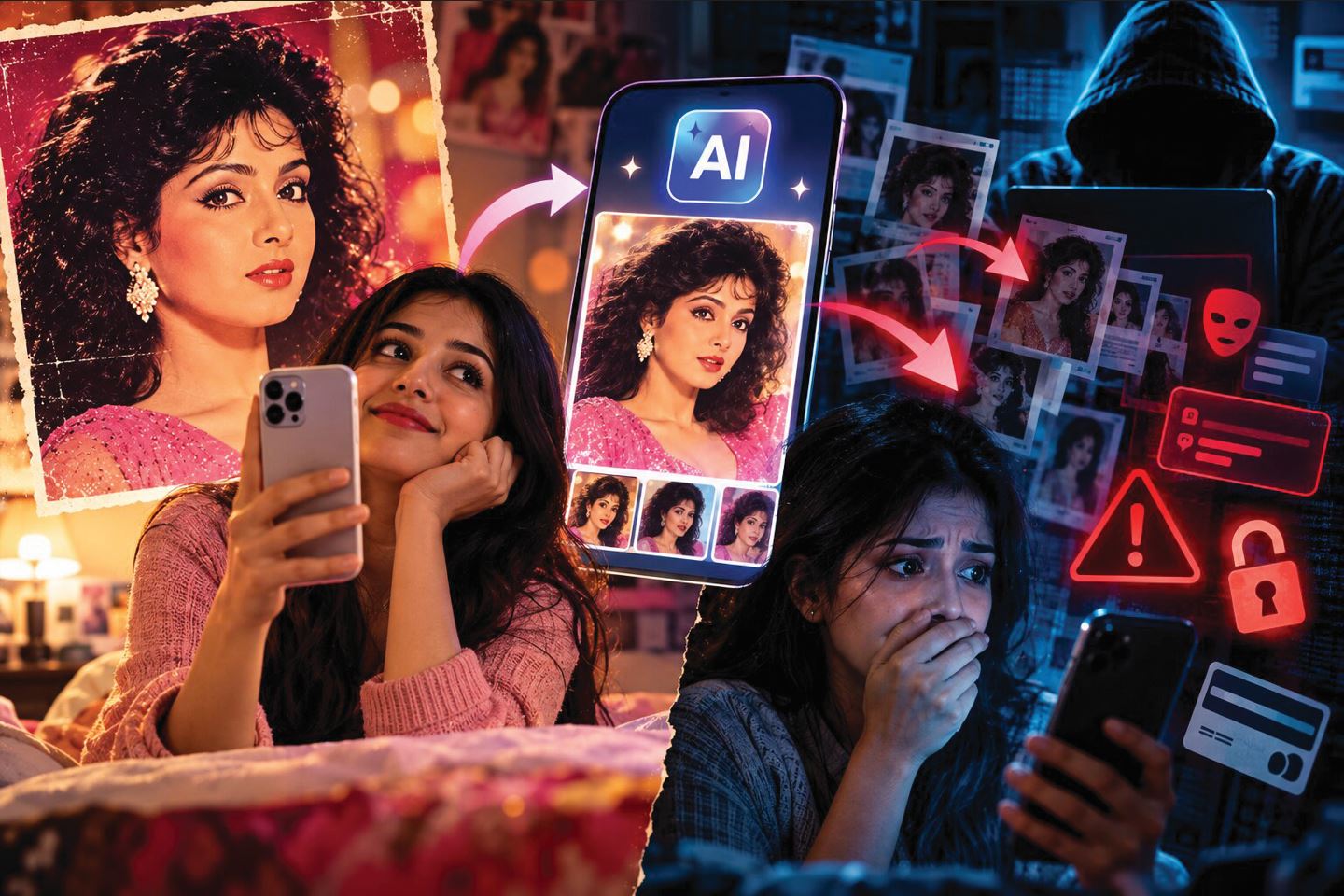
Priya uploaded her selfie at 11 p.m., half-asleep, scrolling past three friends’ feeds already full of 1980s actresses look, block buster movie scenes and so on. When everyone is doing it, why not me? Thought Priya and downloaded the FREE AI app forwarded multiple times on social media. Upload your selfie and chose the celebrity you want to look like. We will give you, with celebrity look alike on a leading film magazine cover, 1986 edition, in under a minute. Carried away by this assurance, Priya had downloaded the app to her phone. During installation it asked for access to contacts, SMS, Camera, Video, Microphone, Accessibility options and storage access, and she tapped ‘Allow’ the way you tap through a software update: without reading a word.
By the time her bank sent a fraud alert two days later, she had already forgotten the app’s name. That is not a hypothetical. It is one of the ways cyber criminals have been stealing data, photographs, video, audio, biometrics and money from innocent users.
The 1980s AI photo trend is real, and it is genuinely fun. Upload a selfie photo, get back a version of yourself as a retro Bollywood hero or heroine, complete with the film grain and power-shoulder glamour of the era. Politicians did it. Actors did it. Your neighbour did it. That is not the story. The story is what happens the moment a viral craze becomes predictable, because predictable is exactly what a cybercriminal needs.
HOW IT WORKS?
It is not complicated, which is precisely why it works. A legitimate AI photo tool goes viral. Internet search for ‘FREE 1980s photo app’ spikes overnight. Fraudsters do not need to build anything sophisticated—they need to build something that looks close enough, fast enough, to intercept that traffic before the real apps do. So, fake photo-editing apps and malicious APK files begin circulating through WhatsApp forwards, social media links, and third-party sites, dressed up as vintage-photo generators. Grant all the permissions, and the app can reach into SMS and OTPs, contacts, stored photographs, and files—which is polite way of saying it can reach into your bank account and your relatives’ inboxes the same afternoon.
Between January and early May this year, Kaspersky detected more than 92,000 attacks using malware and unwanted applications disguised as popular AI tools—nearly half of them impersonating ChatGPT, with fake Claude and Gemini apps each accounting for close to a fifth. Researchers pulled more than 15,000 distinct malware samples out of that haul: banking trojans, spyware, exploit kits, downloaders built to fetch a second, worse payload once they’re inside. In May, a group tracked as Silver Fox pushed trojanised ‘Claude AI’ installers for Windows, macOS, and Linux at users actively searching for legitimate AI software. None of that campaign needed the 1980s trend to exist. It only needed people to trust the words ‘AI app’. The retro-photo craze didn’t invent this criminal economy—it simply handed it a fresh, emotionally loaded hook, and the operators moved on it within days, not months.
WHAT HAPPENED TO PRIYA, STEP BY STEP
Go back to that 11 p.m. install, because the two days between the tap and the bank alert are where the real lesson lives. Priya posted her 1980s diva portrait and the appreciation rolled in—comments, shares, a cousin asking which app she used. She carried on with an ordinary two days: answering calls, replying to messages, checking her bank balance, paying for a couple of online purchases. Her eight-year-old brother Abhishek, watching all this, talked her into making him Gabbar Singh from Sholay. She took a clean, well-lit selfie of him, fed it to the same app, and it delivered again. Abhishek as Gabbar was an even bigger hit than she had been.
Nothing about those two days felt like a crime in progress. That is the design.
The permissions Priya granted at install were not for the photo filter. They were the payload’s delivery route. Storage and photo access let the app pull every image on the phone. Contacts access mapped her entire social circle for the next round of scam messages. And the screen that asked her to “enable Accessibility for the app to work properly”—the one that looked like routine Android housekeeping—is the single most dangerous tap in this whole story. Accessibility Service was built so that blind and low-vision users could have their screens read aloud and controlled by voice. Handed to a malicious app, the same access reads every screen and captures every keystroke. That is how a photo app becomes a keylogger, and it is why a legitimate filter never needs it.
So, when Priya opened her banking app to check her balance, her customer ID, password and transaction PIN were captured as she typed them and relayed out through a chain of command-and-control servers—intermediary machines the criminals use to collect stolen data without exposing their own location. An infostealer module swept up whatever else was sitting on the device: saved passwords, card details in the browser, documents in her downloads folder.
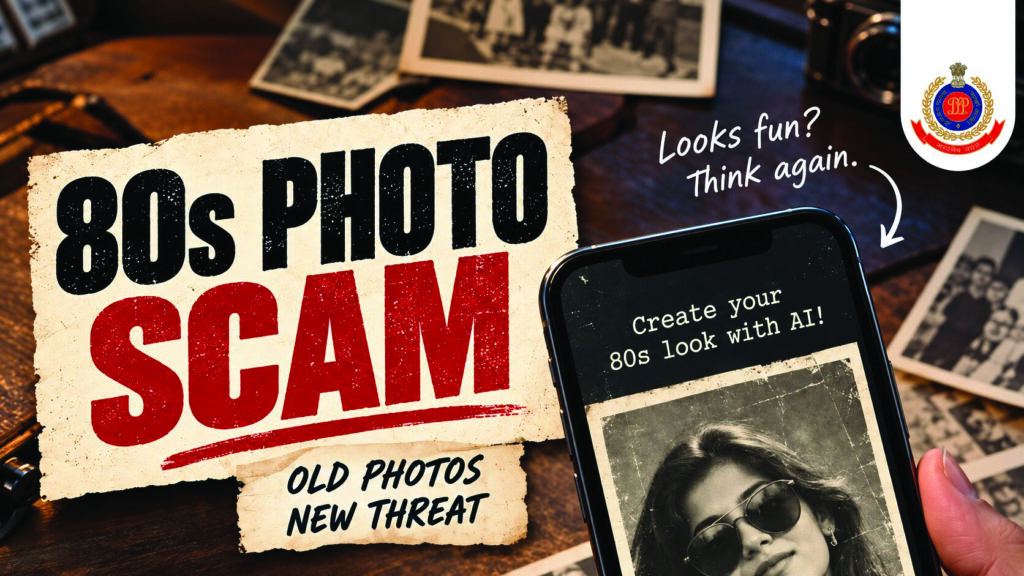
Image Courtesy: Delhi Police/Twitter
Then comes the part most people get backwards. The criminals did not hack Priya’s bank. They did not break any encryption. They logged in—with her own credentials, through the front door, exactly as she would have. Then they added a new payee to her account. The bank did what it is supposed to do: it sent the OTP and the beneficiary-addition alert straight to her phone. But SMS permission meant those messages were read and suppressed before she ever saw them. The safeguard fired perfectly and hit nobody, because the alarm and the intruder were inside the same building.
Every Indian bank enforces a cooling-off window on a newly added payee—anywhere from half an hour to twenty-four hours depending on the bank, usually with a low transfer cap until it expires. That window exists for exactly one reason: to give you time to notice an addition you never made and call the bank. Priya was never given the chance to notice. The criminals simply waited it out, logged in again, and moved the money. The first thing she knew about any of it was the debit alert that finally got through.
ABHISHEK’S PHOTO IS THE PART NOBODY IS TALKING ABOUT
Priya lost money, and losing money hurts—but money is recoverable. Report the fraud within the golden hour on the 1930 helpline or at cybercrime.gov.in, and there is a real chance of freezing the funds downstream. What happened to Abhishek has no such remedy.
A clear, well-lit, front-facing photograph of a child is the highest-grade biometric raw material there is, and it was handed to an unknown operator by a family member who meant nothing but fun by it. Be precise about what that does and does not enable, because the scare stories in circulation overstate it and lose the argument. It does not produce a fake Aadhaar—enrolment requires ten fingerprints, both irises and physical presence at a centre, and a face alone gets nobody through that door. What it does enable is worse in the ways that actually matter: deepfake video and image generation using a real child’s face, morphed and sexualised imagery of a kind that Indian police units now handle as a routine category of complaint, fake social media profiles operated in the child’s name to approach other children, and a permanent, unrevocable biometric record created by a person who cannot consent and will not be consulted.
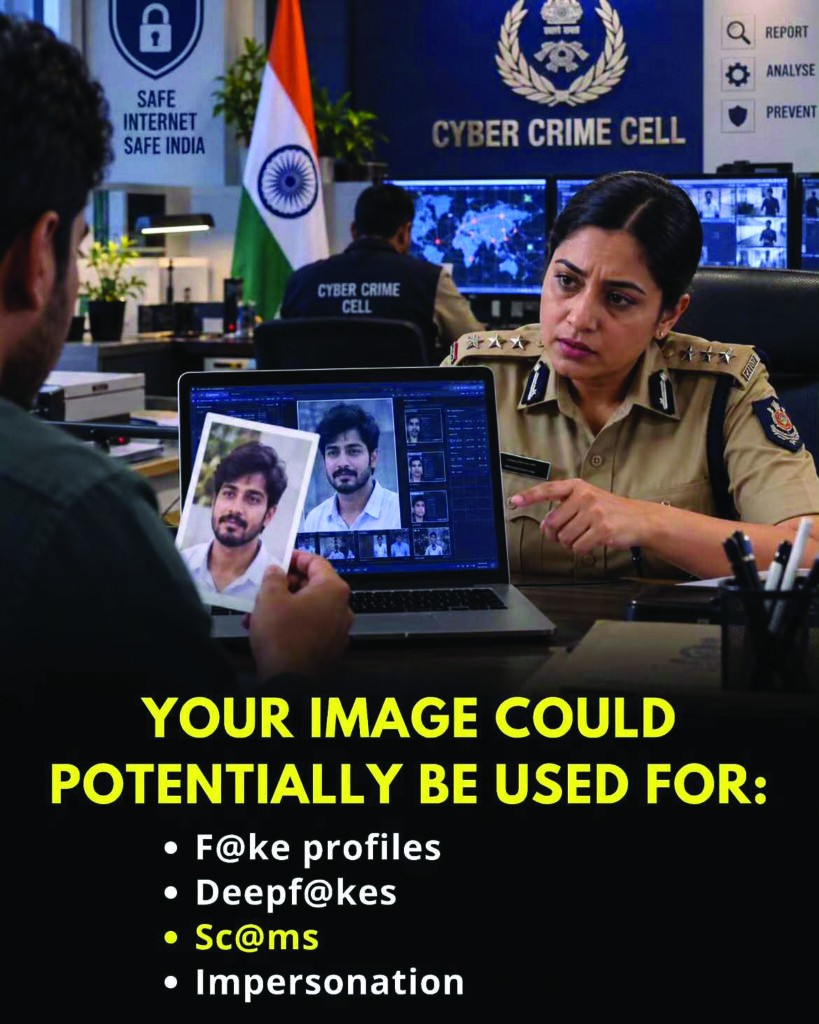
Abhishek is eight. He has sixty or seventy years of face recognition ahead of him—in airports, in offices, in payment systems not yet built. The photograph his sister uploaded for a laugh will outlive every password either of them will ever set.
This is the second cost, and it does not require a malicious app at all—you can hand it over through a completely legitimate one and still lose something you cannot get back. A high-resolution, well-lit, front-facing photo is precisely the raw material biometric systems and deepfake generators are built on: the measurements of your bone structure, your skin tone, the geometry of your face. Unlike a password, you cannot rotate that after a breach. Bengaluru police and Hisar police have both issued public cautions this month specifically about the retro-photo trend, and in February, sixty-one data protection authorities worldwide signed a joint statement warning that AI image generators are now good enough to produce convincing, non-consensual imagery of identifiable people at scale. India’s own IT Rules were amended the same month to force platforms to label and trace synthetic content—regulation moving in step with a threat that is not theoretical. A labourer couple in Gorakhpur learned that the hard way, extorted out of ₹2.80 lakh after fraudsters built an AI-morphed image and threatened to circulate it. Different scam, same raw material: a face, freely handed over, to a system with no obligation to protect it.
McAfee’s 2026 Scamiverse research puts a number on the ambient noise all this generates: Indians now encounter roughly four deepfakes and thirteen scam messages a day, and burn over a hundred hours a year just trying to tell real from fake. That is not paranoia. That is the actual cost of living inside a media environment where the tools to fabricate a convincing lie are now free, fast, and one download away—and where every viral trend is, by design, a new occasion to ask for your face, your permissions, or both.
WHAT ACTUALLY PROTECTS YOU
None of this means boycotting AI tools or refusing every trend that crosses your timeline—that ship sailed, and it wasn’t a bad ship. It means treating the download link with the same suspicion you’d apply to a courier who shows up before you ordered anything.
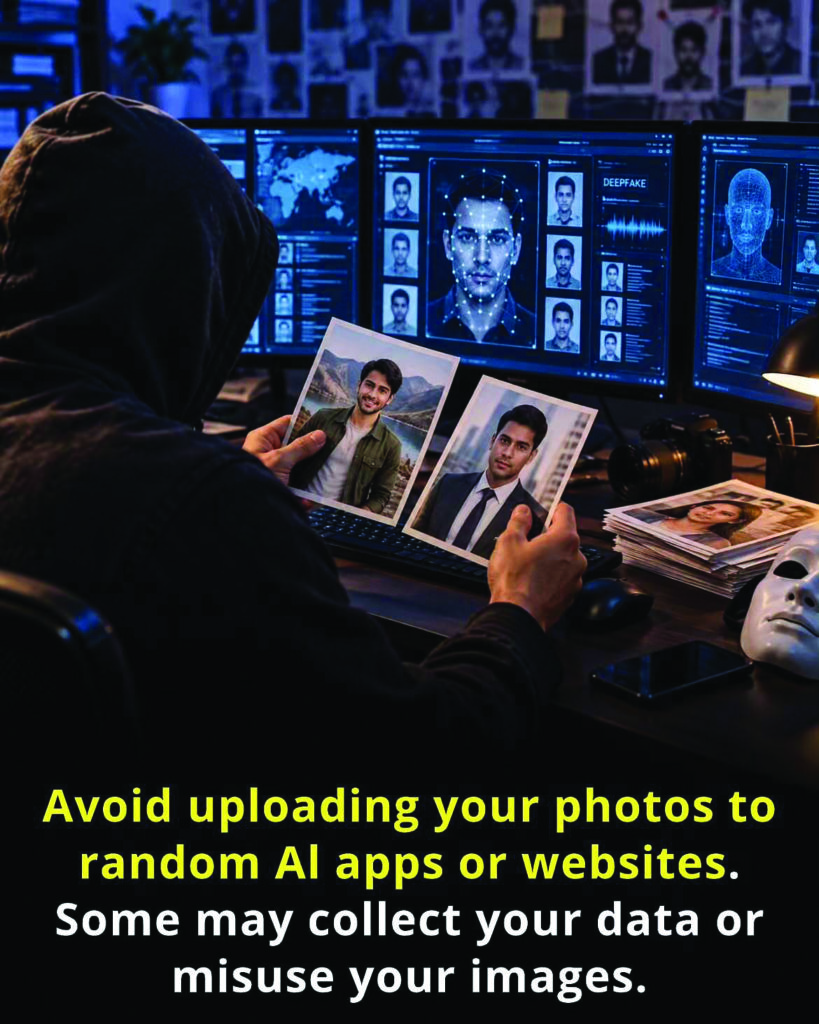
Install only from the official Play Store or App Store, never from an APK forwarded on WhatsApp, however official the thumbnail looks. Read the permissions before you tap ‘Allow’—a photo filter has no legitimate reason to read your SMS or your contact list, and if it’s asking, that’s not caution, that’s the answer. Refuse any Accessibility Service request from an app that is not an actual accessibility tool; no photo filter on earth needs to read your screen. Use official apps from OpenAI, Anthropic, or Google directly rather than a lookalike promising the same result faster. And if the money is already gone, call 1930 or file at cybercrime.gov.in immediately— the first hour is the only hour in which funds are realistically recoverable.

Two habits are worth building permanently. Never upload a clear photograph of a child—to a legitimate AI app or a fake one, it makes no difference to the child’s face once it has left your phone. And don’t stop at your own device: the relative most likely to forward that APK link with “try this, so nice!” attached is usually the one least likely to check where it came from. A five-minute conversation with your parents about official app stores and Accessibility prompts does more for their security than any antivirus subscription you could buy them.
The 1980s look great on you. Just make sure you’re the only one who walks away from that photo with something to show for it.
*The writer is a Director, AI & Cyber Security, MGI, USA.