


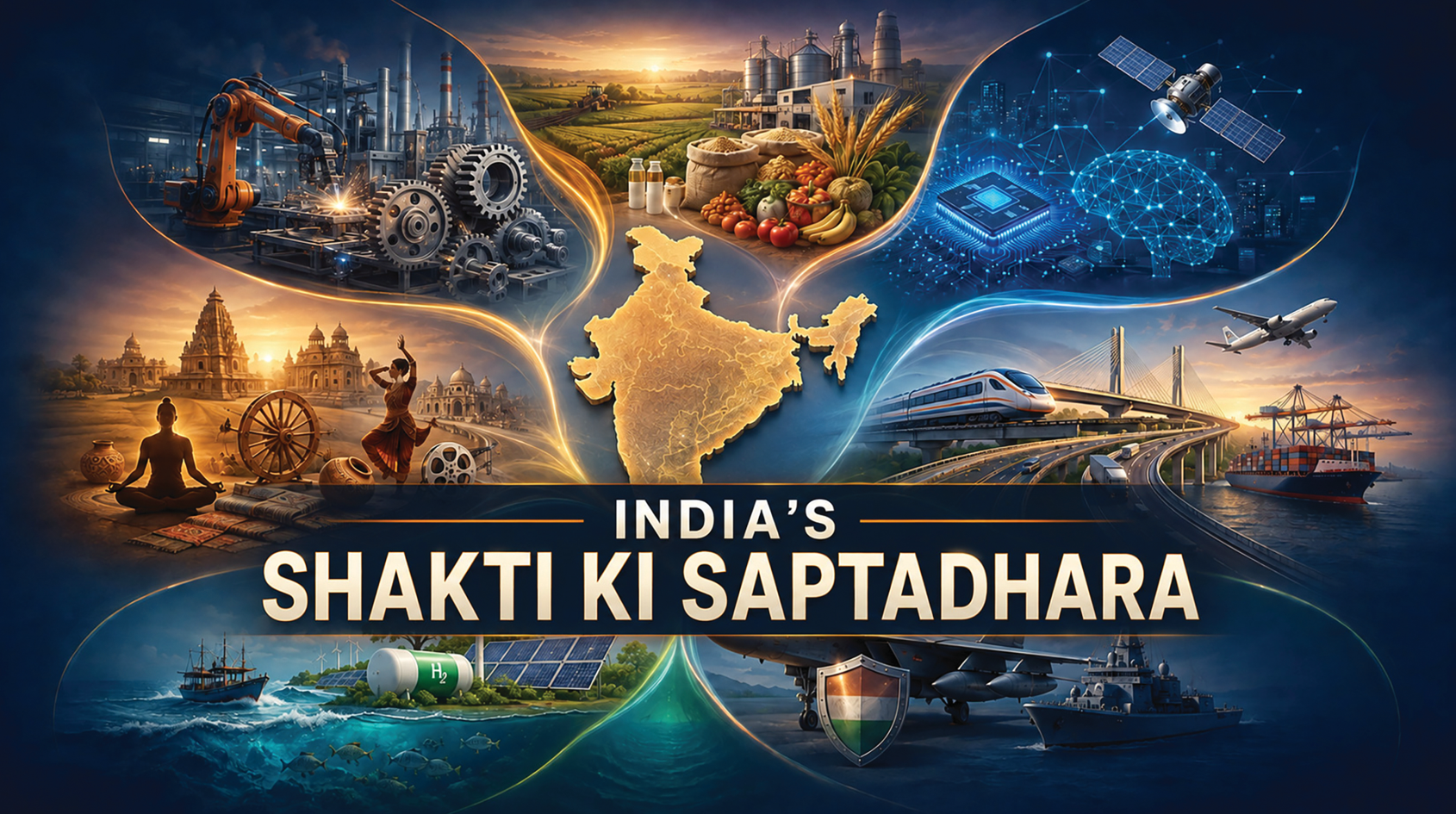
Prime Minister Narendra Modi’s Independence Day address from the Red Fort on 15th August 2026 presented a significant development framework under the idea of ‘Shakti ki Saptadhara’, the seven streams of national strength. These streams are Manufacturing, Agriculture and Food Production, Technology and Innovation, Gati Shakti and Infrastructure, Raksha (Defence) Shakti, Green and Blue Economy, and Soft Power. Rather than viewing them as seven independent sectors, the speech presents them as mutually reinforcing capabilities that can raise India’s productive capacity, technological competence, economic resilience and global influence. The Prime Minister called for these streams to generate new momentum over the next five to seven years and linked them explicitly with the larger aspiration of Viksit Bharat.
The number seven (sapta) holds a distinctive place in Bharatiya intellectual and cultural traditions. It appears in concepts such as Sapta-Sindhu, Sapta-Rishi, and Sapta-Puri, reflecting recurring patterns of classification and cultural meaning. The tradition of invoking seven sacred rivers, Ganga, Yamuna, Godavari, Sarasvati, Narmada, Sindhu and Kaveri, within a single vessel of water expresses a deeper conceptual idea, the movement from plurality to unity. Diverse rivers, geographical regions and cultural traditions converge into one integrated presence, symbolising the enduring principle of unity in diversity.
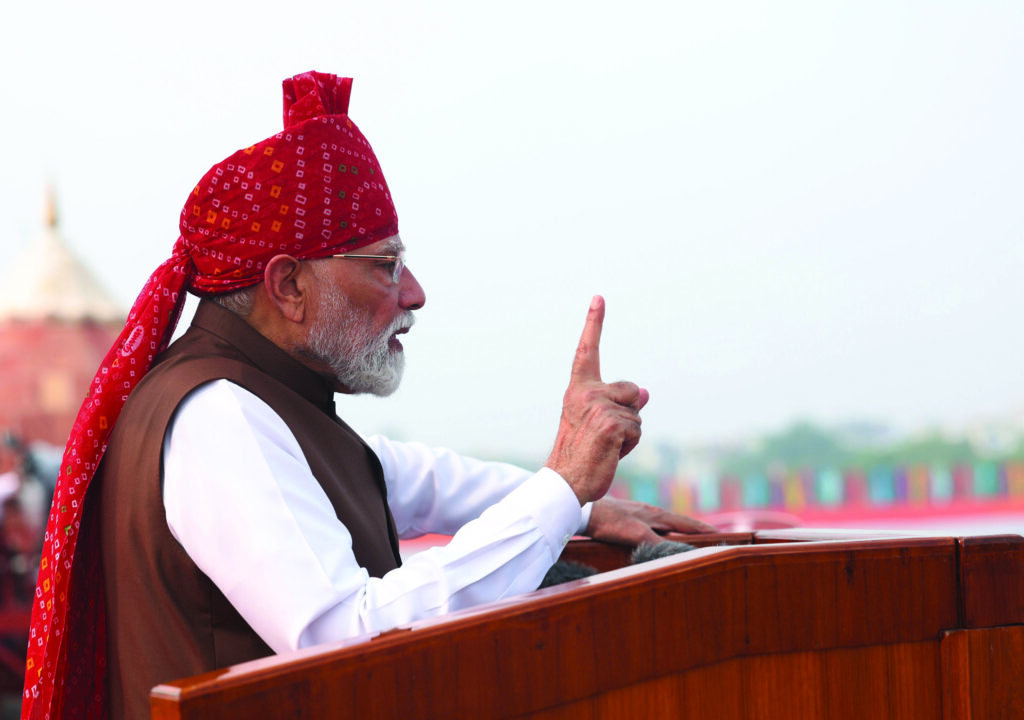
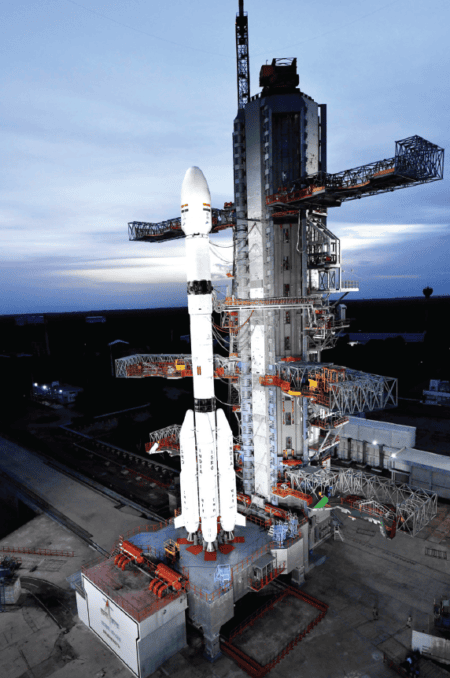
Image Courtesy: PIB
The larger scientific significance of Saptadhara lies in this interconnectedness. A developed nation is not created by growth in one sector alone. Manufacturing requires technology, technology requires research and skilled human resources, agriculture requires processing and logistics, logistics requires infrastructure, infrastructure requires energy, energy must increasingly become sustainable, and all these capabilities ultimately require national security and global partnerships. Soft power, in turn, helps India convert its economic and technological achievements into international influence. The Prime Minister linked this framework explicitly with the objective of Viksit Bharat by 2047 and with the development of indigenous capabilities.
1ST STREAM – MANUFACTURING
The first stream is manufacturing. The scientific and economic importance of manufacturing extends far beyond the production of finished goods. A competitive manufacturing ecosystem requires materials science, engineering, automation, robotics, electronics, artificial intelligence, precision manufacturing, quality control and supply chain management.
The objective is therefore not simply to increase the volume of manufacturing, but to develop the complete value chain, from design and components to production, testing, certification and global distribution. The Prime Minister specifically emphasized India’s aspiration to become a reliable centre of global supply chains, extending from design to complete manufacturing.
Manufacturing has a powerful multiplier effect. It generates demand for research, skilled employment, infrastructure, logistics, energy and services. Semiconductor manufacturing is a particularly important example. It requires sophisticated clean room technology, advanced materials, chemical processing, precision equipment, electronics design and highly trained human resources. Defence manufacturing stimulates electronics, materials science, aerospace and artificial intelligence. Thus, manufacturing can become the bridge between scientific knowledge and economic value creation. This is also where India can advance from Make in India to Discover in India, creating not only products but the knowledge and technologies underlying those products.
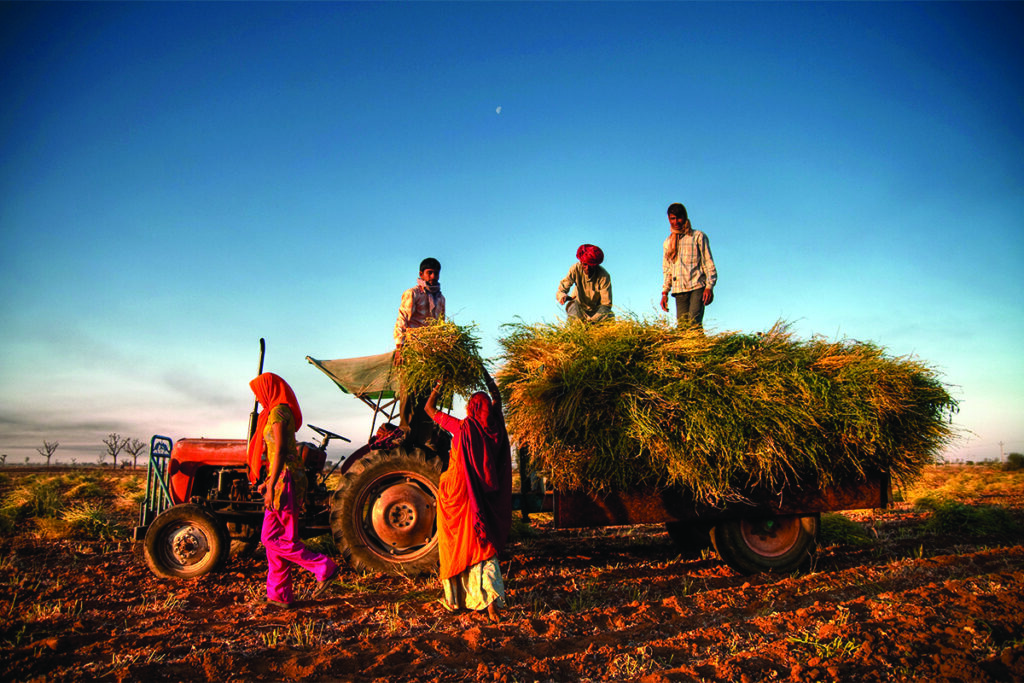
Image Courtesy: Pixabay
2ND STREAM – AGRICULTURE AND FOOD PRODUCTION
The second stream is Agriculture and Food Production. It is particularly important for India because agriculture is not merely an economic activity, it is simultaneously a source of livelihood, a foundation of food security and an important component of ecological sustainability. The Prime Minister’s emphasis on strengthening agricultural and food production also draws attention to the potential of Indian products such as millets, fruits, spices and other traditional foods in global markets. The focus on chemical free and sustainable agricultural practices further highlights the need to develop integrated farm to processing, to export value chains.
The future of Indian agriculture cannot depend solely on increasing production. It must simultaneously improve productivity, farmer income, soil health, water use efficiency, biodiversity, post-harvest management, food processing, storage, logistics and international quality standards.
Traditional agricultural practices evolved through long term observation of soil, seasons, seeds, water systems, biodiversity and local ecosystems. Such knowledge should neither be accepted uncritically nor dismissed as obsolete. Its appropriate contemporary role is to provide testable hypotheses, locally adapted practices and alternative approaches that can be examined through modern scientific methods.
Millets, spices, fruits, vegetables and traditional food products can become important components of this knowledge intensive agricultural economy. Their transformation into high value products will require the convergence of agricultural biology, chemistry, food technology, engineering, data science, environmental science and logistics.
Thus, the second stream can transform Indian agriculture from a predominantly production-oriented system into a science based, value added and globally competitive ecosystem.
3RD STREAM – TECHNOLOGY AND INNOVATION
The third stream, Technology and Innovation, can become one of the most powerful multipliers of the other six streams of Saptadhara. The Prime Minister has highlighted areas such as artificial intelligence, quantum technology, space, robotics, semiconductors, 6G and Digital Public Infrastructure, along with an initiative to train one crore young Indians in AI skills. These priorities reflect a fundamental shift in India’s technological ambitions.
India cannot achieve technological sovereignty simply by becoming a large consumer, or market for technologies developed elsewhere. The goal must be to build capabilities across the entire innovation chain. The basic research must transform into applied research, leading to technology development and innovation, and finally commercialisation of the developed technology.
This requires strong research institutions, skilled human resources, intellectual property, advanced manufacturing and high technical enterprises. The semiconductor sector illustrates this transition, with 12 projects approved across six states involving investment of more than Rs 1.6 lakh crore, while some projects have already entered production.
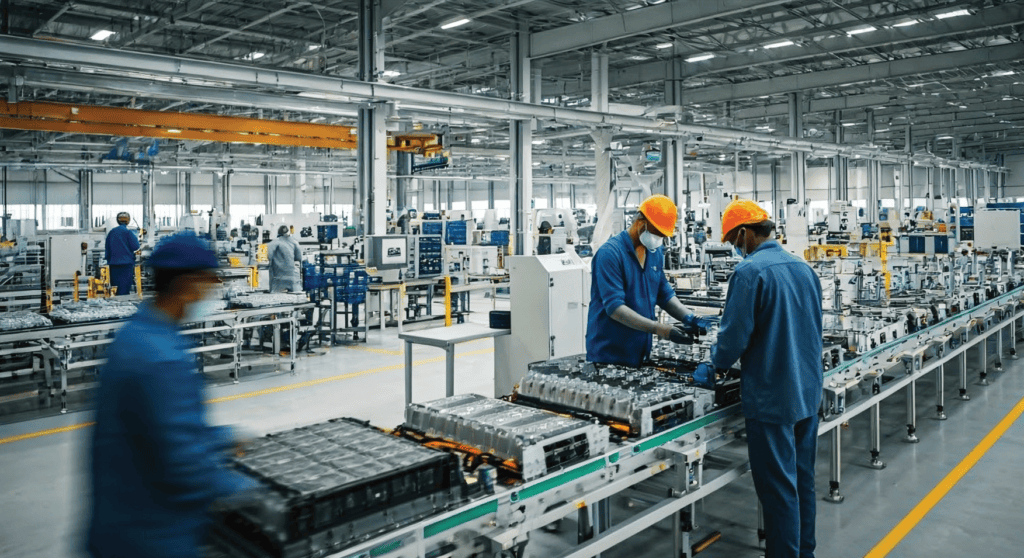
Image Courtesy: Shutterstock
Technology is not limited to hardware. It also includes algorithms, scientific knowledge, data, patents, standards, human capital and institutions. India’s intellectual traditions remind us that technological advancement ultimately rests upon knowledge. A technologically strong India must therefore become a researching, innovating and knowledge creating India, and not merely a technology consuming India.
4TH STREAM – GATI SHAKTI AND INFRASTRUCTURE
The fourth stream is Gati Shakti, representing the power of movement, connectivity and integrated infrastructure. Development requires not only production, but also the efficient movement of people, goods, materials, energy and information. Modern connectivity depends on civil engineering, transportation systems, geospatial technologies, artificial intelligence, telecommunications and logistics management.
The Prime Minister has emphasised multimodal connectivity through highspeed rail, highways, waterways, ports and integrated infrastructure. Such networks can reduce travel time, logistics costs and transaction costs while improving India’s industrial competitiveness.
Gati Shakti should therefore be understood not merely as an infrastructure programme, but as an integrated national systems and engineering framework. A semiconductor industry requires reliable transportation for specialised equipment and materials. Agricultural exports depend on cold chains, efficient roads and ports. Manufacturing clusters require coordinated access to transport, electricity, communication and digital services.
Physical and digital connectivity are now closely interconnected. Digital platforms enable real time logistics management, supply chain monitoring, electronic transactions and intelligent transportation systems.
India’s historical experience also demonstrates the importance of networks. Ancient trade routes, ports, educational centres and pilgrimage networks connected distant regions. Gati Shakti represents a modern effort to recreate this interconnectedness through physical, digital, economic and knowledge infrastructure, thereby converting connectivity into an important source of national power.
5TH STREAM – RAKSHA SHAKTI
The fifth stream is Raksha Shakti, representing the development of strong, self-reliant and technologically advanced defence capabilities. The Prime Minister has emphasised defence self-reliance and identified areas such as drones, counter drone systems, hypersonic technologies and cybersecurity as important areas for India’s future security.
National security today depends on much more than soldiers, weapons and conventional military platforms. Modern defence increasingly relies on semiconductors, artificial intelligence, cyber capabilities, space systems, electronic warfare, autonomous systems, quantum technologies, advanced materials and secure communications. Defence capability is therefore closely connected with science, technology and manufacturing.
A strong defence ecosystem should connect fundamental science to strategic research, leading to indigenous engineering, resulting in increased domestic defence production, and eventually resulting in export. Such an ecosystem can also generate technologies with civilian applications. Advances in sensors, navigation, communications, robotics, advanced materials and autonomous systems can benefit transportation, agriculture, industry and disaster management.
Raksha Shakti therefore, contributes simultaneously to national security, technological self-reliance and industrial development. It also demonstrates why Saptadhara should be understood as an interconnected system rather than seven separate pillars. A technologically dependent defence sector can limit strategic autonomy, while strong defence requirements can stimulate domestic research, innovation, manufacturing and technology development.
6TH STREAM – GREEN AND BLUE ECONOMY
The sixth stream is the Green and Blue Economy, which brings together environmental sustainability, energy security, green manufacturing, marine resources, fisheries and coastal development. A developed India cannot follow resource intensive models of industrialisation indefinitely. Future economic growth must combine economic development, reliable energy, environmental protection and climate resilience.
Energy security is particularly important because sustained economic growth depends on affordable and dependable energy. The Prime Minister has highlighted renewable energy, green hydrogen, energy storage and nuclear power, including the long-term goal of increasing nuclear capacity. This shows that India’s energy transition is not only an environmental concern, but also a matter of strategic autonomy and national security.
The scientific and technological challenges are significant. Renewable energy requires advances in solar technology, batteries, power electronics and smart grid systems. Green hydrogen requires efficient electrolysers, renewable electricity and safe systems for storage and transportation. The blue economy requires expertise in oceanography, marine biology, fisheries, materials science and coastal monitoring.
Critical minerals are equally important because batteries, electric vehicles, renewable-energy systems, electronics and advanced defence technologies depend on resources such as lithium, cobalt, nickel and rare earth elements. Initiatives such as the National Critical Minerals Mission therefore have strategic importance.
The Green and Blue Economy ultimately connects energy, environment, science, technology, resource security and industrial development, promoting growth that is both economically productive and scientifically sustainable.
7TH STREAM – SOFT POWER
The seventh stream is Soft Power, which represents an important dimension of national influence beyond conventional economic and military strength. India’s rich civilisational heritage including Yoga, Ayurveda, Buddhism, Indian languages, mathematics, philosophy, music, cinema, cuisine, democracy and cultural diversity, can contribute significantly to its global presence.
Soft power, however, is more than cultural promotion. Genuine soft power develops when a country’s ideas, institutions, culture, knowledge, products and values become attractive and credible internationally. India’s heritage can therefore become an important instrument of cultural and knowledge diplomacy when presented through rigorous scholarship, authentic documentation and responsible global engagement.
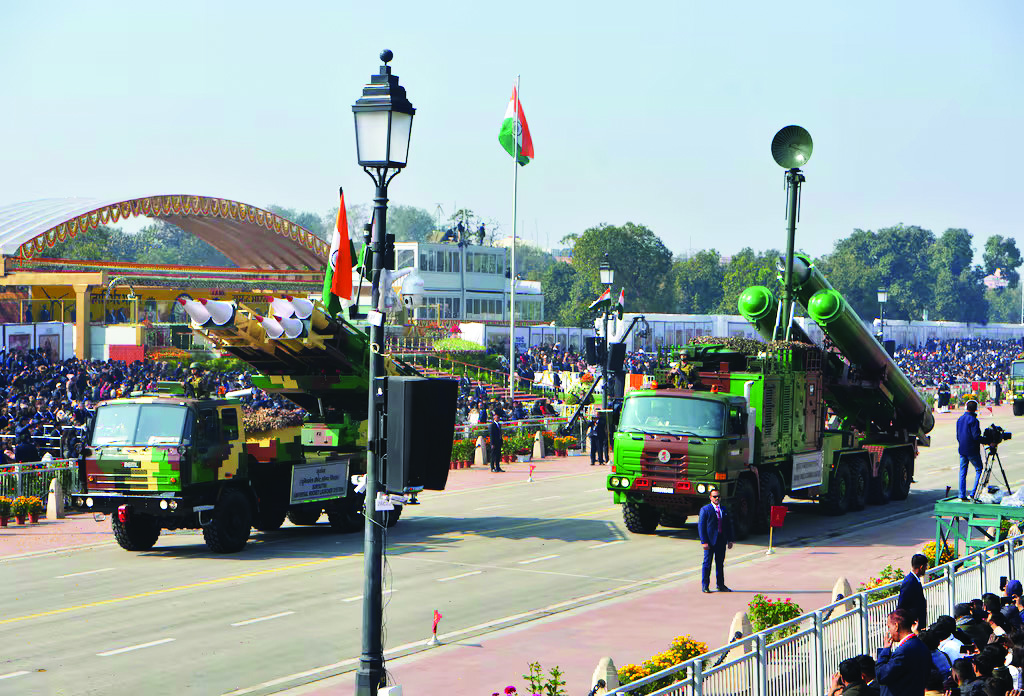
Image Courtesy: PIB
The creative economy also expands India’s soft power. Film, animation, visual effects, gaming, digital content, tourism, sports and the performing arts can create international connections while generating employment and economic value. These sectors increasingly depend on advanced technologies such as artificial intelligence, computer graphics, digital platforms and high-performance computing. India’s traditional knowledge can similarly contribute when historical claims are carefully distinguished from scientifically established evidence and areas requiring further research. Soft power therefore connects culture, knowledge, creativity, technology and international influence, strengthening India’s broader national power.
SAPTADHARA AND VIKSIT BHARAT
The 15th August address placed Saptadhara within the broader national vision of transforming India into a developed nation by 2047. The Prime Minister connected national development with ambition, determination and capability, emphasising that higher aspirations must be supported by stronger national capacities. From this perspective, a scientifically and technologically developed India cannot be measured only by the size of its GDP. It must also demonstrate high productivity, technological sovereignty, globally competitive manufacturing, modern agriculture, world class infrastructure, energy and resource security, indigenous defence capabilities, environmental sustainability, skilled human capital, globally competitive research, innovation driven enterprises and growing cultural and technological influence.
Saptadhara provides a framework through which these objectives can reinforce one another. Its significance lies in treating development as a systems problem rather than a collection of separate sectors. Manufacturing depends on technology, while technology depends on research, skills and infrastructure. Agriculture becomes more competitive through processing, logistics and market connectivity. Infrastructure creates greater value when supported by productive industries and efficient markets. Green development requires scientific innovation and resource security, while defence capability increasingly depends on advanced technologies and domestic manufacturing. Similarly, India’s soft power becomes stronger when supported by economic strength, scientific achievement, technological capability and cultural confidence.
The seven streams therefore converge into a single framework of national capability. The destination is Viksit Bharat, the pathway is Saptadhara, and the underlying engine is the systematic transformation of knowledge into technology, technology into production, production into prosperity, and prosperity into national capability.
*The author is a Professor, Department of Physics, University of Lucknow.