


Image Courtesy: NIOT
TECH TALK / MULTI-FUNCTIONAL NANOBOTS
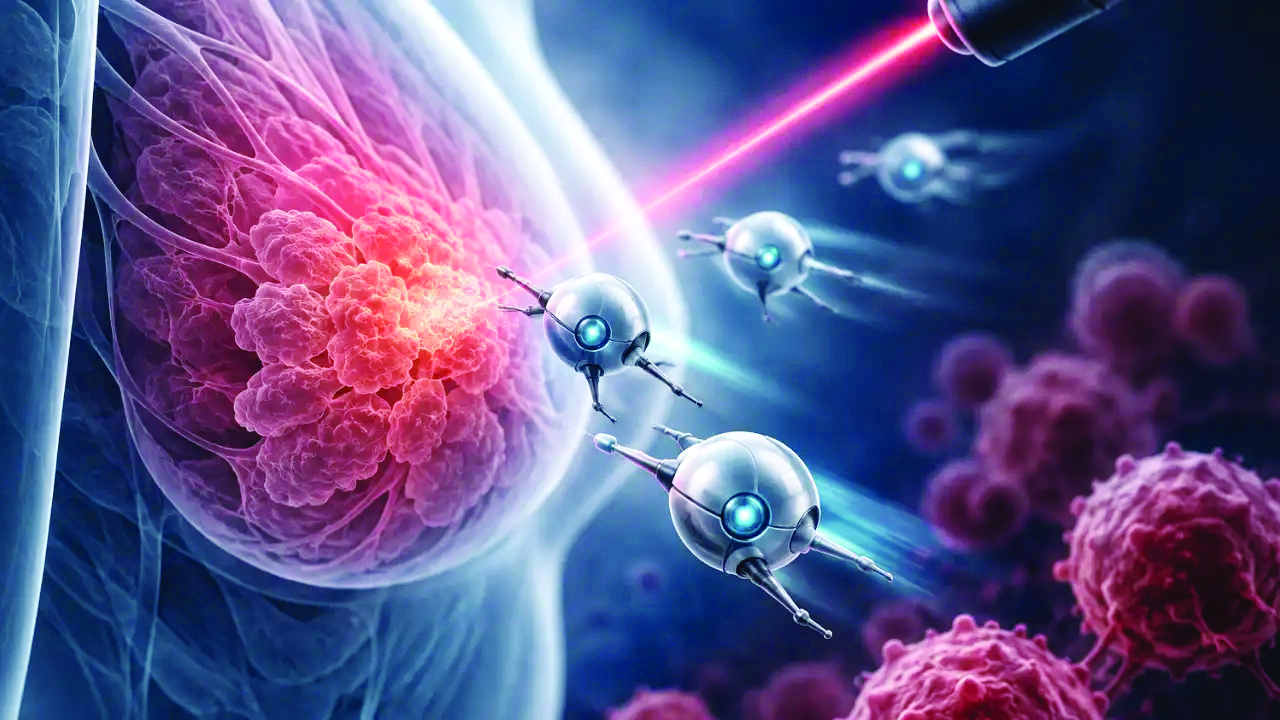
In a significant advance towards precision cancer therapy, Indian researchers have developed multifunctional nanobots that can be remotely guided using near-infrared (NIR) light to target and destroy breast cancer cells.
The research addresses a major challenge in cancer treatment: delivering therapy precisely to a tumour while limiting damage to healthy tissue. Conventional chemotherapy circulates drugs throughout the body and can therefore cause substantial side effects. Nanomedicine has sought to overcome this problem, but many existing nanoparticles still depend largely on passive accumulation inside tumours and have limited ability to penetrate tissue or be externally controlled once administered.
Researchers at the Institute of Nano Science and Technology (INST), Mohali, an autonomous institute under the Department of Science and Technology (DST), sought to combine nanorobotics with phototherapy to create a platform that could both actively navigate and perform cancer treatment.
Dr Jiban Jyoti Panda of INST led the work in collaboration with Dr Santosh K Gupta of Bhabha Atomic Research Centre (BARC), Mumbai. Swapnil Srivastava is the first author, with Annu Balhara, Pankaj Kharra and Jyoti Yadav also contributing to the research.
At the heart of the technology are upconversion nanoparticles, or UCNPs. These materials can absorb near-infrared radiation and convert it into shorter-wavelength light. This property has attracted considerable interest in cancer research because NIR light can penetrate biological tissue more effectively than ultraviolet or visible light typically used for photoactivation. Previous studies have demonstrated the potential of UCNPs for NIR-mediated photodynamic therapy and remotely activated drug-delivery applications.
The Indian team’s nanobots go further by integrating several functions into one system.
When exposed to a 980-nanometre NIR laser, polydopamine incorporated into the system generates localised heat. This creates a temperature gradient that drives the nanobots towards the light source—a phenomenon known as phototaxis. In effect, light not only activates the treatment; it also directs the nanobots to the desired location.
The researchers also functionalised the nanobots with a photosensitiser. Under NIR irradiation, this component produces reactive oxygen species (ROS) that can damage and kill cancer cells. At the same time, the heat generated by the system provides a photothermal effect. Combining photothermal and photodynamic mechanisms can produce stronger tumour inhibition than either approach acting independently.
Targeting is further strengthened through folic acid functionalisation. Certain breast cancer cells overexpress folate receptors, allowing the folic-acid-coated nanobots to preferentially recognise these cells and concentrate their therapeutic action there.
The concept builds on growing evidence that NIR-responsive upconversion nanoparticles can improve the reach and control of photodynamic cancer treatment. Earlier research has shown that UCNP platforms can convert deeper-penetrating NIR radiation into wavelengths that activate photosensitizers, while targeted surface modifications can improve selectivity toward cancer cells.
Importantly, the researchers have tested their system not only in cellular experiments but also in breast tumour-bearing mice, where the nanobots demonstrated therapeutic efficacy.
Published in ACS Applied Materials & Interfaces, the study describes a fuel-free, NIR-responsive nanobot whose behaviour can be influenced by laser intensity as well as conditions such as pH and glutathione concentration in biological environments.
The technology remains at the preclinical research stage, and substantial further testing will be required before any application in human patients. Questions including long-term safety, clearance from the body, manufacturing scalability and effectiveness in human tumours will need to be addressed.
Instead of simply sending medicine throughout the body and relying on it to reach a tumour, such nanobots could eventually allow doctors to exercise far greater spatial and temporal control over therapy, bringing precision medicine closer to treatment that is targeted, remotely activated and potentially less damaging to healthy tissue.