

Image Courtesy: PIB
YOUNG SCIENTIST / DR DEEPA AGASHE
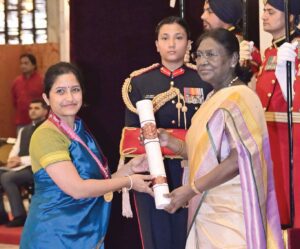
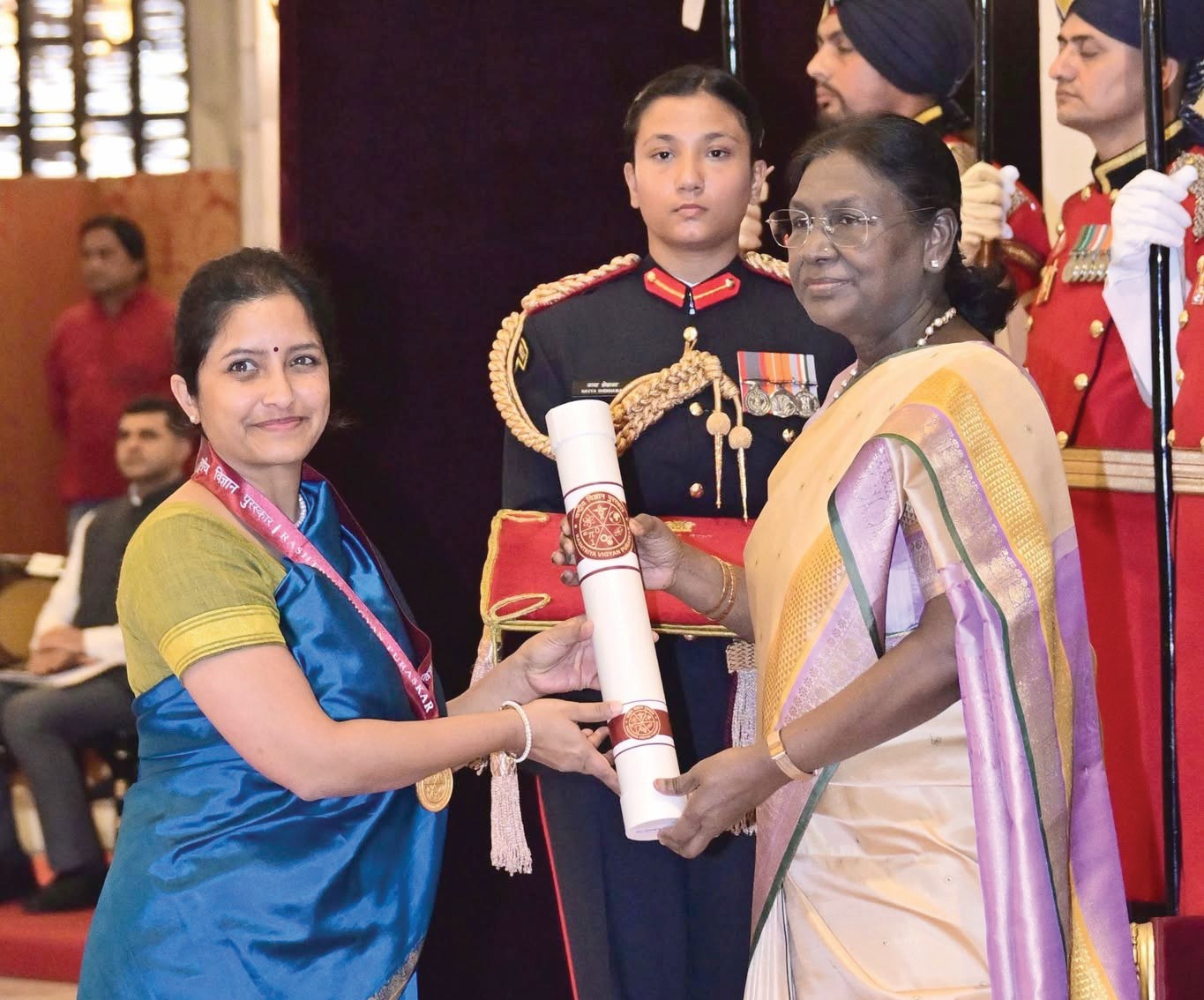
Dr Deepa Agashe was selected for the Rashtriya Vigyan Puraskar 2025 in the Vigyan Yuva–Shanti Swarup Bhatnagar category in Biological Sciences. The award, instituted by the Government of India, recognises scientists under 45 for significant achievements in science and technology.
Dr Agashe is currently an Associate Professor at the National Centre for Biological Sciences, Tata Institute of Fundamental Research (NCBS-TIFR), Bengaluru, where she leads the AdaptationLab. Her central scientific question is deceptively simple: how do living organisms cope with a new environment? Her laboratory investigates this question using bacteria and insects, combining experimental evolution with genomics, molecular biology, bioinformatics and studies of natural populations.
Dr Agashe’s academic journey began in Pune. She completed her Bachelor’s degree in Microbiology from MES Abasaheb Garware College, University of Pune, in 2003. She subsequently moved to the United States for doctoral research and earned her PhD from the University of Texas at Austin in 2009, working with evolutionary biologist Daniel Bolnick.
Her doctoral research examined how genetic variation within populations influences ecological and evolutionary outcomes. Working with flour beetles, she showed that genetic diversity could help stabilise animal populations and improve their ability to adapt to new ecological niches. The work addressed an important evolutionary question: does diversity within a species merely reflect evolution, or can it itself influence a population’s capacity to survive environmental change?
Dr Agashe then undertook postdoctoral research at Harvard University with Christopher Marx. There, she turned to bacterial evolution and investigated so-called synonymous or ‘silent’ mutations. Such mutations do not alter a protein’s amino-acid sequence and were traditionally regarded as relatively inconsequential. Her research helped demonstrate that these mutations can nevertheless have substantial effects on bacterial fitness and evolutionary outcomes.
In 2012, Dr Agashe returned to India and established her independent research programme at NCBS-TIFR.
UNDERSTANDING THE RULES OF EVOLUTION
A major strand of Dr Agashe’s work investigates bacterial genome evolution. Her team studies how features such as codon usage, transfer-RNA genes, genome composition and mutation patterns influence adaptation. A key theme is distinguishing evolutionary changes driven by natural selection from those that arise by chance or from inherent biases in how mutations occur.
One particularly important area of research concerns mutation bias. Evolution depends on mutations, but mutations do not necessarily arise with equal probability. Dr Agashe’s group has investigated how changing the kinds of mutations available to a population can alter the distribution of their beneficial, harmful or neutral effects and, consequently, redirect evolutionary trajectories. Recent work from her laboratory has shown that mutation bias can itself alter the fitness effects of new mutations, adding another layer to our understanding of how evolution proceeds.
Her laboratory also studies insects adapting to new food resources. This work examines the genes, behavioural choices and gut microbes that may help insects exploit unfamiliar environments. In doing so, Dr Agashe connects molecular changes inside an organism with broader ecological processes— how species colonise new habitats, specialise on particular resources and potentially diverge over time.
This combination of bacteria and insects gives her laboratory an unusually broad perspective. Bacteria let researchers watch evolution unfold rapidly over many generations, while insects let them explore behaviour, ecology, diet and interactions with microbes.
In 2020, she received the SERB Women Excellence Award, recognising outstanding research by women scientists working in frontier areas of science and engineering. In 2024, the Society for Molecular Biology and Evolution awarded her its Mid-Career Excellence Award, honouring her contributions to evolutionary and molecular biology.