



Image Courtesy: PIB
TECH TALK / UNIFIED DENTAL IMPLANT
Researchers have developed a bi-layered, single-piece dental implant that could reduce the number of surgical interventions required for implantation while improving durability, stability and biocompatibility.
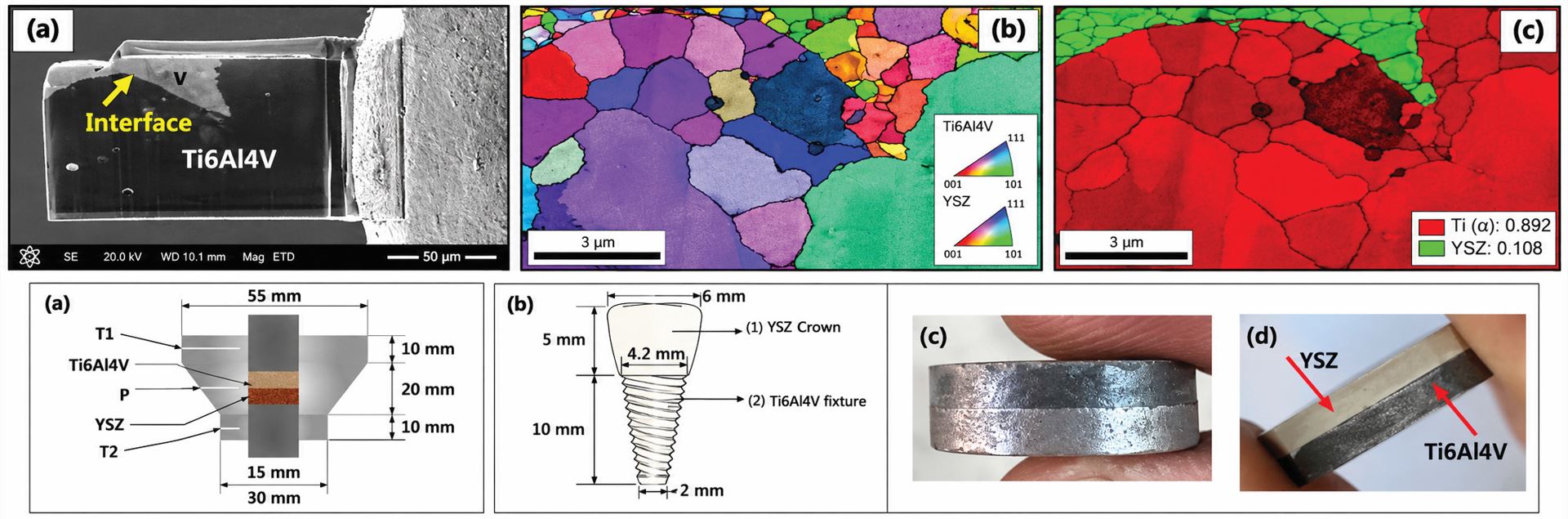
The new structure, developed by scientists at the International Advanced Research Centre for Powder Metallurgy and New Materials (ARCI) in Hyderabad, an autonomous institute of the Department of Science and Technology (DST), combines titanium alloy (Ti6Al4V) and yttria-stabilised zirconia (YSZ) in a unified implant.
Conventional dental implants generally consist of three components—a fixture embedded in the jawbone, an abutment connecting the fixture to the crown, and the crown itself. Micromovements can occur at the interfaces of such multi-component systems, potentially affecting osseointegration and contributing to the loosening of the implant. The procedure can also require two to three surgical interventions, increasing patient discomfort and clinical complexity.
The materials commonly used for implants also have individual limitations. Titanium alloy Ti6Al4V provides high mechanical strength and biocompatibility but can be susceptible to corrosion and gum recession in the moist oral environment. Zirconia, meanwhile, offers corrosion resistance and better aesthetics but may undergo hydrolytic degradation over time.
ARCI researchers sought to combine the advantages of both materials while overcoming these limitations.
In the new bi-layered structure, Ti6Al4V forms the load-bearing fixture, providing mechanical strength and supporting integration with the jawbone. YSZ forms the crown region, offering superior wear resistance, corrosion resistance and aesthetics.
The implant was fabricated using Spark Plasma Sintering (SPS), an advanced powder-metallurgy technique. Researchers used a custom-designed tapered graphite die to precisely control temperature during sintering, enabling simultaneous densification of Ti6Al4V and YSZ despite the two materials having substantially different sintering temperatures.
The process achieved a material density of 99.5 per cent, resulting in a strong and defect-free bi-layered structure in a single processing step.
Researchers subsequently conducted machining trials using a five-axis CNC machine to create the threaded implant shape. Some challenges were encountered in tool movement along curved surfaces, and further optimisation of the process is underway. However, the overall fabrication method was found to be highly reproducible, indicating potential for scaling up to industrial production.
Tests of the interface between the titanium alloy and zirconia showed strong bonding without cracks, delamination, pores or secondary phases. Researchers observed fine YSZ grains of approximately 0.3 micrometres, while Ti6Al4V grains near the interface were refined to around 0.3–1 micrometre.
No noticeable elemental diffusion was detected across the interface, indicating a stable transition between the ceramic and metallic components.
Mechanical testing also demonstrated strong performance. The bi-layered structure recorded hardness values of up to 1,350 HV, compressive strength of approximately 1,550 MPa and flexural strength of around 310 MPa—figures comparable to or exceeding those of commercial implant materials.
Biological studies further indicated that the material was non-cytotoxic and highly biocompatible. MTT assays, which measure cellular metabolic activity, conducted using L929 mouse fibroblast cells showed metabolic activity above 90 per cent across all tested concentrations. Hemolysis testing also showed negligible damage to red blood cells. By combining the mechanical strength of titanium alloy with corrosion and wear resistance, and aesthetic advantages of zirconia, the researchers have developed a single-piece architecture that could address several limitations of conventional dental implants.