

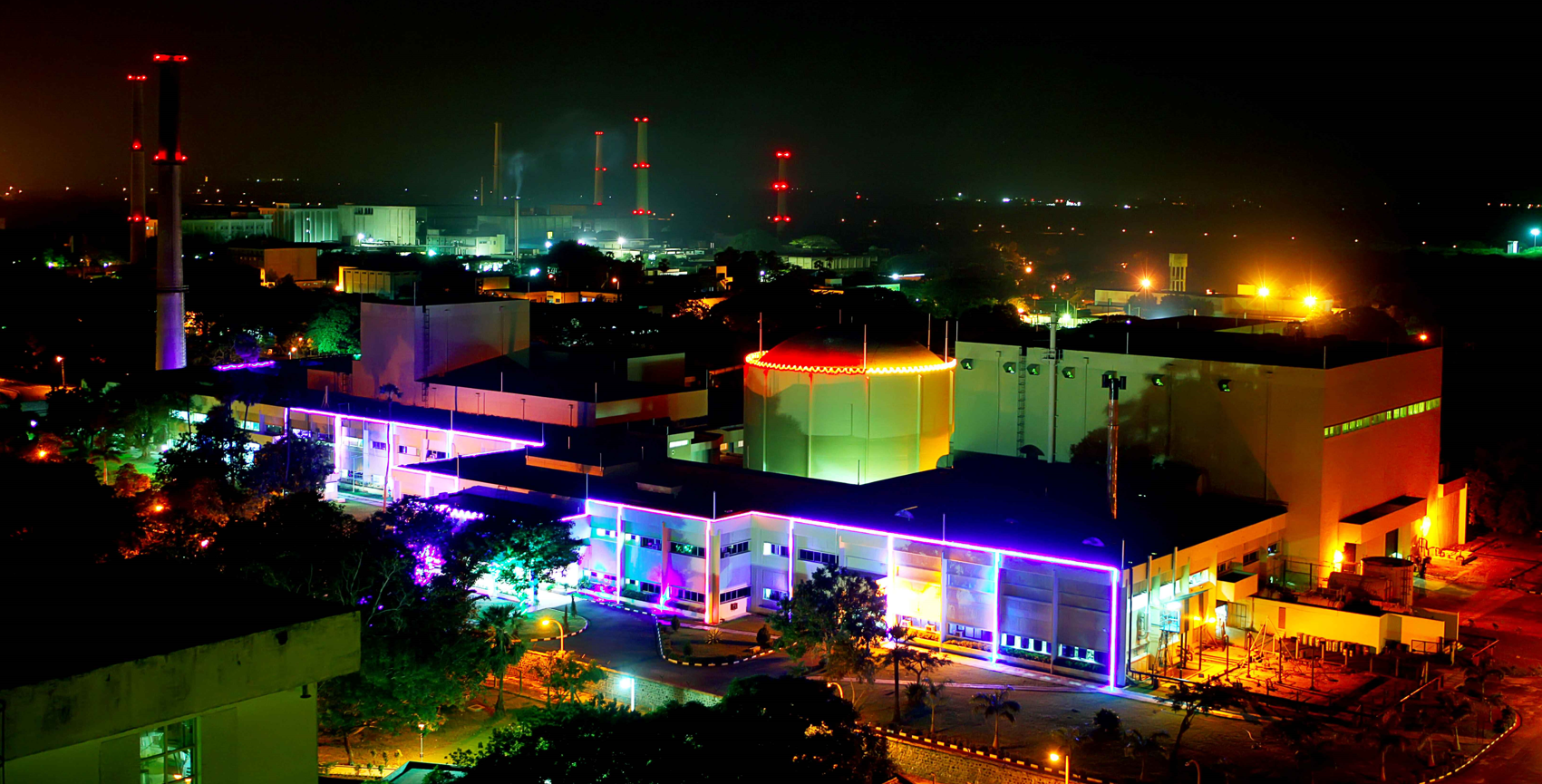
Image Courtesy: IGCAR
Energy is the driver for growth. For India to achieve its vision of Viksit Bharat 2047, availability of adequate energy sources is vital. The energy basket of the country should be a blend of energy sources commensurate with its availability in the country and also enable us to meet the global ‘Net Zero’ commitments. Currently, India possesses the world’s fifth-largest coal reserves, but our oil and natural gas are modest, leading to substantial imports. While renewables like solar and wind are growing, they currently complement base-load stations dependent on fossil or nuclear plants. India has modest uranium reserves but one of the world’s largest thorium reserves. Since electricity generation contributes to over 40% of national greenhouse gas emissions, a nuclear programme based on a closed-cycle approach—enabling the full use of uranium and thorium—is inevitable for our development aspirations.
The main advantages of nuclear energy include: (a) it delivers large scale low carbon power – it is one of the cleanest power sources when assessed across the fuel cycle (b) it is a reliable baseload power – nuclear power plants can provide a continuous and reliable supply of energy because they operate at nearly full capacity (c) Nuclear fuel contains energy in a concentrated form requiring much less tonnage for fuel to be transported or stored. A small pellet of uranium about an inch in diameter and height can deliver the energy equivalent of about 1000 kg of coal and (d) a nuclear energy facility requires much smaller area footprint compared to equivalent solar or wind facilities.
INDIA’S NUCLEAR STRATEGY
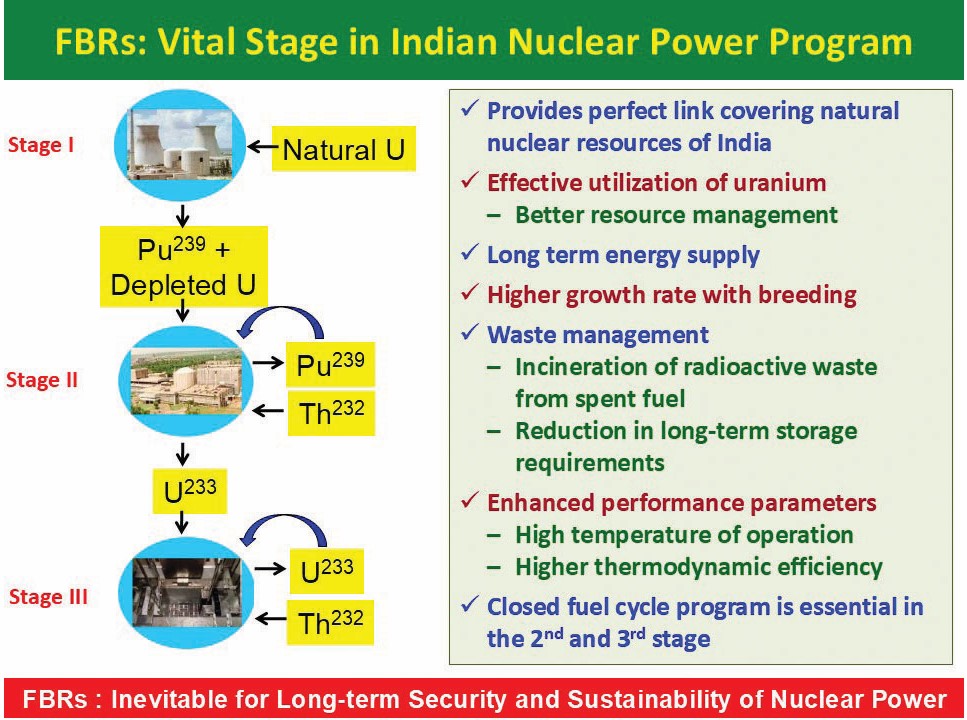
The strategy for growth of nuclear power in India was planned more than seventy years ago by the founding father of Indian Atomic Energy programme, Dr Homi Bhabha. Recognising the fact that we have modest uranium but large thorium reserves, he conceived a three-stage strategy for our nuclear power programme. The first stage envisaged installation of natural uranium fuelled indigenous heavy water moderated thermal reactors, the Pressurised Heavy Water Reactors (PHWRs), to generate electricity and produce large quantities of plutonium. The second stage envisaged plutonium
fuelled fast breeder reactors to produce electricity and also more plutonium as well as U-233 from the thorium blankets surrounding the core, and the third stage envisaged-advanced reactors optimised to operate on the Thorium–Uranium 233 cycle.
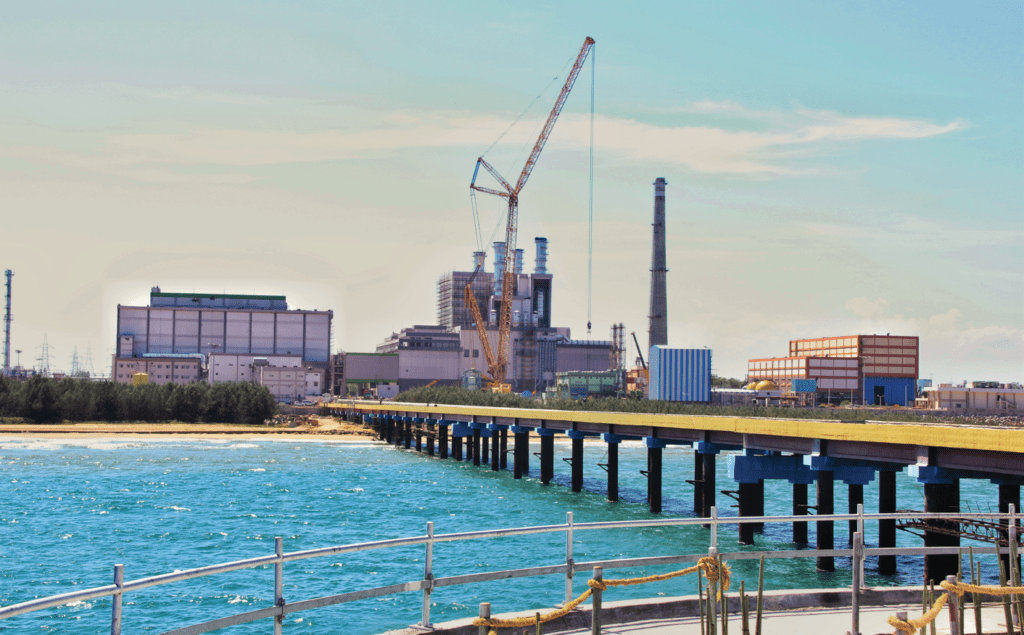
Image Courtesy: IGCAR
The first stage primarily based on PHWRs is very mature with 21 PHWRs so far with an installed capacity of 6560 MWe. Three more plants with unit size of 700 MW are under construction and 10 more plants in fleet mode with unit size of 700 MW have been approved by the Government of India. Nuclear Power Corporation of India Limited (NPCIL) of the Department of Atomic Energy (DAE), which is responsible for design, construction, commissioning and operation of nuclear power reactors, has consistently maintained overall availability factor of reactors above 80% for several years. NPCIL has also set several records in the safe operation of nuclear power plants.
BRIEF GENESIS OF FAST BREEDER TEST REACTOR-SECOND STAGE
The Fast Reactor programme had its humble beginnings in 1968 in the Fast Reactor Section of Reactor Engineering Division, Bhabha Atomic Research Centre (BARC). As a first step, a 10 MW research reactor was envisaged to be built. It was decided that rather than starting ab-initio, we can go for an international collaboration to accelerate the programme, and the French Rapsodie Fortissimo reactor at Cadarache was chosen. The excellent rapport between the French and Indian governments resulted in the signing of an MOU between DAE and French CEA for (a) transfer of design and drawings of Rapsodie fast reactor (b) training of Indian team in design and operation and (c) transfer of manufacturing technology of critical components to Indian industries.
It was due to the vision of Dr Vikram Sarabhai that a decision was taken to establish an exclusive centre named Reactor Research Centre (RRC, subsequently renamed as Indira Gandhi Centre for Atomic Research or IGCAR), dedicated to the pursuit of fast reactor science & technology and its commercial exploitation. On 30 April 1971, Dr Sarabhai signed the order for the formation of the Reactor Research Centre (RRC) at Kalpakkam in Tamil Nadu. A sodium cooled Fast Breeder Test Reactor (FBTR) was to be the hub of this centre. Construction started with the ground breaking ceremony in 1972. Along with the FBTR, activities were initiated in parallel for reactor engineering and design, materials science, metallurgy, materials chemistry, reprocessing, safety and allied infrastructural facilities like engineering workshops, administration and accounts, etc.
However, following the 1974 peaceful nuclear explosion at Pokhran, international collaborations ceased and an embargo was imposed. France refused to supply us with the fuel for FBTR. Even minor equipment, instruments, materials and sensors were denied to us internationally, particularly for FBTR. India had no option but to meet the challenge of developing its own materials, sensors and of course, the fuel.

DAE took a very bold decision of developing an indigenous, high-plutonium mixed carbide fuel to sustain the small FBTR core—a path then considered high-risk and largely experimental. It is worth mentioning here that during the 1960s and ’70s, countries like the USA, France and Russia explored carbide fuels, but eventually abandoned them deterred by their pyrophoric nature, complexities of handling and the challenges of large-scale reprocessing. Despite this, scientists at BARC took up the challenge. They successfully developed the procedures, infrastructure for handling the entire manufacture and fabrication process remotely and in an inert atmosphere, fabricated the unique 70% PuC – 30% UC composition mixed carbide fuel (PuC-UC) for FBTR. The fuel would normally be in the form of small pellets about 5 mm in diameter and about an inch in height. In a nuclear reactor, the fuel isn’t just loaded like this. It is sealed into long, thin metal tubes (pins), and then dozens of these pins are packed tightly into a strong (hexagonal in case of FBTR) metal casing. This entire ‘package’—the casing plus the fuel pins inside—is what we call a subassembly. Manufacturing and fabricating these precision-engineered fuel bundles with the fuel pellets developed by BARC was the responsibility of the Nuclear Fuel Complex (NFC). A total of 23 fuel subassemblies were fabricated and delivered at Kalpakkam during 1983-84.
It was a day of great joy and fulfillment when the Fast Breeder Test Reactor went critical on 18 October 1985.
Since then, the reactor had been operating satisfactorily, meeting many design criteria and providing valuable experience in fast reactor technology. FBTR has achieved many milestones and overcome many problems. On 7 March 2022, FBTR achieved its rated capacity. It has produced more than 200 million units of electricity also.
The PuC-UC fuel stands as a landmark achievement in India’s nuclear history, transitioning from a strategic necessity to a global technological milestone. This ‘forced’ innovation resulted in an unprecedented success; the fuel has exceeded all performance expectations, achieving a world-record burn-up of about 165,000 MWd/t, making FBTR the only reactor in the world to have successfully utilised mixed carbide as its primary driver fuel for four decades.
FBTR is the mother of Fast Reactor Programme. The excellent performance of fuel and components, operational experiences with FBTR and the broad, multidisciplinary R&D base at the Indira Gandhi Centre for Atomic Research provided the confidence to the scientists and engineers of IGCAR and DAE to launch the Prototype Fast Breeder Reactor (500 MWe) as the next step in the development of fast reactor technology.
THE MIGHTY HANUMAN JUMP FROM FBTR TO THE REACTOR THAT BREEDS–PFBR
Referring to India’s bold decision to move directly from FBTR (~10 MWe) to the massive 500 MWe Prototype Fast Breeder Reactor (PFBR), Dr Georges Vendryes (Former Executive Director, CEA France) remarked “Moving straight from FBTR to PFBR is a kind of Hanuman Jump.”
IGCAR initiated the Detailed Project Report as early as 1990s and after multiple reviews and taking into account the international experiences and also lessons from technology development of fast reactor components submitted the proposal to Government of India. The government approved the proposal in September 2003 and a new Public Sector Unit (PSU) called Bharatiya Nabhikiya Vidyut Nigam Limited (BHAVINI) was established in October 2003 for the construction and operation of PFBR. Figure on page 11 provides a comparison of the technical characteristics of FBTR and PFBR.
PFBR is a 500 MWe pool-type sodium-cooled fast breeder reactor developed indigenously by DAE through IGCAR (designer) and BHAVINI (construction and operation) and supported by other DAE units like BARC, NFC, ECIL, HWB etc and with the objective of demonstrating fast reactor technology at commercial scale.
In a fast breeder reactor, the fission chain reaction is sustained by fast neutrons, unlike conventional thermal reactors where neutrons are slowed down by a moderator. The PFBR therefore does not use a moderator. Its core contains mixed oxide fuel, consisting of plutonium oxide and uranium oxide. Around the fissile core, fertile uranium-238 blanket assemblies are provided. During reactor operation, some of the fast neutrons convert uranium-238 into plutonium-239, thereby producing new fissile material. In PFBR we can have thorium blankets in addition to the depleted uranium blankets thus making it possible to produce U-233 the fuel for the third stage. Since the reactor can generate additional nuclear fuel while producing electricity, it is also referred to as “breeder”.
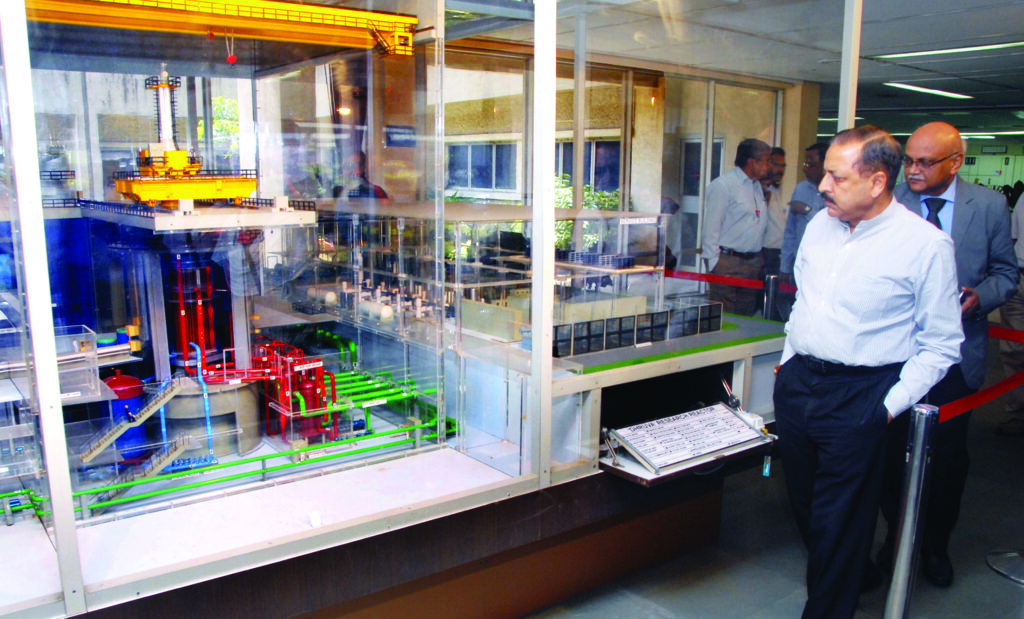
Image Courtesy: Wikimedia Commons
The reactor uses liquid sodium as a coolant because sodium has excellent heat-transfer properties, remains liquid over a wide temperature range, and does not significantly slow down neutrons. Unlike conventional water-cooled reactors (like PHWRs), which must keep water under immense pressure to prevent it from boiling, liquid sodium in PFBR operates at near-atmospheric pressure. This makes the system inherently more stable. The PFBR has a pool-type configuration, in which the reactor core, primary sodium pumps, intermediate heat exchangers and associated primary sodium systems are housed within a large reactor vessel filled with sodium.
Heat generated in the core is removed by the primary sodium coolant and transferred through intermediate heat exchangers to a separate secondary sodium circuit. The secondary sodium then transfers heat to water/steam in steam generators, producing high-pressure steam to drive the turbine-generator and generate electricity. The use of an intermediate sodium circuit ensures that radioactive primary sodium is isolated from the water-steam system, adding an important safety barrier.
The PFBR core is compact and has a high power density compared with thermal reactors. The core consists of several types of subassemblies, including fuel subassemblies, blanket subassemblies, control and safety rod assemblies, reflector and shielding assemblies. Reactor power is controlled by absorber rods, while independent shutdown systems are provided for safe and rapid reactor shutdown when required.
From a materials and engineering point of view, PFBR is very technologically challenging and highly demanding system. Components must operate at elevated temperatures in a sodium environment, with stringent requirements on purity, dimensional tolerances, weld quality, creep-fatigue performance, thermal striping resistance and long-term structural integrity. Large components such as the reactor vessel, main vessel internals, roof slab, rotating plugs, primary pumps, intermediate heat exchangers and steam generators required advanced manufacturing, welding, inspection and quality assurance practices. The codes of practice adopted was much more stringent compared to the existing international codes of practice. IGCAR and BHAVINI engineers hand held with the Indian industries for the manufacture of these components.
PFBR also incorporates multiple engineered safety features. These include negative reactivity feedbacks, two independent shutdown systems, decay heat removal systems, sodium leak detection, fire protection systems, inert cover gas systems, biological shielding, containment provisions and extensive instrumentation for monitoring sodium temperature, flow, level, purity and activity. In the event of a total power failure where all pumps stop, the PFBR is designed so that the natural laws of physics—specifically natural convection—take over. The heat naturally rises and dissipates through dedicated safety chimneys (Safety Grade Decay Heat Removal System), cooling the reactor without needing any human intervention, electricity, or ‘active’ machinery.
In essence, PFBR is not merely a power reactor but a technology demonstrator for India’s closed fuel cycle and fast breeder programme. It is an Atmanirbar effort and a unique collaboration between DAE and more than 200 industries which spanned industrial giants like L&T, BHEL, Kirloskar Brothers, Walchandnagar, Godrej, MTAR, Avasarala, etc. to medium and small scale industries. It is a matter of pride that these critical components were built with micron level precisions and very close design tolerances within India. PFBR integrates reactor physics, sodium technology, high-temperature structural materials, fuel fabrication, remote handling, advanced manufacturing, and nuclear-grade quality assurance. Its successful realisation is therefore a major step towards establishing India’s long-term vision of energy security through the three-stage nuclear power programme.
As India continues to expand its clean energy portfolio, fast breeder reactors are expected to play a crucial role in delivering reliable, low-carbon, base-load power with higher thermal efficiency. The successful achievement of first criticality represents not only a technological milestone but also a major step toward a sustainable and self-reliant energy future for a Viksit Bharat.
*The writer is DAE Homi Sethna Chair Senior Professor, Homi Bhabha National Institute, Distinguished Scientist and Former Director, Indira Gandhi Centre for Atomic Research, Kalpakkam.