


Image Courtesy: AAKA Space
TECH TALK / 3D-PRINTED SHIELD
In a breakthrough that signals India’s growing ambition in deep-space exploration, Ahmedabad-based AAKA Space Studio has developed Asia’s first 3D-printed radiation shield designed for houses on Mars. This innovation is not just a technological milestone but a crucial step toward making human life on the Red Planet a practical reality.
The development comes at a time when global space agencies are actively planning long-duration missions to Mars. While rockets and propulsion systems often dominate headlines, the real challenge lies in something more fundamental, how humans will live, survive, and build on another planet. AAKA Space’s breakthrough directly addresses this challenge.
At the heart of this innovation is a 3D-printed shield capable of protecting future Martian habitats from cosmic and solar radiation, one of the biggest threats to human survival on Mars. Unlike Earth, Mars lacks a strong magnetic field and a dense atmosphere, leaving its surface highly exposed to radiation that can cause severe health risks, including long-term cellular damage.
What makes this innovation particularly significant is its reliance on the concept of In-Situ Resource Utilisation (ISRU) – a method of using locally available materials instead of transporting everything from Earth. Transporting construction materials across millions of kilometres is prohibitively expensive and logistically complex. AAKA’s solution tackles this problem by using Martian soil-like material (regolith) to build protective structures directly on-site.
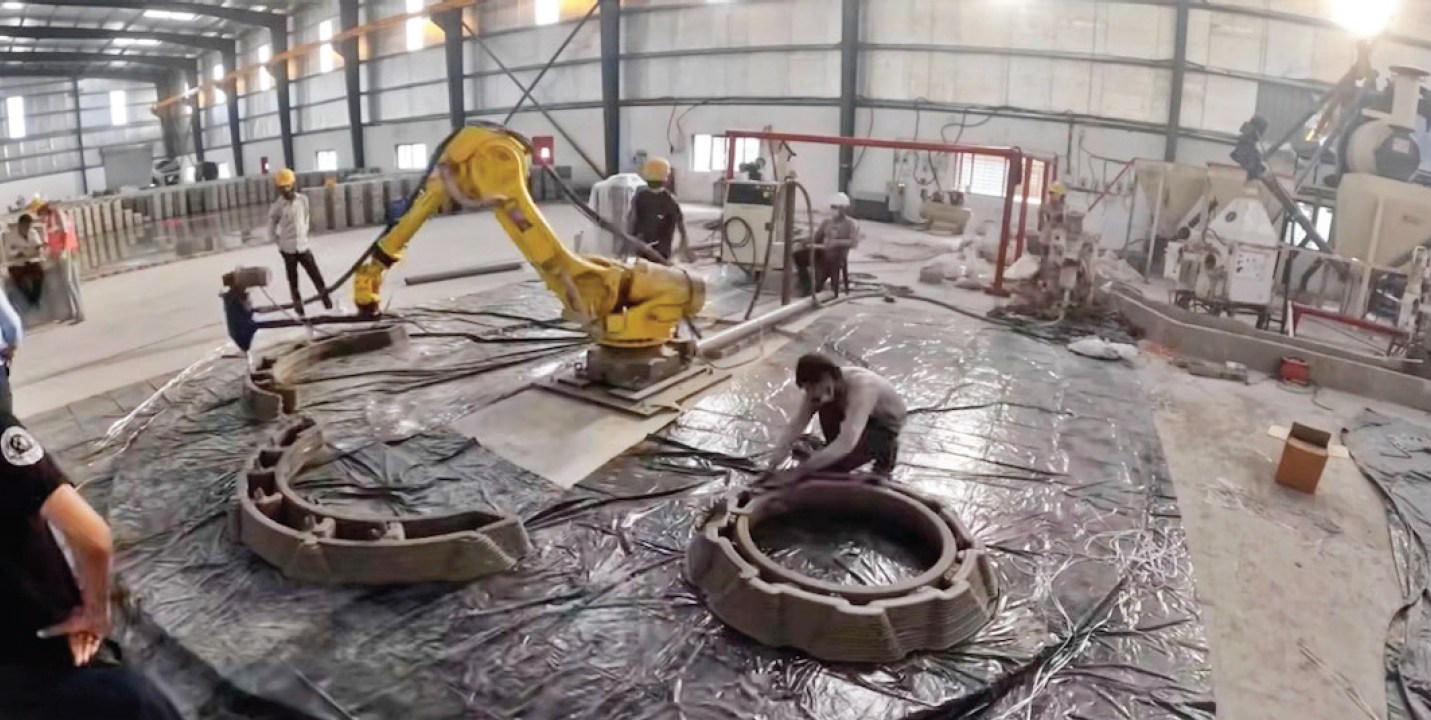
To test this idea, the team recreated Martian conditions on Earth with remarkable precision. They used olivine-rich rocks sourced from Tamil Nadu and limestone analogues from the Ariyalur basin (also in Tamil Nadu), combining them with specially engineered binders to simulate Martian soil behaviour. This allowed them to develop a material that could be used in large-scale 3D printing, layer by layer, just as it would be on Mars.
The actual construction process involved advanced robotic systems and 3D concrete printing technology developed in collaboration with MiCoB (a 3D Concrete Printing firm located in Gujarat). These systems enabled autonomous, precise, and scalable construction, a necessity in space environments where human labour will be extremely limited. The result is a monolithic radiation shield that not only protects against radiation but also provides thermal stability and structural strength, key requirements for long-term habitation.
The innovation was successfully tested during an analog space mission in India, simulating extraterrestrial conditions. This real-world validation is critical, as it demonstrates that such structures can be built efficiently and reliably even in extreme environments.
The implications of this development are far-reaching. By reducing dependence on Earth-supplied materials, this technology can significantly lower mission costs and payload requirements. More importantly, it enables the possibility of scalable habitat construction—a crucial factor if humans are to establish permanent settlements on Mars or even on the Moon.
Globally, agencies like NASA have long explored 3D printing as a solution for extraterrestrial construction, including habitat challenges focused on building structures using local materials. AAKA’s achievement places India firmly within this global race, not just as a participant but as an innovator. Beyond its technical brilliance, the project also represents the rise of India’s private space ecosystem. Startups like AAKA Space are bridging the gap between architecture, material science, and aerospace engineering, fields that must converge for successful space colonisation.