


Image Courtesy: NIOT
TECH TALK / HIGH-ALTITUDE HEXACOPTER DRONE
For decades, India’s weather forecasting infrastructure has relied heavily on satellites, ground-based observatories and radiosonde balloons. While these systems have played a crucial role in meteorological observations, scientists have long sought a method that can repeatedly gather atmospheric data from the same location with greater precision.
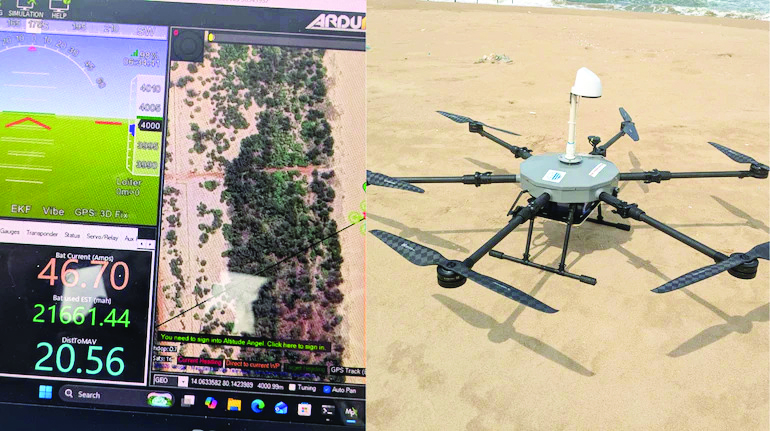
The answer has come in the form of a high-altitude hexacopter drone developed by the National Institute of Ocean Technology (NIOT) in Chennai. Weighing just 16 kilograms, the drone has been engineered to fly up to an altitude of five kilometres, carrying sophisticated instruments capable of measuring both meteorological and air-quality parameters.
The drone recently completed its first field trials at NIOT’s seafront campus along the Pamanji coast near Nellore in Andhra Pradesh. During the tests, it successfully collected atmospheric and pollution-related data up to four kilometres above ground level, validating its airworthiness and proving the feasibility of the technology.
The drone is equipped with an array of sensors capable of monitoring particulate matter (PM2.5), carbon dioxide, carbon monoxide, ozone, nitrogen oxides and sulphur dioxide. In addition, it records key meteorological variables such as air pressure, humidity and temperature. These measurements are vital for understanding the vertical structure of the atmosphere and for improving weather and climate models.
Unlike conventional weather balloons that drift with the wind and burst after reaching high altitudes, the NIOT drone is reusable and can perform repeated measurements over the same geographical location. This ability to collect consistent, location-specific data could significantly improve the accuracy of weather forecasting and air-quality assessments.
Developing a drone capable of operating in thin air and low-pressure environments was no easy task. Scientists built the aircraft using lightweight carbon composite materials and designed customised propellers that can function efficiently in low-density air. The team also replaced conventional lithium-ion batteries with lighter solid-state batteries to improve endurance and reduce overall weight.
The drone is capable of withstanding wind speeds of up to 50 kilometres per hour, enabling it to operate in challenging atmospheric conditions. Although it is not intended to fly directly into severe cyclones, researchers believe it can play a valuable role in studying pre- and post-cyclonic environments as well as less intense weather systems.
The drone has been developed under Mission Mausam, the Government of India’s flagship programme aimed at strengthening the country’s weather observation and forecasting capabilities. The initiative seeks to create a more resilient forecasting system capable of providing better warnings for extreme weather events, including heatwaves, heavy rainfall and cyclones.
As climate variability intensifies and urban pollution becomes an increasing public health concern, the need for precise atmospheric observations has never been greater. The successful trials of NIOT’s high-altitude drone demonstrate that indigenous innovation can provide cutting-edge solutions to these challenges.
India’s new weather sentinel may be small in size, but its contribution to understanding the atmosphere could be immense, helping scientists predict disasters better, monitor pollution more accurately and build a climate-resilient future.