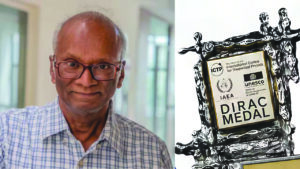


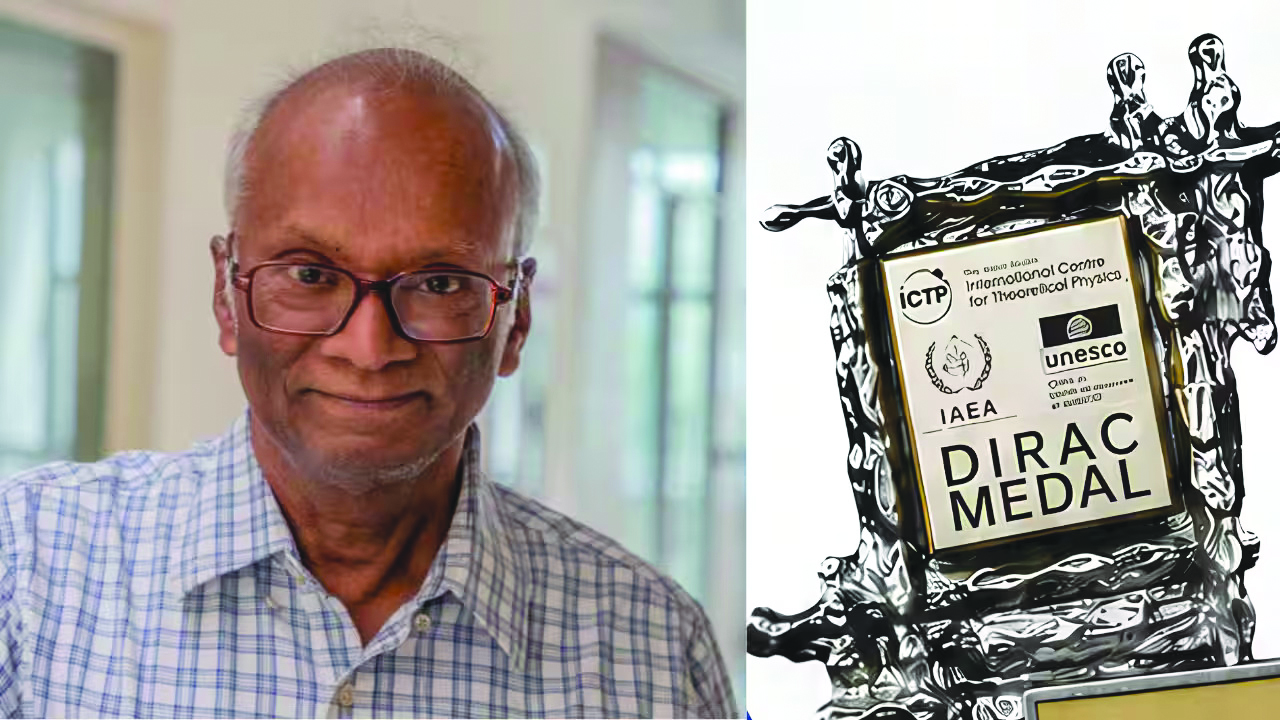
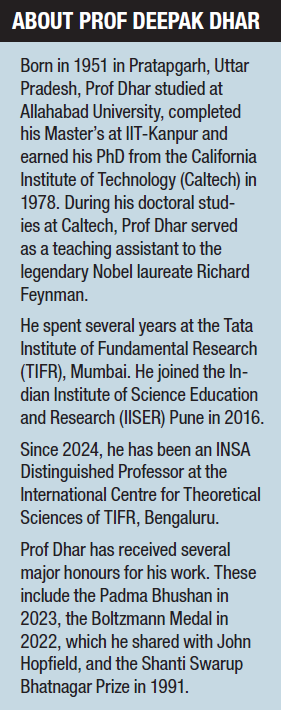
Noted Indian Theoretical Physicist Prof Deepak Dhar has been awarded the 2026 Dirac Medal by the International Centre for Theoretical Physics (ICTP) in Trieste, Italy, for his important work in statistical mechanics. Dhar is an INSA Distinguished Professor and is known for his research on statistical physics and stochastic processes. He is among four physicists selected for this year’s award for their contributions to theoretical physics.
The other recipients are Bernard Derrida, Honorary Professor at the College de France; Marc Mezard, Professor of Theoretical Physics at Bocconi University; and Haim Sompolinsky, Professor of Neuroscience and Physics at the Hebrew University of Jerusalem and Visiting Professor at Harvard University.
Instituted in 1985, the medal has previously been awarded to some of the biggest names, including Stephen Hawking. Prof Dhar is only the second scientist working in India to receive the Dirac Medal, after Ashoke Sen in 2014.
According to ICTP, Prof Dhar’s research has helped scientists understand how simple interactions between individual parts of a system can produce complicated behaviour when the system becomes large.
One of his best-known contributions is his work on the Abelian Sandpile model. The idea is fairly simple. When grains of sand are added to a pile, most of them either do nothing or cause a small movement. But sometimes, adding just one more grain can lead to a much bigger collapse.
ABELIAN SANDPILE MODEL & PROPERTY
Prof Dhar developed the Abelian Sandpile Model in 1990 as a mathematical advancement of the Self-Organized Criticality sandpile concept proposed in 1987 by Per
Bak, Chao Tang and Kurt Wiesenfeld. It explains how simple local interactions can generate complex, cascading behaviour in large systems.
Prof Dhar showed that the final stable configuration remains the same regardless of the order in which individual grains topple. This property allows the behaviour of the sandpile to be mathematically analysed despite its apparently unpredictable cascading behaviour.
The model demonstrates how a system can naturally reach a critical state, where a small disturbance may trigger anything from a minor event to a large-scale avalanche. This provides a framework for understanding cascading behaviour in complex systems. The model provides a way to understand cascading and complex behaviour in real-world systems. Its concepts have been applied to phenomena such as earthquakes, forest fires, traffic jams, neural activity and financial-market fluctuations.