

Image Courtesy: PIB
YOUNG SCIENTIST / DR WALIUR RAHAMAN
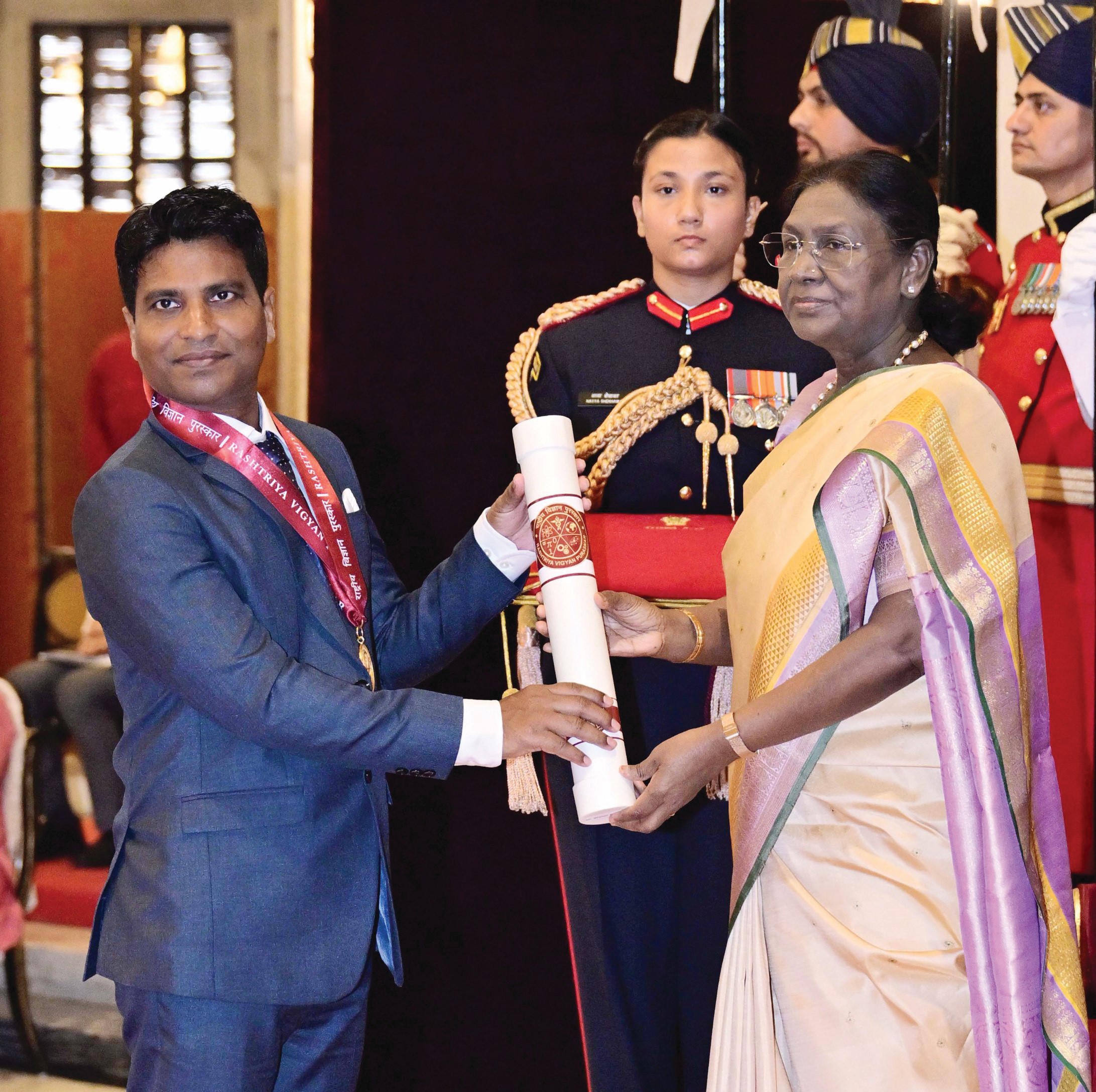
When scientists want to understand what the Earth looked like hundreds or thousands of years ago, there are no written records to turn to. Instead, they read clues preserved in rocks, sediments, oceans and ancient ice. Dr Waliur Rahaman has spent much of his scientific career learning how to decipher these clues. It is for this field of study, involving geochemistry and paleoclimatology, that he has been awarded the Vigyan Yuva– Shanti Swarup Bhatnagar Award 2025 in Earth Sciences.
A Scientist-F in the Isotope Geosciences division of the National Centre for Polar and Ocean Research (NCPOR), Goa, Dr Rahaman specialises in isotope geochemistry, paleo-oceanography and paleoclimatology. His research stretches geographically from the Himalayas to the oceans and Antarctica, but it is united by one fundamental question: how has the Earth changed over time, and what can its past tell us about the environmental and climatic changes occurring today?
Dr Rahaman’s journey in Earth Sciences began at the Aligarh Muslim University, where he completed his BSc in Geology and subsequently an MSc in Applied Geology. He then moved to the Physical Research Laboratory (PRL), Ahmedabad, for his doctoral research in geochemistry. His PhD work examined the chemistry and isotopic composition of estuaries and sediments of the Ganga basin—an early indication of his interest in using chemical fingerprints to reconstruct Earth processes.
His research career subsequently took him to Germany as an Alexander von Humboldt Postdoctoral Fellow at GFZ Potsdam. In 2012, he joined NCPOR, where his research expanded across some of the most complex questions in Earth and climate science. He was again awarded an Alexander von Humboldt Fellowship for Senior Researchers in 2022.
One of Dr Rahaman’s important contributions at NCPOR has been the establishment of ISOTRACE, a specialised laboratory for isotope geochemistry. Equipped with sophisticated facilities including Multi-Collector Inductively Coupled Plasma Mass Spectrometry and Quadrupole ICP-MS, the laboratory enables researchers to analyse trace elements as well as radiogenic and metal isotopes. Such measurements allow scientists to identify extremely subtle chemical signatures and use them to reconstruct geological, oceanic and climatic processes.
A major part of Dr Rahaman’s research concerns Antarctica, where layers of ice accumulated over long periods preserve chemical information about the Earth’s earlier atmosphere and climate. His work has examined Antarctic climate variability through chemical and isotopic records preserved in ice cores. In a 2024 study, Dr Rahaman and fellow NCPOR researchers investigated whether nitrate preserved in Antarctic ice could reliably record past solar activity. Using a high-resolution ice-core record from coastal Dronning Maud Land in East Antarctica, spanning 1905 to 2005, and comparing multiple Antarctic records, the researchers identified periodicities corresponding to the approximately 11-year solar cycle.
The study went further, examining ten ice-core nitrate records from different parts of Antarctica. It found that solar activity was a major factor influencing nitrate variability, followed by snowfall and precipitation affected by climate phenomena such as El Nino-Southern Oscillation and the Pacific Decadal Oscillation. The findings strengthened scientists’ understanding of both the possibilities and limitations of using Antarctic ice to reconstruct past solar activity.
Dr Rahaman’s research, however, extends well beyond polar ice. His work covers weathering and erosion in the Himalayas, interactions between climate and tectonics, the movement of elements and isotopes from continents into oceans, paleo-oceanography and the use of non-traditional stable isotopes to understand processes occurring at the Earth’s surface and in the oceans.
The Vigyan Yuva honour is the latest in a series of recognitions for Dr Rahaman. In 2019, the Ministry of Earth Sciences gave him a Certificate of Merit for his contributions to cryospheric and polar science. In 2021, he received the Ministry’s Young Researcher Award for his work spanning isotope geochemistry, Antarctic climate variability and Himalayan weathering and erosion. He was also conferred the National Geoscience Award in 2023 by the Ministry of Mines. Besides establishing advanced isotope-analysis facilities, Dr Rahaman has been involved in teaching postgraduate students and guiding doctoral researchers, helping build the next generation of Indian expertise in isotope and Earth sciences.