



Image Courtesy: Wikimedia Commons
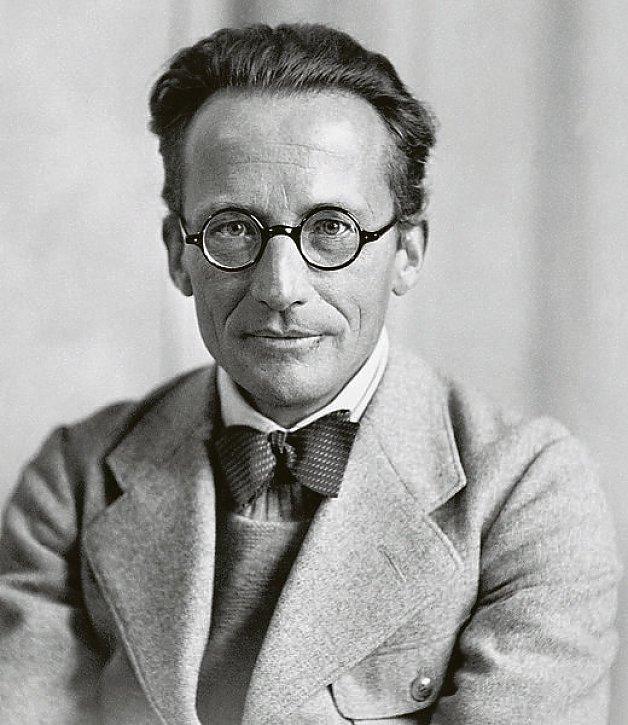
The history of science in India is full of interesting stories about institutions and scientists who shaped the development of modern scientific education. One such story is connected with the University of Allahabad and the great physicist Erwin Schrödinger (1887-1961), one of the founders of modern quantum mechanics. Around 1940, the University of Allahabad offered Schrödinger the position of Professor and Head of its Department of Physics. Schrödinger accepted the offer, but the Second World War prevented him from travelling to India and taking up the position. The chair was eventually occupied by the distinguished Indian physicist K S Krishnan in 1942.
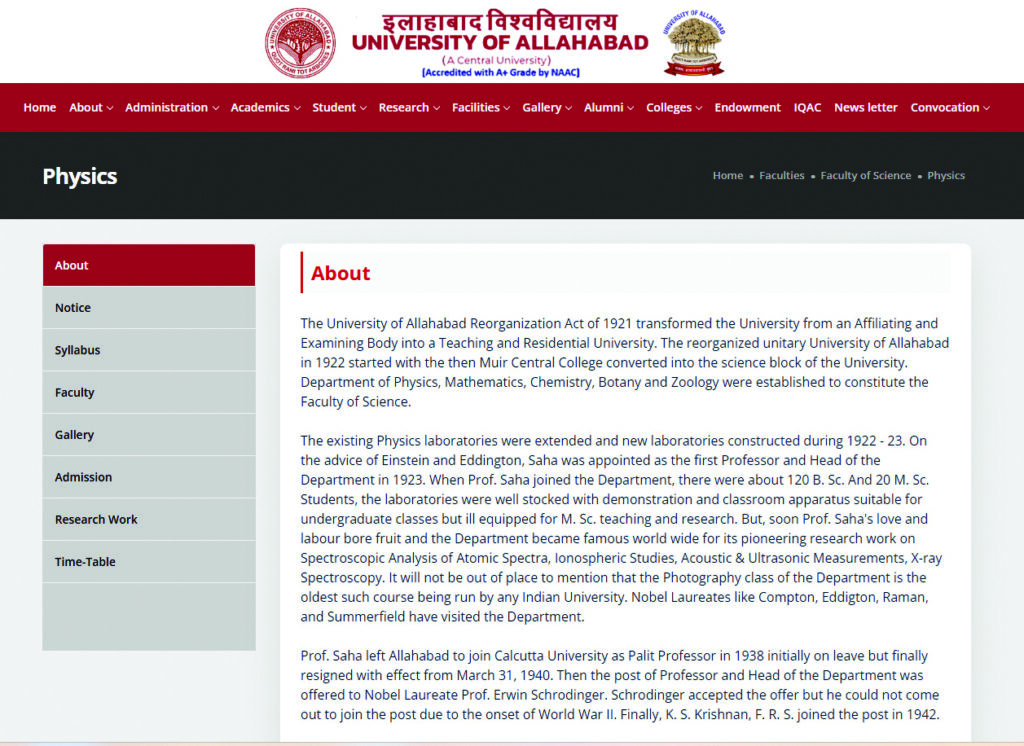
The story becomes more meaningful when seen in the context of the remarkable development of the Physics Department at Allahabad. The University of Allahabad became a teaching and residential university in 1922. At that time, the Physics Department was established as part of the Faculty of Science. In 1923, Meghnad Saha was appointed as its first Professor and Head.
Saha was already a rising scientist when he came to Allahabad. His work on the thermal ionisation of elements had established his reputation in astrophysics. At Allahabad, he found an opportunity to develop a new centre for advanced teaching and research in physics. When he arrived, the university had students and laboratories, but its facilities for postgraduate teaching and research were still developing. Saha worked to improve the laboratories, strengthen teaching and introduce modern areas of physics.
His efforts had a major impact. During his years at Allahabad, the Physics Department became known for research in spectroscopy, ionospheric studies, acoustics and ultrasonics, and X-ray spectroscopy. The university describes the department as becoming famous worldwide for pioneering research in these areas. Several distinguished scientists and Nobel Laureates also visited the department.
Saha remained at Allahabad for about fifteen years. His departure was therefore a major event for the department. In 1938, he accepted the Palit Professorship at the University of Calcutta. Contemporary accounts confirm that after nearly fifteen years at Allahabad, Saha returned to Calcutta as Palit Professor of Physics. The University of Allahabad records that he initially left on leave and subsequently resigned from the Allahabad position with effect from 31 March, 1940.
The question before the University was therefore not simply who would occupy a vacant professorship. The person chosen would have to continue the high scientific standards established by Saha. The Physics Department had acquired an international reputation, and the choice of its next head was consequently important.
The University turned towards one of the most famous physicists in the world, Erwin Schrödinger, who was already a Nobel Laureate and one of the central figures of modern physics. His greatest contribution was the development of wave mechanics. In 1926, he formulated the famous Schrödinger equation, which became one of the fundamental equations of quantum mechanics. His work changed the way scientists understood atoms, electrons and the microscopic world.
In 1933, Schrödinger shared the Nobel Prize in Physics with Paul Dirac for the discovery of new productive forms of atomic theory. Therefore, by the time Allahabad University considered him for its Physics chair, he was not an unknown foreign scientist, but one of the leading theoretical physicists of his generation. A contemporary report from 1940 described him as one of the world’s foremost authorities on wave mechanics and noted that he had been elected by the University’s Executive Council to the chair of physics.
The decision to approach Schrodinger reflected the intellectual ambition of Allahabad University that was not merely trying to fill a vacant post but seeking a scientist of international stature who could lead an already respected centre of physics.
There was also a strong intellectual connection between the period and the rapid development of quantum physics. During the 1920s and 1930s, physics was undergoing a major transformation. Classical ideas about matter and radiation were being replaced or extended by quantum theory. Schrödinger, together with scientists such as Werner Heisenberg, Max Born, Paul Dirac and Niels Bohr, was at the centre of this transformation.
For an Indian university to offer its most important physics position to Schrödinger was therefore significant. It showed that Indian universities were participating in the international scientific world and were willing to attract leading scientists from abroad.
The political situation in Europe had become increasingly dangerous. Nazi Germany had expanded its power, and the international situation deteriorated rapidly. In September 1939, the Second World War began. Schrödinger was then living in Ireland. The war made international travel extremely difficult and disrupted the University’s plan. Although Schrödinger had accepted the position, he could not travel to Allahabad to take charge of the department. The University of Allahabad’s official history gives the same explanation, Schrödinger accepted the offer but could not come to join because of the outbreak of the Second World War.
This was an important lost opportunity in the history of Indian science. Had Schrödinger joined Allahabad University, the intellectual history of physics in India might have taken a different path. A Nobel Laureate who had played a central role in the creation of quantum mechanics would have been teaching and conducting research in India at a time when quantum physics was rapidly developing.
One can only imagine the possible impact on students and young researchers. Schrödinger’s presence could have created a direct link between the developing Indian scientific community and the European school of theoretical physics. Students at Allahabad could potentially have interacted with one of the principal architects of quantum mechanics. The department could have become an even stronger centre for theoretical physics. However, such possibilities remain matters of historical speculation. What is firmly established is that the appointment did not take place.
The University ultimately appointed K S Krishnan, one of India’s leading experimental physicists, to the position in 1942. Krishnan was an important figure in Indian physics and had worked with C V Raman. His appointment ensured continuity in the department’s tradition of high-quality research. The University records that Krishnan strengthened the existing infrastructure for postgraduate teaching and research.
The story of Schrödinger and Allahabad is therefore not simply a story of an appointment that did not happen. It represents a particular moment in the development of Indian higher education and scientific research.
The story also reminds us that the development of science does not take place in isolation from world history. Universities may make ambitious plans, but wars, political changes and international events can change the course of academic institutions. In the case of Allahabad and Schrödinger, the Second World War was the decisive factor that prevented a remarkable scientific exchange.
Today, the episode deserves greater attention because it highlights the international character of India’s scientific heritage. The University of Allahabad was not simply a place where science was taught. It was becoming a centre where important scientific ideas were developed, discussed and connected with the wider world.
Although Schrödinger never taught in Allahabad, the fact that the University offered him its most important position in physics, and that he accepted the offer remains a remarkable chapter in the history of both the University of Allahabad and Indian physics.
*The author is a Professor, Department of Physics, University of Lucknow.