





Author: Science India Bureau


The human genome is the ultimate instruction manual of life—a comprehensive blueprint that directs every biological process essential to our existence. Composed of DNA, which in turn is made up of four nucleotides (Adenine (A), Cytosine (C), Guanine (G), and Thymine (T)), our genetic code stretches across an astonishing three billion letters. Every cell in our body houses this intricate sequence organised within 23 pairs of chromosomes. Through the marvel of heredity, we inherit half of our genetic material from our mother and the other half from our father, ensuring that the blueprint of our life is a unique blend…

India boasts of an extraordinary array of microbial diversity, with millions of microbial species yet to be discovered. To harness this vast potential, the Department of Biotechnology (DBT) and the Biotechnology Research and Innovation Council (BRIC) have initiated the ‘One Day One Genome’ (ODOG) mission. This innovative project is dedicated to showcasing and leveraging India’s microbial wealth by releasing a fully annotated bacterial genome every day. WHY ‘ONE DAY ONE GENOME’ MATTERS IN INDIA Microorganisms are essential to every aspect of our ecosystem—they drive biogeochemical cycles, shape soil formation, and significantly impact human health and agriculture. Given India’s abundant flora…

International News An exotic phase of water, called Plastic Ice VII, which defies all conventions that are known about what we understand as water and ice, has been observed by researchers at the Institut Laue-Langevin in Grenoble, France. This ice emerges under extreme conditions of 6 gigapascals pressure and temperatures of 327°C (or 620°F). This discovery was recently reported in the science journal, Nature, on February 12. This strange type of ice is known to be found deep in the oceans of distant planets such as Neptune or moons such as Europa (smallest of the four moons orbiting Jupiter). Scientists…

Dr Swarup Kumar Parida, a distinguished scientist at the National Institute of Plant Genome Research (NIPGR), New Delhi, has been honoured with the prestigious Vigyan Yuva-Shanti Swarup Bhatnagar Award in Agricultural Sciences for his groundbreaking contributions to molecular breeding and crop improvement. His research has significantly advanced the field of plant genomics, particularly in the development of high-yielding and stress-tolerant rice and chickpea varieties. Dr Parida has been at the forefront of next-generation molecular breeding for crop improvement. His work focuses on developing novel concepts and integrated genomics-assisted breeding strategies aimed at enhancing yield, plant architecture, and nutritional quality while…

In a significant breakthrough for breast cancer treatment, researchers from the Indian Institute of Technology-Guwahati (IIT-G) and the Bose Institute, Kolkata, have developed an advanced injectable hydrogel that enables localised and controlled drug delivery. This innovation not only enhances the efficacy of anti-cancer drugs but also reduces harmful side effects, marking a transformative step in oncological care. According to a statement released by IIT-G, the hydrogel acts as a stable reservoir for chemotherapy drugs, releasing them in a controlled manner specifically at the tumour site. This ensures that healthy tissues remain unharmed, a crucial advantage over conventional treatments like chemotherapy,…

The headquarters of Vijnana Bharati in the national capital moved to a new destination at South Extension I on 7 February. With the inauguration of its new four-storeyed office-cum-residence building — ‘Jayant Smriti’, the Vijnana Bharati enters a new phase with a plush office, reception, meeting rooms, conference hall, guest house, parking, pantry and what not. The headquarters — ‘Jayant Smriti’ — has been named in loving memory of the late Shri Jayant Sahasrabudhe, the former national organising secretary of VIBHA, who had spearheaded the relaunch of SCIENCE INDIA magazine in its new avatar in 2020. It was he who…

BUDDING INNOVATOR / SINDHOORA RAJA Sindhoora Raja, a sixteen-year-old innovator and research enthusiast from Bengaluru, was awarded the Pradhan Mantri Rashtriya Bal Puraskar in New Delhi recently. She received the award for innovation from the President of India, Droupadi Murmu at the Rashtrapati Bhavan. She also had the opportunity to meet the Prime Minister Narendra Modi at the Bharat Mandapam in New Delhi where he interacted with the winners. During their interaction, she explained her innovations in neurotechnology, and the Prime Minister encouraged her to continue her research. She recalls that receiving the Rashtriya Bal Puraskar was a moment of…

The work that had been initiated in 2012, came to fruition on 8 January 2024. On this day, at the Sidhu Kanu Birsa University in Purulia town, there was the virtual inauguration of an observatory stationed atop the Panchet Hill in the Garpanchakot area of Purulia district. Stationed at a height of 600 metres above the ground level, this will be a major observatory not only in eastern India, but also along the longitude of 86°E. The observatory has been set up by the S N Bose National Centre for Basic Sciences, Kolkata. Dr Tanusri Saha-Dasgupta, director of S N…

Image Courtesy: PIB Prime Minister Narendra Modi on 9 January announced the completion of the Genome India Project, describing it as an “important milestone in the biotechnology revolution” in the country, and unveiled the sequencing database of 10,000 Indians. In his video message, the PM congratulated the scientific community on the achievement and laid out a roadmap for India’s future in genomics. He praised the initiative as a testament to India’s scientific prowess and its vision for the future of healthcare and biotechnology. This initiative will also develop an ecosystem which would act as Knowledge Hub and Innovation Hub and…
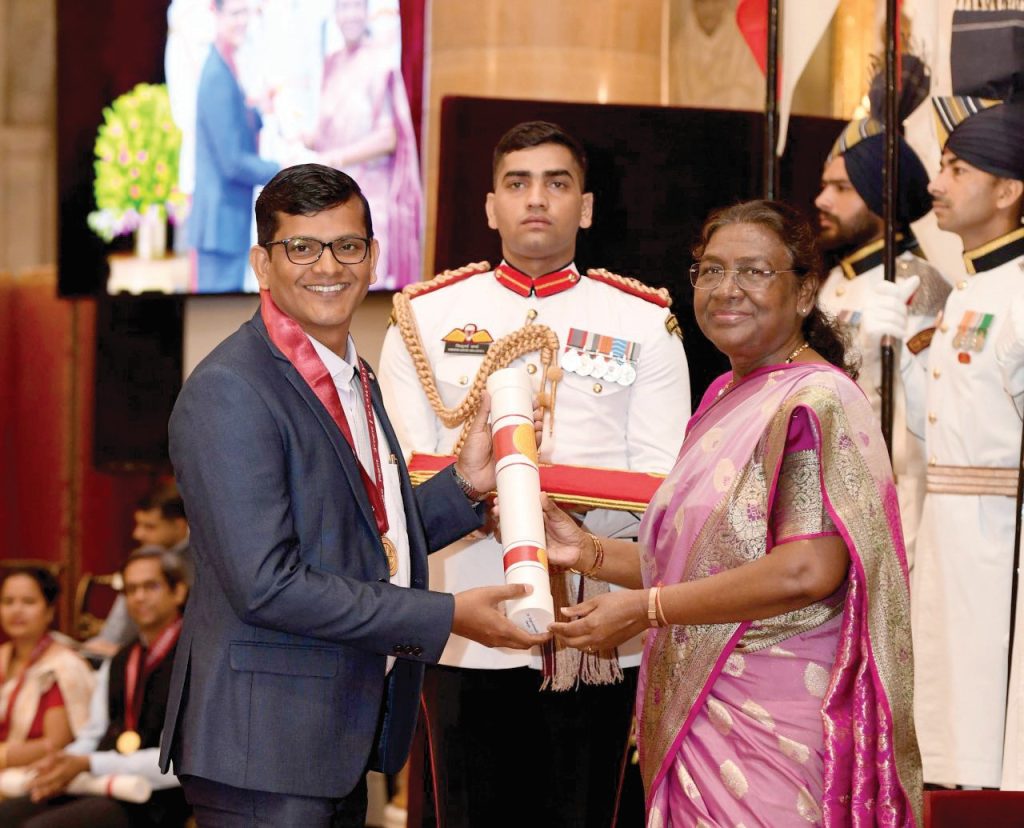
YOUNG SCIENTIST/ Dr DIGENDRANATH SWAIN Dr Digendranath Swain, a senior researcher at the Vikram Sarabhai Space Centre (VSSC), Thiruvananthapuram, under the Indian Space Research Organisation (ISRO), has recently been conferred the prestigious Vigyan Yuva Shanti Swarup Bhatnagar Award. Presented by President Droupadi Murmu, the award recognises his remarkable contributions to the field of space science and technology. As a leading figure in structural engineering, Dr Swain has played a pivotal role in ensuring the reliability and success of India’s ambitious space missions. At the heart of Dr Swain’s work lies his expertise in structural engineering for rocket components, with a…