






Few nations can claim to have built Nalanda, one of the world’s earliest great universities, and, centuries later, to have sent spacecraft to the Moon. India can. These achievements, separated by nearly two millennia, symbolize a civilization that has continuously sought to understand nature and apply knowledge for society’s benefit. As the country advances toward the vision of Viksit Bharat 2047, an important question naturally arises: What kind of science policy should guide its future?
The growing discussion about a Bharat-centric Science, Technology, and Innovation Policy is therefore timely and welcome. Every major scientific nation aligns its research priorities with its own circumstances. The United States invested heavily in aerospace and defence during the Cold War. Japan built global leadership in advanced manufacturing. Israel focused on water technologies suited to an arid landscape, while China has pursued long-term missions in artificial intelligence, semiconductors, and quantum technologies. Scientific excellence has never developed in isolation from national priorities. India, likewise, must focus on challenges such as water security, affordable healthcare, sustainable agriculture, clean energy, disaster resilience, and advanced manufacturing.
Yet, the phrase ‘Bharat-centric science’ requires careful interpretation. It should not be understood as science confined within India’s borders, limited to subjects drawn from its past, or driven by scientific isolation. Rather, it should mean beginning with India’s unique realities and contributing knowledge of value to the entire world.
Such a policy has four complementary objectives. It should solve problems that matter to India’s people, generate original knowledge in Indian laboratories, deepen scientific understanding of India’s unique ecology and society, and enable Indian institutions to lead in global research. National priorities and universal knowledge are not competing pursuits; they reinforce one another.
India’s experience illustrates this principle. The Green Revolution transformed food security and influenced agriculture across the developing world. The country’s space program demonstrated that world-class missions could be accomplished with remarkable cost-effectiveness. The Jaipur Foot combined engineering innovation with social relevance. More recently, Digital Public Infrastructure has attracted worldwide attention as a model for delivering public services at scale. These achievements addressed Indian needs while meeting global standards of scientific and technological excellence.
A Bharat-centric science policy should therefore shape the questions India chooses to pursue. Science must determine how those questions are answered. Scientific priorities may legitimately differ from one nation to another, but the standards for establishing scientific knowledge remain universal. The challenge is not to choose between national priorities and global science, but to pursue national priorities using globally accepted scientific methods.
Science is defined not only by the questions it asks but also by the methods it uses to answer them. This is the central distinction in the current debate. A science policy may legitimately reflect national priorities, but science itself cannot be national. Its conclusions must rest on evidence that is universal, reproducible, and open to scrutiny.
Science may have a geography, but evidence has no nationality.
That is precisely why a Bharat-centric science policy and an evidence-centric scientific enterprise are complementary rather than contradictory.
This principle is especially relevant when discussing Indian Knowledge Systems. India’s intellectual heritage is undeniably rich. The decimal place-value system revolutionized mathematics. Ancient metallurgists produced high-quality steel that continues to fascinate materials scientists. The surgical descriptions attributed to Sushruta remain an important chapter in the history of medicine. Traditional communities accumulated valuable knowledge of medicinal plants, water management, agriculture, and biodiversity through centuries of observation and experience. These achievements deserve careful historical scholarship and broader international recognition.
Yet, civilization and science serve different purposes. Civilization preserves knowledge, beliefs, and practices. Science asks whether they withstand objective examination. The two complement one another, but they are not the same.
A useful way of understanding this relationship is through a simple progression:
Heritage -> Hypothesis -> Investigation -> Evidence
Heritage deserves preservation because it embodies the accumulated experience of generations. It also offers hypotheses worthy of scientific investigation. Farmers who cultivated crops over centuries, physicians who observed the effects of medicinal plants, and engineers who perfected traditional water-harvesting systems generated valuable empirical knowledge. Their observations merit scientific inquiry not because they are ancient, but because they may contain insights that modern science has yet to explain.
The crucial distinction is that heritage can generate hypotheses, but only scientific investigation can validate them. History offers compelling examples. Artemisinin, one of the world’s most effective antimalarial drugs, originated in traditional Chinese medicine but entered modern medicine only after rigorous experimental validation. Similar opportunities may well exist within India’s own traditions of medicine, metallurgy, and agriculture. At the same time, every civilization has preserved beliefs that failed scientific scrutiny. The origin or age of an idea, therefore, tells us nothing about its scientific validity. Evidence alone does.
This approach is not foreign to Indian thought. On the contrary, it resonates deeply with India’s intellectual traditions. The Nyaya school developed sophisticated methods of logic and inference. Buddhist scholars institutionalized debate as a path to knowledge. The Charvaka tradition challenged accepted doctrines with remarkable intellectual courage. Nalanda became a great university not because it discouraged disagreement but because it welcomed it. The strength of India’s intellectual heritage lay not in uniformity of belief but in openness to questioning.
Modern science itself evolved through continuous exchanges among civilizations. Knowledge travelled from India to the Arab world, from Greece to West Asia, and from China to Europe, eventually becoming part of humanity’s shared intellectual heritage. Scientific progress has always depended on questioning, testing, and refining ideas rather than preserving them unchanged. Every civilization has contributed to science and corrected its own errors. No civilization owns science.
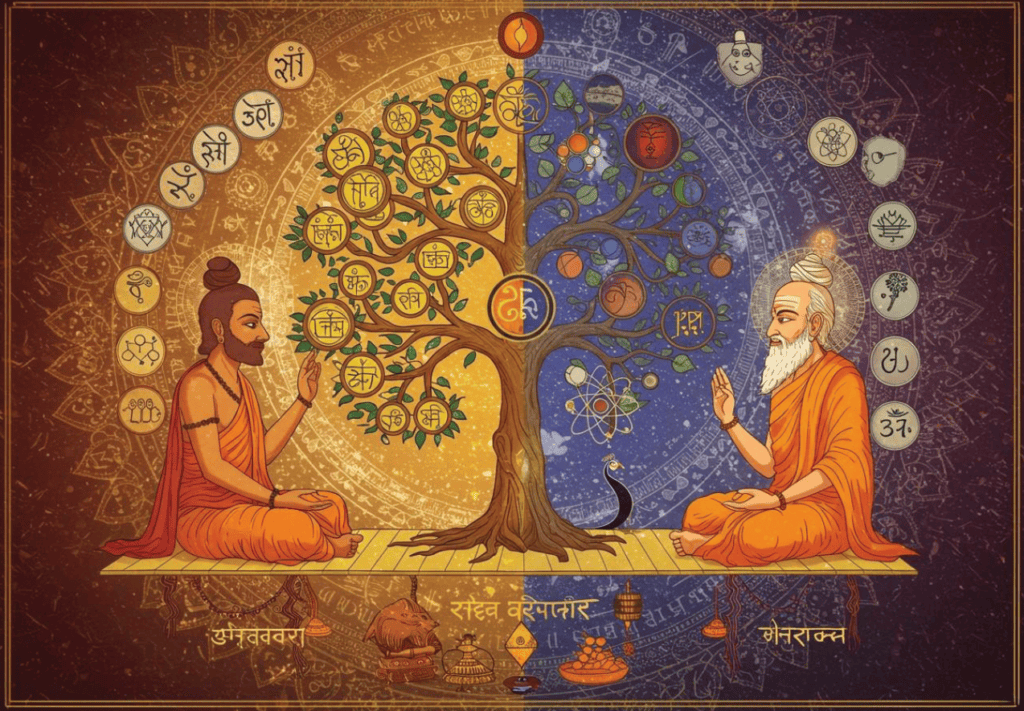
Image Courtesy: Poojn.in
For this reason, presenting mythology as scientific fact or treating civilizational pride as evidence ultimately weakens, rather than strengthens, India’s scientific standing. A civilization confident in its achievements has nothing to fear from scrutiny. On the contrary, genuine discoveries gain credibility only when they withstand independent verification.
Scientific temper should therefore not be seen as an alternative to India’s heritage but as one of its finest expressions. Article 51A(h) of the Constitution of India calls upon every citizen to develop scientific temper, humanism, and the spirit of inquiry and reform. This is not a call to reject tradition. It is a call to examine every claim, whether ancient or modern, with intellectual honesty. National priorities may guide the direction of research, but evidence must always determine its destination.
The success of a Bharat-centric science policy will ultimately depend not only on the vision it articulates but also on the institutions that translate that vision into discovery. Scientific leadership is built over decades through sustained investment in people, infrastructure, and scientific culture. Policies provide direction; institutions create breakthroughs.
Scientific knowledge transforms society only when people can understand it. Promoting science in Bharatiya languages can broaden participation and inspire future generations. At the same time, Indian scientists must remain active participants in the global scientific conversation. The challenge is therefore not choosing between Indian languages and English, but using both effectively.
The same principle applies to scientific publishing. India should aim to build journals of international standing and reduce its excessive dependence on foreign publishing platforms. Reputation, however, cannot be created by legislation or national sentiment. It must be earned through rigorous peer review, editorial independence, and uncompromising standards of quality. A journal earns respect not because it is published in India, but because scientists everywhere trust its publications.
Scientific leadership also requires stronger partnerships among academia, industry, government, and philanthropy. Universities generate new knowledge; industry translates discoveries into technologies and products; government creates an enabling policy environment; and philanthropy can support high-risk research that conventional funding mechanisms often avoid. A successful science policy must ensure that these sectors reinforce one another rather than operate in isolation.
Recent initiatives, including the Anusandhan National Research Foundation (ANRF), One Nation One Subscription, the National Quantum Mission, and other strategic programs, indicate that India is moving toward a more integrated research ecosystem. However, their long-term success will depend less on the volume of funding than on the quality of implementation. The most successful research systems encourage interdisciplinary collaboration, promote sharing of expensive research infrastructure, reduce unnecessary administrative burdens, and give talented researchers the freedom to pursue ambitious ideas.
The scientific challenges facing India are both distinctive and globally significant. Understanding the Himalayan ecosystem, improving monsoon prediction, ensuring water and food security, combating antimicrobial resistance, developing affordable healthcare technologies, harnessing artificial intelligence for India’s linguistic diversity, and accelerating the transition to clean energy are national priorities whose solutions will benefit the world. Bharat-centric priorities and international relevance are therefore not competing objectives but complementary ones.

Image Courtesy: Wikimedia Commons
Curiosity-driven research must remain an integral part of this vision. Governments understandably seek visible social and economic returns from investments in science, yet history repeatedly reminds us that many transformative discoveries emerged without immediate practical objectives. Quantum mechanics eventually enabled the semiconductor revolution, while research on bacterial immune systems unexpectedly led to CRISPR gene editing. A mature research ecosystem, therefore, supports both mission-oriented and investigator-driven research because each strengthens the other.
Ultimately, scientific excellence depends less on regulation than on trust. Great institutions give researchers the freedom to pursue bold ideas while upholding the highest standards of integrity, rigor, and accountability. Countries become scientific leaders not by eliminating uncertainty or risk, but by creating environments where originality is encouraged, failure is accepted as part of discovery, and excellence is consistently rewarded.
India has every reason to pursue a science policy rooted in its priorities. Its biodiversity, demographic scale, climatic diversity, and developmental aspirations pose scientific challenges unmatched elsewhere. Addressing them is not an inward-looking exercise but an opportunity to generate knowledge that advances both national development and global progress.
Ancient knowledge deserves respect, careful scholarship and rigorous investigation. It enriches our understanding of the past and may inspire new scientific questions. Inspiration, however, is not evidence. Every claim, whether it originates in an ancient manuscript or a modern laboratory, must ultimately be judged by the same standards of observation, experimentation and independent verification. Science does not distinguish among ideas based on age, geography or cultural origin. It distinguishes only between those that withstand evidence and those that do not.
The journey from Nalanda to Chandrayaan was not a journey from tradition to modernity. It was a continuous journey of inquiry. Across centuries, India’s greatest intellectual achievements have emerged not from unquestioning acceptance but from the courage to observe, question, and discover. That spirit remains as relevant today as it was a thousand years ago.
The true measure of a Bharat-centric science policy will not be how often it invokes India’s glorious past, but how effectively it shapes India’s scientific future. If future historians recognize twenty-first-century India as a nation that expanded humanity’s understanding of nature while solving some of its most pressing challenges, the objective will have been achieved.
A Bharat-centric science policy should determine the questions India chooses to pursue. Evidence-centric science must determine the answers. Heritage can inspire discovery. Only evidence can establish it.
*The writer is ANRF Prime Minister Professor, COEP Technological University, Pune, and former Director, Agharkar Research Institute, Pune.
