





On 12 December 2015, during the UN Climate Change Conference (COP21) in Paris, 195 countries adopted the Paris Agreement, a legally binding international treaty on mitigating global warming. The agreement aims to limit the rise in global temperatures to below 2°C above pre-industrial levels while striving to restrict it to 1.5°C. The agreement also sets the long-term objective of achieving net zero by 2050. To realise such an ambitious goal, the global greenhouse gas (GHG) emissions rate must reach its peak before 2025 and then decline rapidly. By 2030, emission rates must be about half of the present rate and reach net zero by 2050.
The World Meteorological Organisation declared 2024 as the warmest year with global mean temperature exceeding the 1.5°C limit. This suggests that even the most aggressive efforts to reduce GHG emissions are no longer sufficient to achieve the Paris Agreement limits. Scientists and policymakers are compelled to consider additional interventions to achieve a balance between reducing emissions and mitigating the cumulative effects of the GHGs already present in the atmosphere. The most researched options broadly fall into two groups: change in the carbon sinks and include carbon dioxide removal (CDR) technologies, carbon capture, or alter the albedo of the planet by solar geoengineering.
WEIGHING IN AVAILABLE TECH
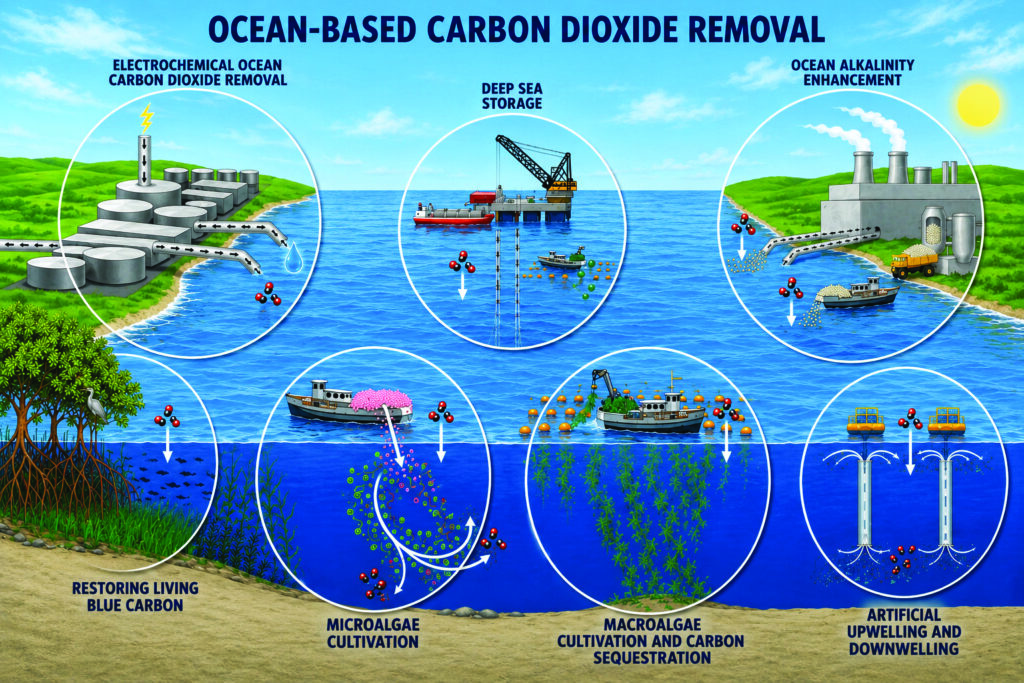
Carbon Dioxide Removal (CDR) methods refer to a collection of technologies to capture CO2 gas at the source itself before it is released into the atmosphere. This method has been successfully demonstrated in industries such as coal power, steel, cement manufacturing, production of ethanol, etc. The exhaust from industries (flue gas) is pumped through ducts and cooled to a lower temperature, which is then passed through an absorber. In the absorber, the gas runs upwards through an amine solution, and the CO2 gets bound in the amines and left behind in the absorber. The clean gas is released into the air, and the CO2-rich amine solution is heated till the compounds are separated and pure CO2 is obtained. The amine is reused while the pure CO2 is passed through a compressor and may be treated variously for storage. The cost-benefit analysis of this method suggests that CDR imposes a substantial extra cost for any industry and will be feasible only with government interventions, such as either subsidies or penalties. Much speculation also revolves around where to store the captured carbon without the risk of gas escaping back to the surface or disturbance of geology by injection processes deep into the earth. Some low-cost nature-based methods of CDR include carbon sequestration in biomass and soil by expanding existing forests, restoring and managing of encroached forests, and wetland restoration. The technical and financial issues involved with this approach lead us to explore another strategy called carbon emission trading.
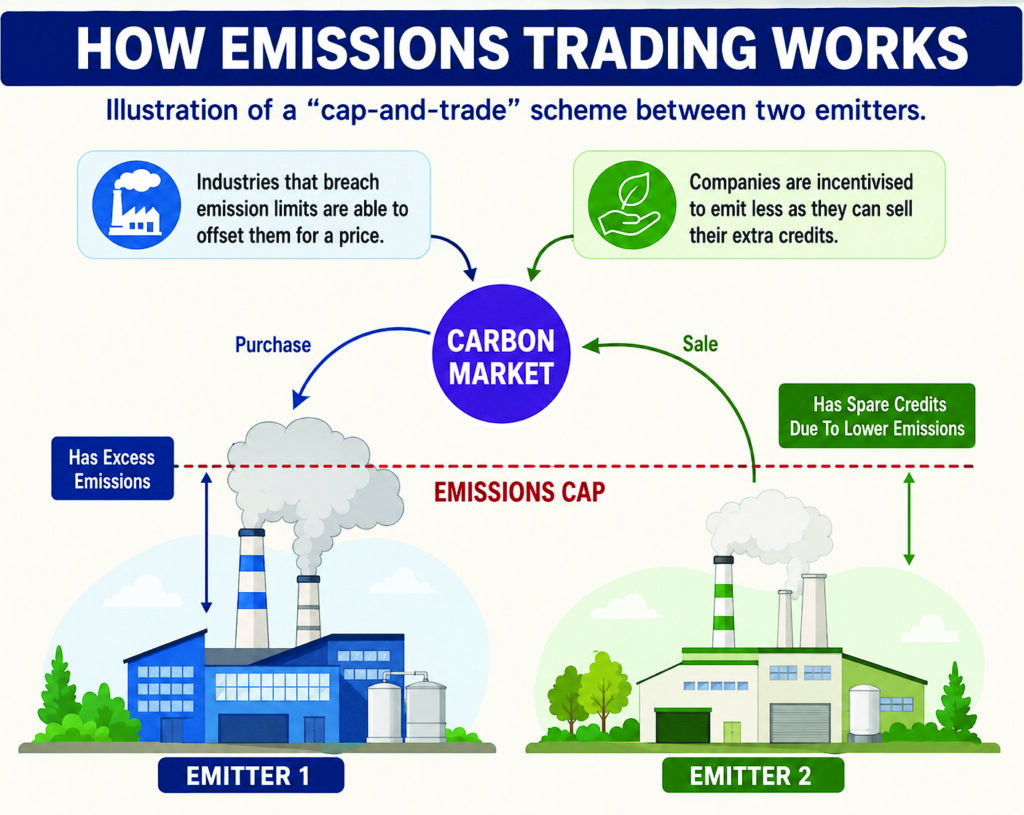
The Carbon Emission Trading Scheme (ETS) was introduced in the EU in 2005 with the purpose of trading carbon emission rights between countries as well as within countries, as if GHG emissions were a commodity. Under the Kyoto Protocol, participating countries agreed to abide by fixed emission targets. Emissions are allocated as Assigned Amount Units, each unit representing one metric tonne of carbon dioxide equivalent. If a country emits less than the targeted limit, it can sell its unused emission units to countries that have exceeded their limit. The units are traded under the Kyoto Protocols ETS and tracked and recorded through an international registry system to ensure transparency and accuracy in the carbon markets.
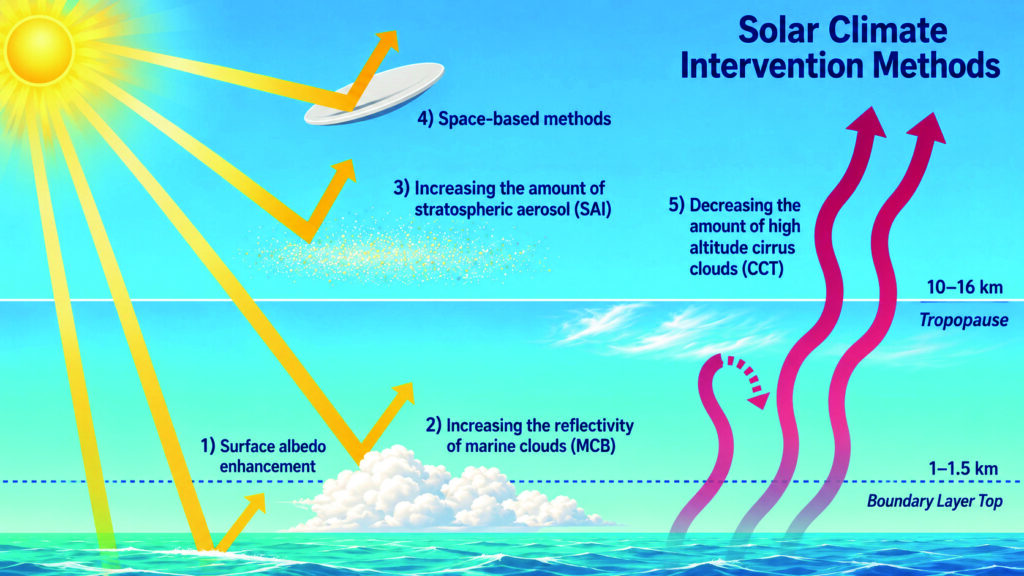
Despite the development of such ideas and the deployment of technologies, the pressing concern is that of time. It is speculated by some workers that certain climate tipping points could be triggered before these mitigation strategies produce visible effects. Therefore, as an alternative with expected rapid manifestations of results, discussions surrounding solar radiation management (SRM) techniques have gained prominence. SRM techniques do not reduce the amount of GHGs in the atmosphere. Instead, they aim to lower global temperatures directly by intentionally altering the Earth’s radiative balance. To modify albedo, several schemes are considered. Cloud seeding to enhance cloud brightness, thinning of high clouds, and injecting sulphate aerosols or compounds that react to form sulphates into the stratosphere are some examples.
SOLAR GEOENGINEERING
Out of all the SRM methods discussed, Stratospheric Aerosol Injection (SAI) is gaining the most popularity. The concept of SAI emerged well before the ideas of carbon trading or carbon capture, following the eruption of Mount Pinatubo (The Philippines) in June 1991. The enormous amount of sulphur particles released into the stratosphere by the volcano cooled the Earth’s surface by nearly 0.6°C in the following 15 months. SAI involves the continuous release of reflective sulphur compounds or their precursors into the stratosphere at 18 to 20 km from the Earth’s surface by high-altitude jets. These compounds increase planetary albedo, backscatter the incoming solar radiation into space, and allow only a fraction of it to reach the Earth, inducing a cooling effect. Solar geoengineering could reduce global temperatures relatively quickly and at comparatively lower costs. However, several ongoing studies have focused on the implications this practice might have on our environment and have questioned uncertainties regarding changes in global climatic patterns, monsoonal systems, and regional climate. As the weather patterns responsible for rainfall / precipitation are different for tropical and mid latitudinal regions of the globe, the reduced incoming radiation might affect the surface processes leading to changes in rainfall. Sulphate aerosols can speed up chemical reactions that destroy the stratospheric ozone, particularly in the mid and high latitudes, thereby allowing the proliferation of harmful UV rays into the Earth. These effects have been observed after large volcanic eruptions and have had a considerable effect on the biosphere. The impact of sulphur injection on precipitation patterns varies across regions, and a profound impact was observed on the South East Asian Monsoon (SEAM). The SEAM supports the livelihood of a vast majority of the population belonging to the mostly agrarian and highly vulnerable Asian countries and is the backbone of regional food security. Any intervention that could potentially alter precipitation patterns must therefore be approached with extreme caution.
Another solar geoengineering process includes brightening of marine clouds by increasing cloud condensation nuclei (CCN) into the troposphere. This technique is called Marine Cloud Brightening and involves increasing the reflectivity of clouds towards incoming solar radiation and hence, lowers surface temperature. The idea was developed by observing that particulates released from ships acted as CCN, thereby proving their effectiveness. It is suggested that salty seawater may be sprayed upwards as mist and the particles remaining after evaporation may act as CCN. Much less research has been conducted on the cost, effectiveness and challenges of this method but its effects are expected to be strictly regional. Scientists have also suggested thinning of high clouds as a solar geoengineering method and is expected to be more economically and technically feasible. High altitude clouds have a net warming effect on the radiation budget. Dispersing them by the use of chemicals may result in cooling.
Despite all the studies conducted worldwide, SRM is by far only a theoretical concept, unlike CDR and ETS which are already being implemented globally. SRM may be used only in the case of an emergency as the risks posed to the environment are yet unknown and may be adverse. Research shows that the implementation of solar radiation modification would lead to the modification of the temperature gradients between land and oceans which results in affecting the El Nino Southern Oscillation (ENSO) and other circulations of air. This further may connect to the major circulations such as Hadley and Walker circulations, finally changing the overall picture of the Asian climate. It is also found that the termination of solar geoengineering after the experiments would switch situations to those that were under the global warming scenario and hence it needs to be closely examined.
Climate models of geoengineering show a cooling over the Indian monsoon region that leads to a dry bias in the rainfall scenario, particularly over the Western Ghats of India. It is also reported from the model simulations that rainfall would decrease by 10% in future during the monsoon season when these experiments, particularly SAI, is carried out. This is due to the fact that the rainfall over India, which is in the tropical region, is mainly convection-dependent. The reduced incoming solar radiation may affect the convective activity and further reduce precipitation. It is understood that the application of SAI experiments may reduce the temperature but also affect the rainfall. The repercussions on implementing the other experiments such as marine cloud brightening and cirrus cloud thinning over different regions have not been demonstrated fully. However, the detrimental consequences need to be studied in detail, and the effects of SAI need to be quantified over the Indian region. Since the deliberations are happening among the international scientific community to implement these experiments, this knowledge is essential for the policy makers of India. Studying the suitability of these experiments for the Indian region through modelling experiments will enhance understanding and enable informed decisions. Several researchers in India have started working on the impacts of such experiments over the climate of the Indian subcontinent.
India has taken several major steps to reduce GHG emissions and switch to renewable sources for energy. India’s progress in implementing solar projects is phenomenal and India’s capacity in installing wind energy projects is also growing up fast. India submitted its first climate commitments in 2015, with targets to reduce emissions intensity by 33-35% by 2030 and to ensure that 40% of electric power capacity is from non-conventional resources. Both of these targets have been met well ahead of their committed timelines. Such a remarkable achievement was due to the tactical implementation of several schemes, particularly the National Action Plan on Climate Change, the PM-KUSUM Scheme (for clean energy in agriculture), the National Solar Mission, the FAME Scheme (to promote adoption of hybrid and electric vehicles), and the National Green Hydrogen Mission. Indian scientists are now showing growing interest in researching SRM, with an eye on the implications for the monsoon system. It is proposed that a certain method may be developed that offsets warming without disrupting the hydrological cycle.
Regardless of the Paris Agreement’s resolutions, global temperatures have continued to soar, and achieving the climate targets now seems very challenging. Reducing GHG emissions alone no longer remains the only solution. Climate policies must incorporate technological evolution to implement different strategies responsibly, scientifically, and with minimal harm to the environment.
*Varbina Barkakoti is a Research Scholar, School of Environmental Sciences, Jawaharlal Nehru University, New Delhi, while Lakshmi Kumar TV is an Associate Professor at the School of Environmental Sciences, JNU, New Delhi. They can be reached at barkakotivarbina@gmail.com & lakshmikumar.jnu@gmail.com