

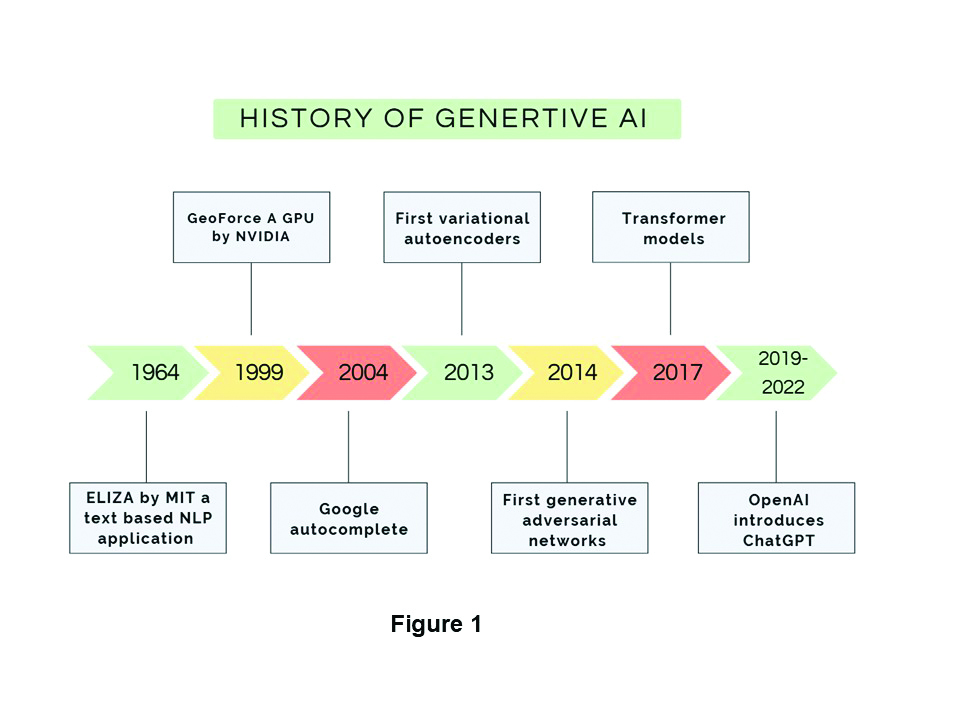
Advances in computing technology opened the gateway to processing complex software applications. Generative AI (Gen AI) is not a new term; it has been part of technological advancement for decades. However, with increased computing power and advancements in hardware devices such as GPUs, it has become much easier to adopt AI & GenAI in the emerging frontiers of Science & Technology. ChatGPT, Gemini, Cloude are some of the popular GenAI models that are becoming essential for tasks related to scientific analysis, research, and knowledge generation and interpretation. A brief timeline of GenAI is depicted as follows and shown in the figure 1.
1 GEN AI APPLICATIONS TO ENHANCE THE QUALITY OF ASTRONOMICAL OBSERVATIONS
1.a. Morpheus, an AI tool
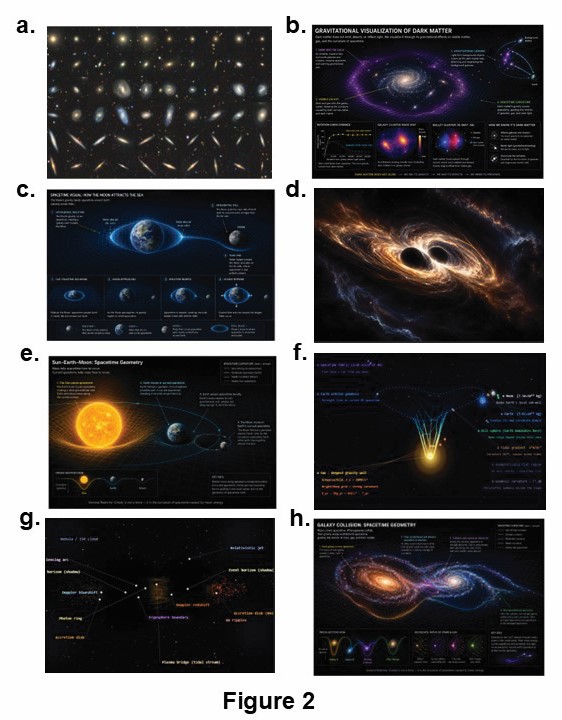
It is an AI model to classify astronomical images captured by JWT. It was trained by the NVIDIA GPU-enabled supercomputer, lux, at the University of California, Santa Cruz. It analyses captured images pixel by pixel to identify which pixel belongs to star, galaxy or any astronomical object. Morpheus observes galaxy images and finds out which class it belongs to, e.g. spherical, elliptical, spiral, disk and irregular. Morpheus is useful to process Webb’s massive image datasets much faster than manually inspecting everything.
All Images Courtesy: Authors
1.b. Reconstruction of galaxy images: Diffusion Model
A useful extraction from galaxy images depends on its quality, which is measured in terms of pixel density. Earlier methods use semi-analytical models that depend on assumptions, experimentation and parameter tuning. In contrast, data-driven generative models learn from observational data and are able to generate high-quality images of galaxies. In the diffusion model, noise is gradually added to the original image to learn how noise degrades the quality of the image. Further, noise is removed step by step to learn how data quality degrades. Overall, the diffusion model develops high-quality images by learning how to remove noise from random images. Using the diffusion model, noise is added to high-resolution images and low-resolution images are enhanced. The Dark Energy Spectroscopic Instrument (DESI) and Sloan Digital Sky Survey (SDSS) were applied to train the model. A diffusion model, GalCatDiff, enhances galaxy image features and astrophysical properties to generate better quality images, as shown in Figure 2.
1.c. Galaxy image simplification using Generative AI
A GenAI method has been developed to simplify distant galaxy images. The method generated publicly available 125,000 simplified galaxy images. Galaxy10 DECaLS and Illustris were used to develop a GenAI model for the processing of galaxy images across ultraviolet, visible and infrared bands.
1.d. Generate visualisations of astronomical phenomena
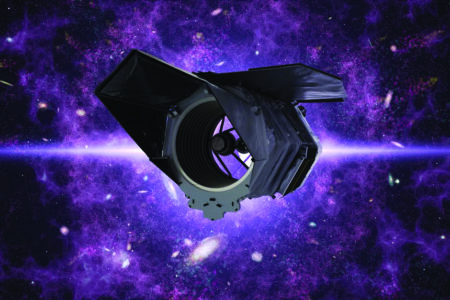
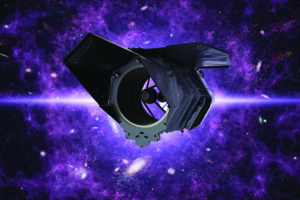
Generative AI can be applied to create visual representations of astronomical phenomena e.g., galaxy formation, galaxy collision, black hole merger and space-time visualisation. Visualising them accurately requires solving Einstein’s field equations, a task that has traditionally been computationally intensive. GenAI simplifies this by training on existing simulations and observational data to generate realistic representations. GenAI-based models can produce images that help researchers, academics, and students for better understanding of complex concepts. For example, a black hole merger cannot be photographed directly in the traditional sense, but scientists can model it using physics equations and gravitational-wave data. Generative AI can turn physics equations and gravitational-wave data into visual scenes to model black hole mergers. Black holes spiralling inward, warping spacetime, and combining into one larger black hole, such astrophysical events can be visualised. Such AI-generated visualisations are not exact photographs (Figure 2); they are interpretive representations based on available scientific data. It helps the scientific community to explore phenomena beyond normal human observation and supports science communication, education, and public outreach.
2. GENERATIVE AI AGAINST TWO CONVERGING THREATS: CLIMATE CHANGE AND SUPERBUG EVOLUTION
The world is quietly stumbling into the overlap of two crises it was never quite prepared for. The first is antimicrobial resistance: the stubborn, relentless ability of bacteria to evolve around the drugs we throw at them. It already kills more than 1.2 million people a year. That number, on its own, should be enough to command front pages. It rarely does. The second crisis is more familiar: climate change, which is not just warming the planet but redrawing the biological map where pathogens flourish, how quickly they mutate, how far they travel. Taken separately, each is a serious problem. Taken together, they are beginning to look like something we genuinely do not have the tools to handle.
Here is what makes the situation so uncomfortable. Developing a new antibiotic, the old-fashioned way, takes somewhere between ten and fifteen years. It costs well over a billion dollars. And by the time the drug finally reaches the patients who need it after trials, approvals, manufacturing, and distribution, and there is a real chance the bacteria it was designed to kill have already shifted. Resistance does not wait for paperwork. Climate change makes this worse. Warmer temperatures do not just make summers unpleasant; they accelerate the rate at which bacteria swap genetic material with each other, which is the primary mechanism through which resistance spreads from one species to another. Floods, increasingly severe and increasingly common, carry hospital wastewater and agricultural runoff, both laced with resistance genes into rivers, groundwater, and eventually the food supply.
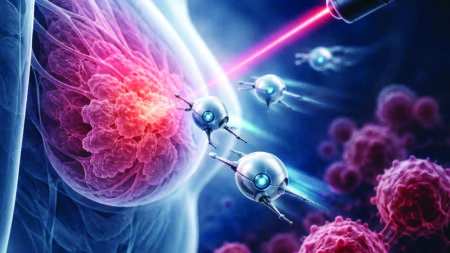
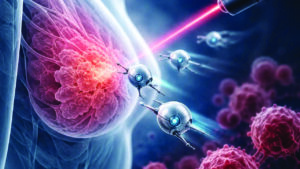
One can already see where this is heading. Candida auris, a fungal infection that kills somewhere around half the patients it hospitalises, emerged simultaneously on several continents within the span of a decade. That is not a coincidence. Researchers tracing its spread have pointed directly at rising environmental temperatures as the selective pressure that allowed a thermotolerant, drug-resistant strain to thrive where it previously could not. It is, in a very uncomfortable sense, a dress rehearsal. The resistant organisms of the next decade are not being engineered in some rogue laboratory. They are evolving right now, in warming floodplains and stressed soils, on a timeline nobody controls (Figure 3).
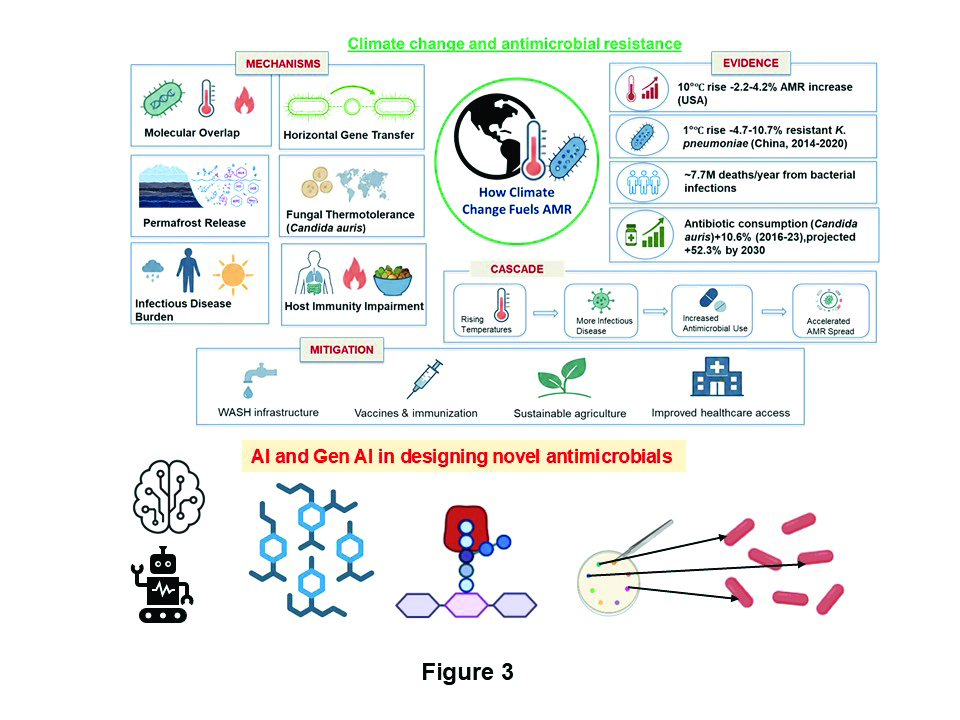
So where does that leave us? Honestly, in a better position than we were five years ago, and that is largely because of AI. Machine learning models can now scan millions of chemical structures in the time it once took a research team to run a single assay. They are not just fast; they are finding patterns in molecular data that human chemists, working through conventional intuition and trial and error, would simply never have noticed. Generative AI goes a step further, and it is worth pausing on this because it represents something genuinely new. These models do not just rank existing compounds. They invent, given a bacterial target like a protein the pathogen cannot survive without, and a generative model can design a molecule from scratch, shaped specifically to disable that target, built from chemical logic rather than chemical precedent. Studies have already produced real candidate antibiotics this way, including compounds active against Acinetobacter baumannii, a pathogen so dangerous that the World Health Organization keeps it on its critical priority list.
What is perhaps most striking is how this research is beginning to absorb climate data directly. Scientists are building surveillance systems that pull together wastewater samples, environmental genomics, and atmospheric data to spot emerging resistance patterns before they become outbreaks. Large language models are reading and synthesising the global AMR literature, tens of thousands of papers surfacing connections that no single research group would have the bandwidth to find on their own. Bacteria have been evolving for billions of years, but what is different now is that the tools are, for the first time, beginning to move at biological speed.
3. BEYOND RESEARCH & INNOVATION, THE DARK SIDE OF GENAI: DEEPFAKES, FRAUD, AND MISINFORMATION
The contribution of GenAI to science definitely leads to more dimensions. It not only enhances human research ability but also opens new pathways to explore the unsolved mysteries. Nature exploration has always been the prime interest of humans from early civilisation, e.g. ancient Indian and Sumerian, to the present era. Using GenAI, we can expedite the search from a vast knowledge base, solve complex equations and enhance the visualisation of complex processes. It can generate content on demand and has the potential to produce high-quality, cost-effective results. It enhances creativity by enabling quick decision-making and improving accessibility.
Apart from these benefits, GenAI has significant negative impacts also. These include hallucinations, inappropriate outputs, bias, and potential threats to security and privacy. Such shortcomings mislead scientific innovations and discoveries. The deepfake information is one of the problems that spreads rapidly and may harm the reputation of an individual or society’s image. The possibility of cybercrimes related to financial fraud and scams may also increase due to the misuse of GenAI.
Deepfake Threat Landscape: The term ‘deepfake’ combines the deep learning concept with something fake.
3.1. Financial fraud using Identity theft
Financial frauds are increasing day by day; when integrating with GenAI, its impacts are becoming severe. Generative AI may increase the risk of identity theft by making impersonation easier and more convincing. Cybercriminals can use it to generate fake voices, images, videos, and messages that mimic real individuals. It allows them to trick people into sharing personal information, financial details, or login credentials. As GenAI tools become more accessible, identity theft threats are growing more sophisticated and harder to detect. Imagine a well-known financial person giving some money-making techniques, offering, etc. Anyone can be trapped and may become the victim of such scams.
3.2. Fake news and Synthetic media
Several instances of fake news are generated by AI tools, and fake videos of Middle East conflicts are circulating on the internet. It is hard to find for a common man to identify the difference between fake videos and the original ones. Such videos may cause civil unrest, political instability, financial losses, and severe damage to a state.
3.3. Hoax images
GenAI can generate hoax images that look highly realistic, making it hard to determine whether they are real or not. Such AI-generated images spread with false information, create panic, damage reputations, or manipulate public opinion. Such hoax images are often shared on social media and may be used for scams or propaganda. As GenAI improves, verifying image authenticity has become increasingly important.
3.4. How to detect deepfakes
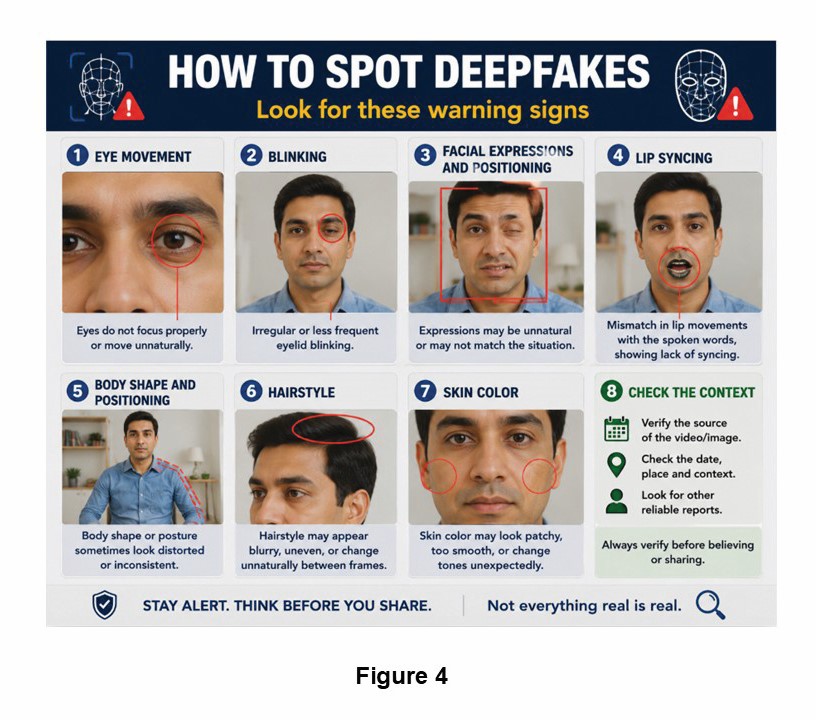
A careful observation of visual details in a video or image is required to spot a deepfake. In such videos, the eye movement or eyes do not focus properly, and it is a warning sign. Irregular or less frequent eyelid blinking is another common clue in AI-generated faces. The facial expressions may be unnatural or may not match the situation. An odd shift in face positioning, or it seems slightly misaligned with the head. A mismatch in lip movements with the spoken words, showing a lack of syncing. The body shape or posture sometimes looks distorted or inconsistent. A mismatch hairstyle that may appear blurry, uneven, or change unnaturally between frames. Skin colour may look patchy, too smooth, or change tones unexpectedly. Paying attention to these signs can help identify manipulated content.
Figure 4 shows a GenAI-suggested way to spot deepfakes.
CONCLUSION
AI and generative AI are, like every transformative technology before them, a double-edged sword. They can map the farthest galaxies, accelerate the hunt for new antibiotics, and help us understand a climate in crisis. They can, with equal ease, manufacture falsehoods and sow chaos at scale. The difference between those two outcomes is not written in any algorithm or programming; rather, it is written in the choices humanity makes about how to govern, direct, and restrain what it has built. The technology belongs to this generation. So does the responsibility.
*Dr Varun Barthwal is an Assistant Professor in the Department of Information Technology at Hemvati Nandan Bahuguna Garhwal University, Srinagar Garhwal, Uttarakhand. He has multiple years of expertise in Data analysis, AI & ML and Computer Programming. (varuncsed1@hnbgu.ac.in)
Dr Digar Singh is an Assistant Professor in Microbiology at HNB Garhwal University, and has expertise in metabolomics, microbial interactions and systems biology. (singhdigar1986@hnbgu.ac.in)
Prof Hemwati Nandan is a Professor of Physics, and Director, Research & Development Cell, HNB Garhwal University. He can be reached at hemwati.nandan@hnbgu.ac.in.