


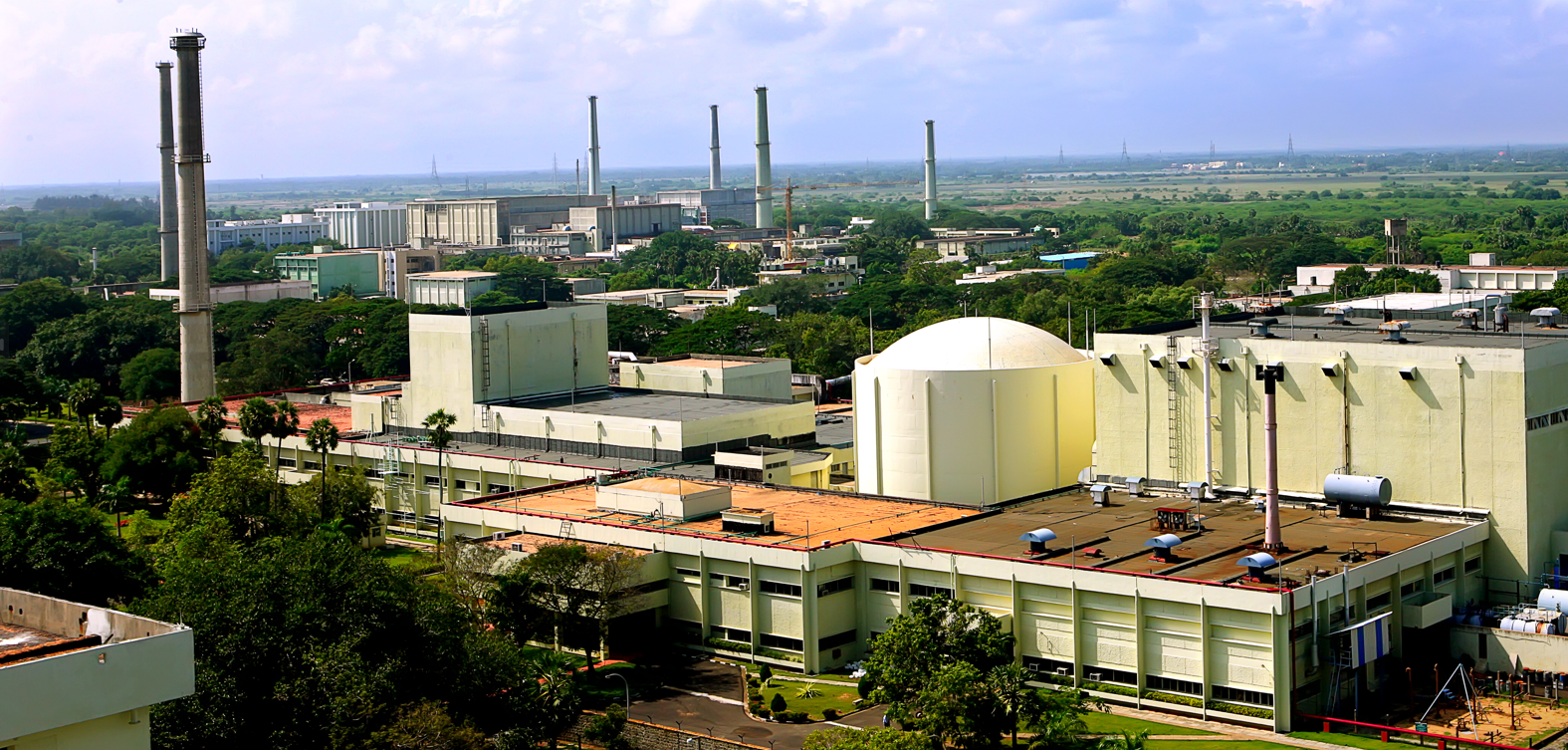
Image Courtesy: IGCAR
Researchers at the Indian Institute of Science (IISc) have developed a new approach that could dramatically reduce power leakage in next-generation electronic devices. The breakthrough may accelerate the adoption of gallium nitride (GaN) power transistors, which are widely viewed as a key technology for electric vehicles, renewable energy systems, and high-performance computing infrastructure.
This PFBR is a 500 MWe (MegaWatt electrical) reactor built by Bharatiya Nabhikiya Vidyut Nigam Limited (BHAVINI) at the Kalpakkam Nuclear Complex. Designed by the Indira Gandhi Centre for Atomic Research (IGCAR) under the guidance of Department of Atomic Energy (DAE), this 500 MWe reactor will help India tap into its vast thorium reserves and decrease dependency on imported enriched uranium.
This achievement is a testament to the decades of scientific effort led by the Department of Atomic Energy. It also marks a significant step in India’s clean energy journey, reinforcing the country’s commitment to reliable, low-carbon power. Additionally, it brings India closer to its goal of achieving net zero emissions by 2070, as announced by Prime Minister Narendra Modi.
Announcing the development, Prime Minister Narendra Modi described it as a defining moment in India’s nuclear journey. “Today, India takes a defining step in its civil nuclear journey, advancing the second stage of its nuclear programme. The indigenously designed and built Prototype Fast Breeder Reactor at Kalpakkam has attained criticality,” the PM said in a statement. “The depth of our scientific capability and the strength of our engineering enterprise is a decisive step towards harnessing India’s vast thorium reserves in the future,” he added.
WHAT IS CRITICALITY?
Criticality refers to the point at which a reactor achieves a self-sustaining nuclear fission reaction, where the number of neutrons produced is sufficient to keep the reaction going without external intervention
With this achievement, India has officially entered the second stage of its three-stage nuclear power programme, a vision first conceived by Dr Homi Jehangir Bhabha, the architect of India’s nuclear programme. The milestone carries substantial global significance. Once fully operational, India will become only the second country in the world after Russia to operate a commercial fast breeder reactor.
In the past, several other countries had pursued breeder reactor programmes but abandoned them due to cost, safety concerns, and technological complexity. In this stage, plutonium produced in pressurised heavy water reactors is used in fast breeder reactors, paving the way for the third stage—thorium-based reactors—where India holds one of the world’s largest reserves.
Fast breeder reactors like the PFBR are seen as potential game changers, enabling long-term energy security while sharply reducing carbon emissions.
WHY INDIA MUST SCALE ITS NUCLEAR POWER?
India’s energy demands are growing rapidly and its clean energy commitments are firm. Nuclear power is a base load source of electricity available round the clock, with lifecycle emissions comparable to renewables. It is uniquely placed to meet the always-on power needs of data centres, advanced industries, and emerging technologies. Scaling nuclear capacity is not just a strategic choice but a practical necessity for India’s long-term energy security and clean power transition.