




Artificial Intelligence (AI) has emerged as one of the most popular technologies of the 21st century. Countries across the globe are in a race to develop sophisticated AI, which has the potential to revolutionise governance, government services, industry, and daily life. In the case of a nation such as India, where the linguistic diversity is immense, the digital infrastructure is expansive, and the technology ecosystem is growing at a very rapid rate, the difficulty is not to embrace AI but to create its own AI models that are cognizant of the social, cultural, and linguistic realities of the country.
In this regard, the development of Sarvam AI, an Indian-based artificial intelligence firm, founded by Dr Vivek Raghavan and Dr Pratyush Kumar in August 2023 and dedicated to developing foundational AI models aimed at the Indian scenario, is an important milestone. During the recent India AI Impact Summit, held in New Delhi in February 2026, Sarvam AI drew the attention of the entire country through the release of cutting-edge AI models and platforms that would suit the needs of the multilingual population of India. The project reflects India’s growing interest in becoming a leader in artificial intelligence while ensuring that technological innovation is inclusive, open, and aligned with national priorities. Sarvam AI is a radical move to technological independence that would allow India to decrease its reliance on a foreign AI system and establish a strong ecosystem of local AI services.
THE NEED FOR INDIGENOUS AI IN INDIA
Artificial intelligence models resemble a computer brain. An AI model is a software program that learns from data to perform tasks like classifying images, predicting trends, analysing language, or generating content. Most of the global AI models are, however, trained mostly using Western data, language, and context. This poses serious constraints on the applicability of such models in countries such as India, where language differences and cultural backgrounds vary drastically. There are 22 official languages in India, hundreds of dialects and millions of individuals who communicate with digital services within their language worlds. To truly empower citizens, AI should be able to learn and speak these languages, and to combat local issues across governance, education, healthcare, and finance. With such an awareness, Sarvam AI was founded with a well-defined vision, which is the creation of artificial intelligence tailored to India. The company aims at building the fundamental models using Indian data and Indian language and at the same time making sure that the whole technological infrastructure and its application are built and controlled locally. These are essential efforts since AI is becoming a more significant part of how people receive services, how companies provide services and how people interact in general. Native AI models will also ensure that technological advancement serves the developmental interests of India, and also remains accessible to every stratum of society. In an interview with the Indian Express, Vivek Raghavan, the co-founder of Sarvam AI, said, “India requires AI trained on Indian languages, code-mixed communication, and local cultural data”. Localised AI will unlock digital services for millions who do not primarily use English.
SARVAM AI AT INDIA AI IMPACT SUMMIT
The India AI Impact Summit 2026, held in New Delhi, was a great event to showcase India’s prowess in artificial intelligence. The Sarvam AI became one of the most remarkable players of the summit, presenting their recent AI models, and showing how Indian technology firms can create global competitive AI systems. Union Home Minister Amit Shah, who attended the summit, highlighted Sarvam AI as an example of India’s technological strength in the AI sector. He underscored that such initiatives embody the vision of Viksit Bharat, in which innovation empowers citizens and builds national capabilities. In its announcement at the summit, Sarvam AI released a number of open-weight AI models, including the flagship Sarvam-105B, an enormous mixture-of-experts language model with 105 billion parameters. This model was trained on the most powerful GPU-equipped clusters as well as on the Indian computational infrastructure, which shows how the country is becoming capable of developing large AI systems in the country itself. The launch was not a pure technological success but an indication of India’s desire to be part of the global edge of artificial intelligence research and development.
DRIVING DIGITAL SELF-RELIANCE THROUGH AI
Among the most important contributions of Sarvam AI is its role in advancing digital self-reliance, a major element of the overarching Indian technology policy. The Government of India has launched programmes on the IndiaAI Mission to support AI development by indigenous communities, including funding, infrastructure and research partnerships. Sarvam AI is one of the 12 organisations chosen under the pillar of the IndiaAI Mission, the Innovation Centre, with financial and computing assistance valued at Rs. 246.72 crore to design base AI models. They are large language models (LLMs) for Indian languages and public service speech models. The goal is not to develop high-level AI technologies but to make them accessible, scalable and relevant to the population-level digital ecosystem in India.
With the development of AI models within the country, India can:
i) Minimise reliance on foreign AI infrastructure.
ii) Secure confidential information and achieve regulatory compliance.
iii) Encourage open innovation at startups and research organisations.
iv) Empower local service provision in local languages.
Sarvam AI is thus an important move towards technological autonomy, whereby AI innovation is built in accordance with the Indian concerns and not a foreign factor.
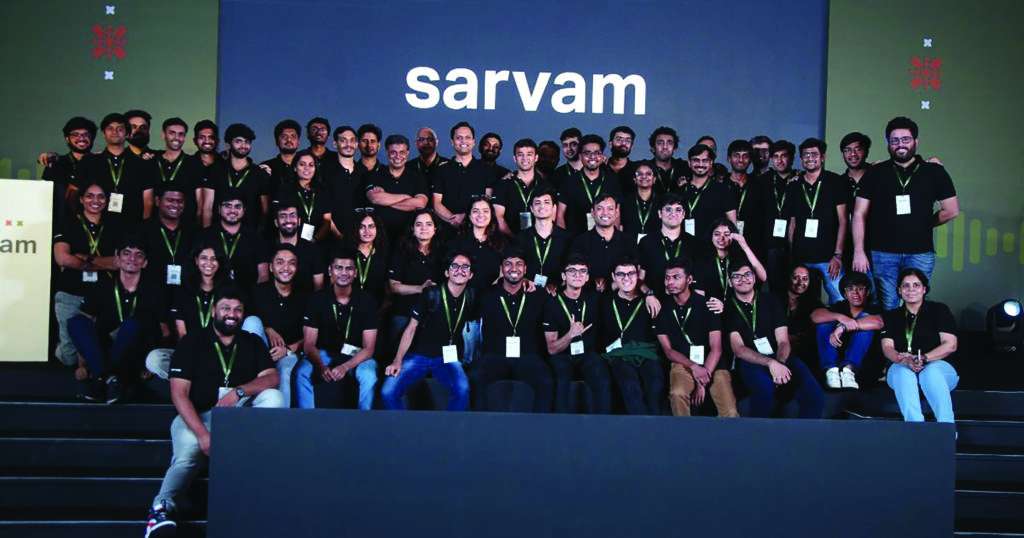
All Images Courtesy: Sarvam AI
CRITICAL AI MODELS AS DEVELOPED BY SARVAM
Sarvam AI has proposed a few base models that would help meet the Indian language and technological needs. The company has come up with a series of AI products, solutions that listen, understand, respond, and capture what the users want to do in their day to day lives.
1. Bulbul – Text-to-Speech Model
Bulbul is a text-to-speech system that can produce natural-sounding voices in 11 Indian languages, with 39 different speaker voices. The technology enables digital platforms to interact with users in natural voice interfaces. These systems may be especially effective on the public service platforms and educational systems, as well as in the accessibility systems of the visually impaired.
2. Saaras – Speech-to-Text Model
Saaras is another important innovation that is a speech-to-text system that supports all 22 languages listed in the Eighth Schedule of the Indian Constitution. It is able to run telephony audio, code-mixed speech recognition, and speech-to-text conversion. With voice communication and mobile phone being very common in India, speech-based interface is the way to ensure that the digital services are available to millions of citizens.
3. Vision – Document Understanding Model
The Vision model focuses on document understanding. It can analyse documents in 22+ Indian languages, including handwritten and mixed-script documents. This technology can make a huge difference on how efficient the government services, banking system, and legal documentation are in automated processing and translation of documents. Collectively, these models depict how Sarvam AI is developing India-focused artificial intelligence that can remove linguistic diversity along with enhancing access to digital governance.
In addition to building individual AI models, Sarvam AI has built a complete AI ecosystem. Simply put, an AI stack can be described as a complex of tools and technologies that are needed to develop, deploy, and run AI applications. The ecosystem of Sarvam AI covers all the components of AI value-chain, including computational infrastructure and underlying models, enterprise platforms and real-world uses.
GOVERNMENT AND INSTITUTIONAL STRATEGIC PARTNERSHIPS
The Sarvam AI has been cooperating with governmental agencies and academic institutions. The idea of these partnerships is to integrate AI technologies in the public infrastructure and services to citizens.
Partnership with UIDAI
The Unique Identification Authority of India (UIDAI) has collaborated with Sarvam AI to improve Aadhaar services by the use of AI-based voice interactions and fraud detection platforms.
The collaboration includes:
- Multilingual voice interfaces
- Real-time enrolment feedback
- AI-driven fraud detection systems
These systems will operate within UIDAI’s secure infrastructure, ensuring data privacy and reliability.
Collaboration with the Government of Odisha
Sarvam AI collaborates with the Government of Odisha to create a 50 MW AI-optimised Sovereign AI Capacity Hub. This project will provide computing solutions for AI research and industry products. The project is expected to support sectors like:
- Mining safety
- Industrial monitoring
- Local language skill development
Digital Sangam with Tamil Nadu and IIT Madras
Digital Sangam is another large-scale project, which is a sovereign AI research park under development in partnership with the Government of Tamil Nadu and IIT Madras. Within the research park, there will be a 20 MW AI data centre that will facilitate in-depth research, startup incubation, and large-scale AI implementation. Such collaborations show that both government bodies and commercial innovators can work together to create AI-based infrastructure at a population scale.
THE DEBATE ON EVALUATION AND VERIFICATION
Despite its achievements, Sarvam AI’s rapid rise has also sparked an important debate about AI evaluation and verification. Few analysts have noted that although the models of Sarvam AI boast excellent benchmark scores, most of these scores are self-reported and have not yet been substantiated through independent means. This also indicates a broader structural issue within the AI ecosystem in India: the lack of a formally recognised nationwide evaluation framework capable of testing AI models independently. Experts argue that India must establish:
1. Independent AI evaluation institutions
2. National benchmarks for multilingual AI performance
3. Transparent reporting standards for government-deployed AI systems
These mechanisms would make AI technologies used in public services reliable, unbiased, and accountable. Nevertheless, the discussion is a sign of a healthy and growing AI ecosystem, in which technological advancement is supported by debates on governance, ethics, and transparency.

INDIA’S GLOBAL AI AMBITION
Sarvam AI’s progress must also be viewed within the larger global context. In his interview with the Indian Express, Raghavan argues that the race should not only be about building the largest models, like those in the US or China. Instead, India should focus on control, relevance, and independence in AI development. India’s approach is distinctive because it emphasises population-scale deployment, multilingual inclusivity, and digital public infrastructure.
With over 800 million internet users and some of the world’s largest digital platforms—such as Aadhaar, UPI, and DigiLocker—India possesses an unparalleled opportunity to integrate AI into everyday life. Homegrown companies like Sarvam AI play a crucial role in ensuring that this transformation remains inclusive, secure, and aligned with national priorities.
FUTURE OF SOVEREIGN AI
Sarvam AI is more than a technological success—it is the vision of India to develop autonomous, inclusive, as well as accountable artificial intelligence systems. The company is making efforts to create a foundation of a future-ready digital ecosystem through its local AI models, multilingual platforms, and through partnerships with government institutions. With India on the road towards the vision of Viksit Bharat, projects such as Sarvam AI show that technology can be used to give citizens more power, enhance governance, and become a leader in the global AI environment. The path to come is however also in need of establishing strong institutions of AI assessment, regulation, and disclosure. The real technological sovereignty should not be just about the production of sophisticated AI models, but also about making them reliable, responsible, and helpful to society. The coming of Sarvam AI is thus a landmark in the history of technology in India—a moment where technology, national aspiration, and national responsibility are coming together to define the future of artificial intelligence in India.
*The writer is the Dean-Academic Affairs, Garden City University, Bengaluru, and an adjunct faculty at the National Institute of Advanced Studies, Bengaluru. He can be reached at bijudharmapalan@gmail.com.