





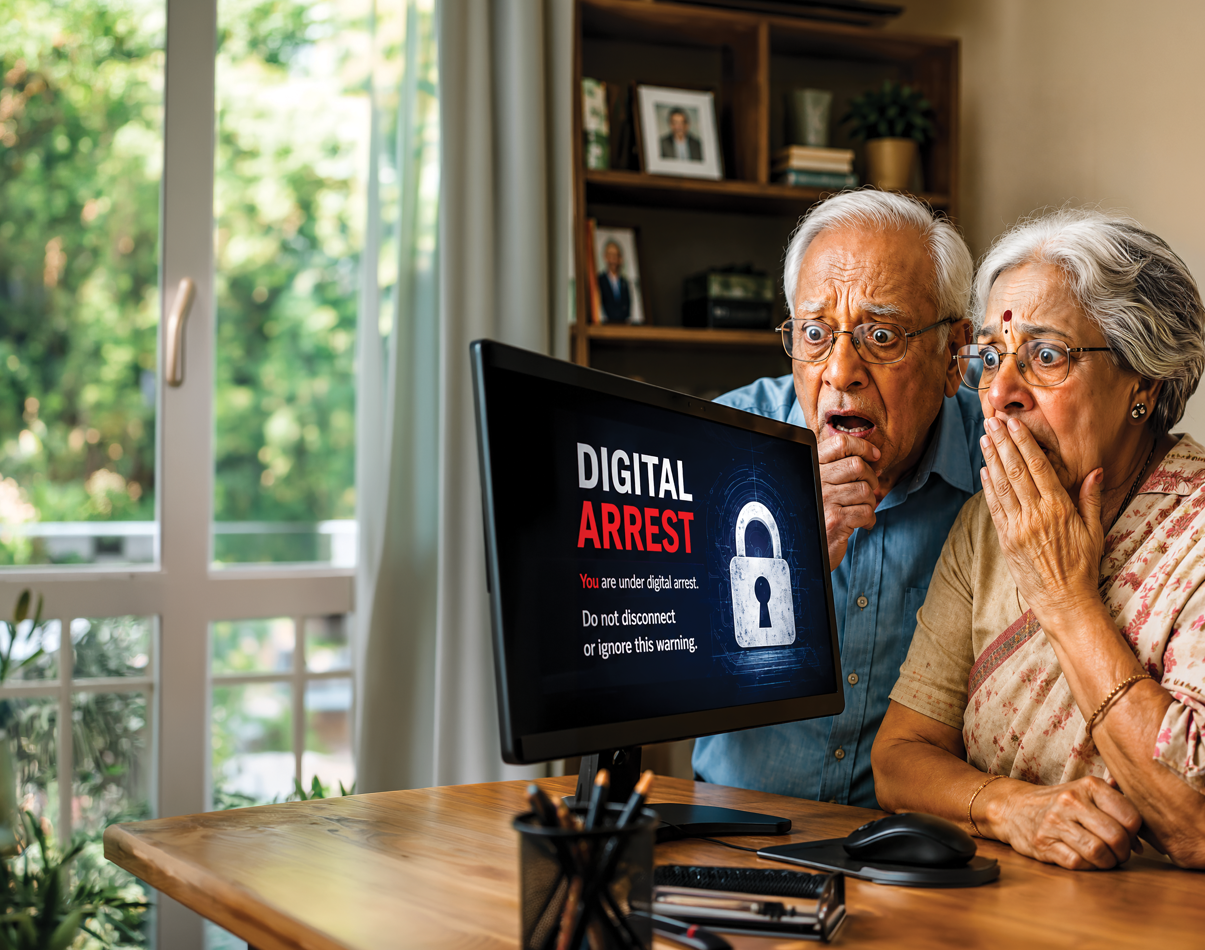
On 3 September 2025, a bank in Ambala made a small clerical mistake. Fifteen thousand rupees meant for a young man named Vikram Kumar landed instead in the account of a stranger who happened to share his first name. Vikram Kumar’s in-laws, Shashi and Harish Sachdeva—both retired government employees—went to Punjab Sindh Bank to sort it out. It should have ended there.
Instead, their phone rang. The caller said their Aadhaar card had been misused, and that they were suspects in a money-laundering case worth ₹1,100 crore. For the next ten days, the Sachdevas lived what can only be described as house arrest by video call—monitored, questioned, forbidden from leaving the frame of the camera or speaking to anyone outside it.
We were not allowed to go anywhere or talk to anyone.
That is how Harish Sachdeva later described it. He recalled being timed to the second on the one occasion he stepped out—to attend a prayer service for a friend he had just lost—and returning to a caller who already knew which neighbour’s house he’d gone to. The callers, posing as CBI and Enforcement Directorate officials, produced what looked like a court order signed by a real Supreme Court judge. The couple emptied their savings and encashed family gold. By the time it was over, they had transferred more than Rs 1.05 crore, and their scammers had even threatened their granddaughter to keep the pressure on.
None of it was real. There is no law in India, no procedure in any court, that allows an arrest to be conducted over a phone call or a video screen. The Sachdevas were never under investigation. They were the target of a script run on tens of thousands of Indians—and the fact that two intelligent, professionally accomplished retirees fell for it completely is not an embarrassing footnote to this story. It is the story.
A CHARGE INVENTED FROM NOTHING
‘Digital arrest’ does not exist as a legal term anywhere in Indian law. High Courts have said so; a Rajasthan High Court judge recently reminded citizens that no statute permits law enforcement to detain or interrogate a person through a screen. Yet Indians lost more than Rs 19,000 crore last year to roughly 120,000 such frauds. What makes an invented crime this effective isn’t cleverness—the script barely changes. It’s what the caller already seems to know about you.
AN OLD TRICK IN A NEW COSTUME
Take away the fake warrants and the video calls, and digital arrest is not really a new crime. It is plain old phishing, dressed in a police uniform.
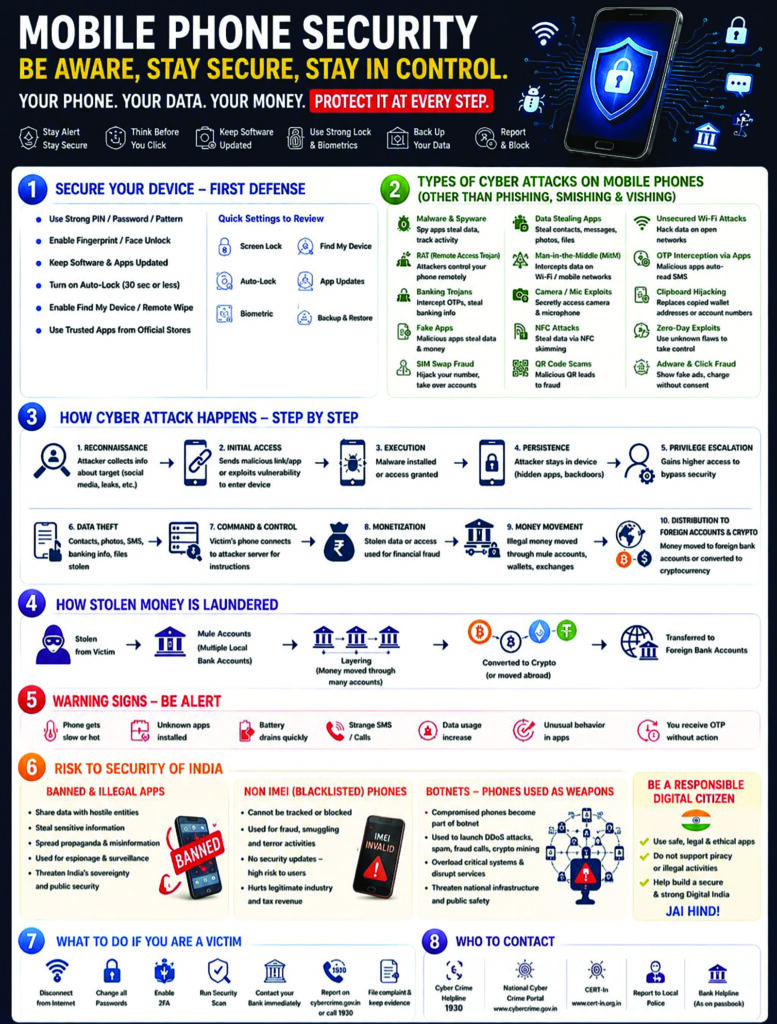
Phishing, in simple terms, is a message designed to make you act before you think—a fake bank alert, a fake courier message, an office email with a bad attachment. It works by borrowing the trust you have in some institution, and spending that trust before you stop to question it. Vishing is the same trick over a phone call, smishing the same trick over SMS. Digital arrest simply takes this basic trick and gives it a stage, a script, and hours to work with instead of seconds—pure social engineering, taken to its most elaborate form yet.
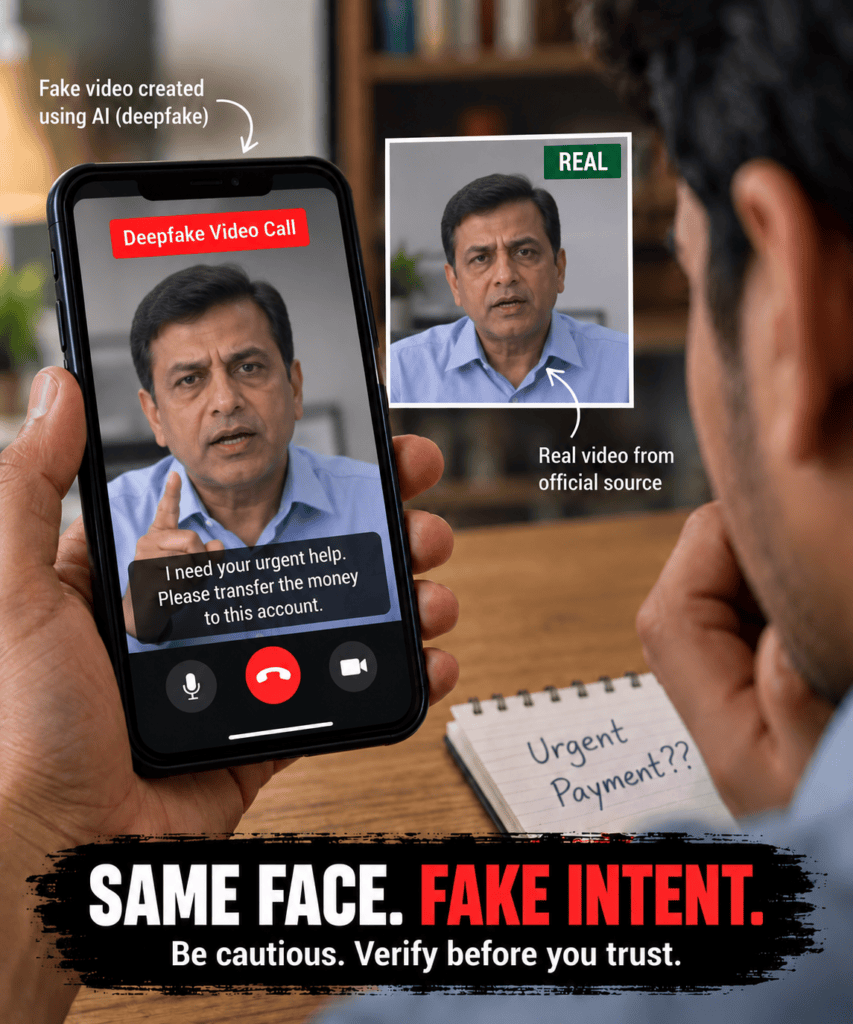
It is also not unique to India. The trick traces to phone scams targeting mainland Chinese citizens around 2009–2011, and went global with the Chinese diaspora from around 2016 as ‘virtual kidnapping’ calls, a pattern the FBI was still warning students about in 2025. India’s own version, and the term ‘digital arrest’ itself, took shape only in 2023–24: Cases nearly tripled between 2022 and 2024, PM Modi flagged the scam in a Mann Ki Baat broadcast in October 2024, and the Oswal case that August became its highest-profile early example. What looks distinctly Indian is the length and drama of the performance—America’s government-imposter scams ($920 million lost in 2025) and Britain’s ‘safe account’ fraud tend to be shorter and blunter. The backbone behind all of them traces to the same scam compounds across Myanmar, Cambodia and Laos.
HOW THE CRIME IS COMMITTED
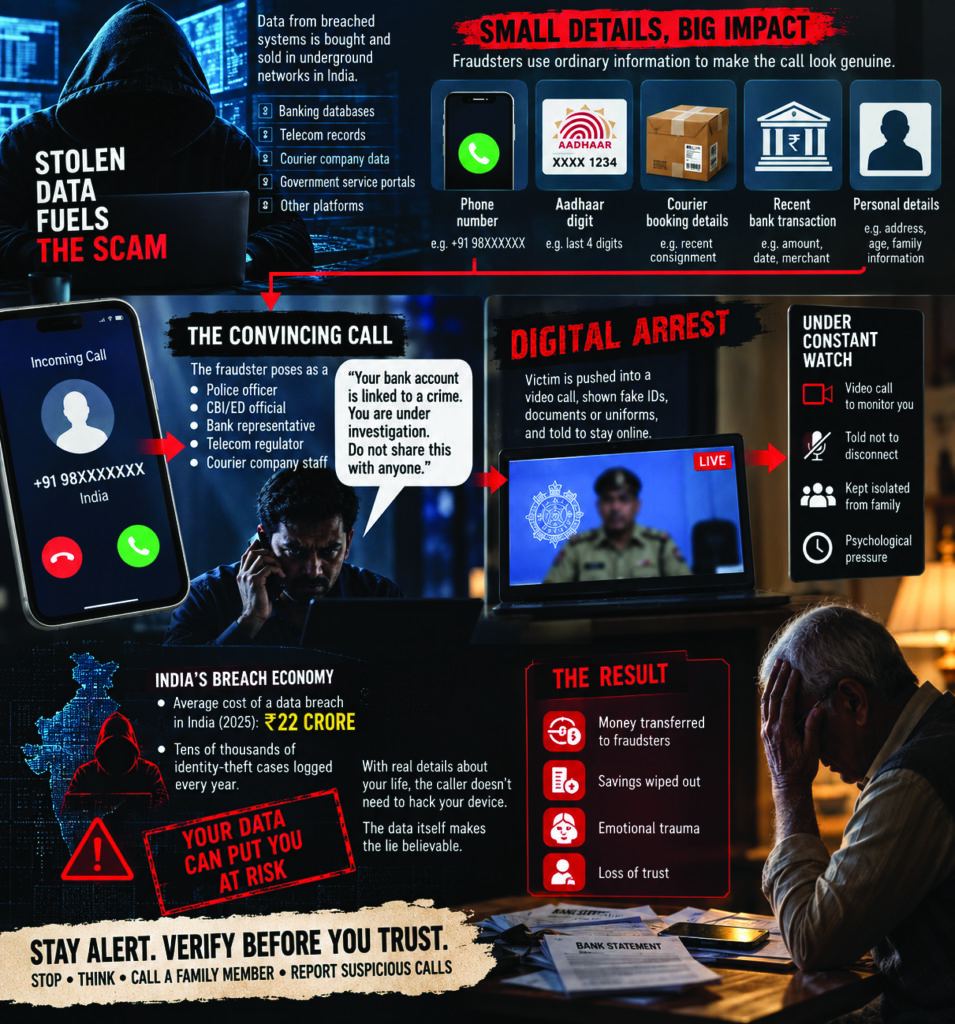
A phone number. A fragment of an Aadhaar digit. A courier booking. A recent bank transaction—the kind of clerical detail that, in the Sachdevas’ case, arrived within hours of a bank visit. Very little of this comes from hacking anyone’s device in real time. Almost all of it comes from India’s breach economy: The average cost of a data breach here reached roughly Rs 22 crore in 2025, and tens of thousands of identity-theft cases are logged every year from breached banking, telecom and courier databases quietly circulating for sale. A caller who can casually mention your own recent transaction doesn’t need to convince you he’s real. The data does the convincing for him.
That is also why age is not a coincidence in who gets targeted. Many senior citizens are alone at home during working hours, when these calls land, and their savings sit liquid rather than locked in employer schemes. The instruction to stay silent—’for the sake of the investigation’— exploits a disconnection from adult children many seniors already feel. The fraud doesn’t need to defeat anyone’s intelligence. It only needs thirty uninterrupted seconds of unearned authority before a victim can call someone else to check.
WHEN THE JUDGE IS A DEEPFAKE
Two months before the Sachdevas were held hostage by a webcam, a very different kind of victim fell for the same script—but with a technology twist that shows where this crime is headed next.
SP Oswal is not an easy man to fool. At 82, he was chairman and managing director of the Vardhman Group, a textile conglomerate worth more than a billion dollars, and a Padma Bhushan awardee. On 27 August 2024, a caller posing as a TRAI official reached him, followed by a WhatsApp video call from a man in police uniform, sitting in front of a background showing the CBI’s logo. Over the next two days, Oswal got 25 to 30 calls, a fake arrest warrant carrying the Enforcement Directorate’s seal, and—the boldest part of the scam—a fake online court hearing, with a digitally created copy of the then Chief Justice of India, D Y Chandrachud, playing judge. Convinced he was one court order away from arrest, Oswal transferred Rs 7 crore—roughly Rs 70 million—across five instalments before he realised what had happened. Ludhiana Police recovered Rs 5.25 crore and arrested the nine-member gang behind it, spread across Assam and West Bengal.
What makes the Oswal case matter isn’t the amount of money. It’s the fake judge. Copying the face of one of India’s best-known public figures to run a fake court hearing was a shock back then. It isn’t shocking anymore. A 2025 study found that 47% of Indian adults had either fallen for an AI voice-cloning or deepfake scam, or knew someone who had—almost double the world average. Making a convincing voice clone once needed a recording studio and a specialist. Now it just needs a laptop, a few seconds of audio from a voice note or an Instagram reel, and downloadable software. The same has happened with video: face-swapping tools can now put a fake officer—or a fake relative—on a live call, convincing enough to survive the few minutes of doubt most people allow before believing what they see.
The performance keeps getting more convincing. The trick underneath stays the same: Borrowed authority, manufactured urgency, and cutting the victim off from anyone who could tell them the truth.
INSIDE THE SCREEN: WHAT ACTUALLY HAPPENS
Every digital arrest, no matter which agency’s name is used, follows the same four steps once the target picks up the phone—each one designed to stop a frightened person from checking anything.
First, borrowed authority: A real-sounding rank and badge number, against a fake video background made to look like a CBI or ED office, crest and framed photographs included. Next, fake evidence—a document that looks exactly like a real court order, forged signature and all, sent over WhatsApp minutes after being “issued”. Then, isolation— victims are told not to inform family, lawyers, or their bank, “for the sake of the investigation”. These instructions protect the fraud, not any real case. Last, surveillance—the victim must keep a video call running non-stop, sometimes for days, unable even to walk to the bathroom without announcing it first.
None of this is how real investigations work. No Indian agency carries out an arrest or a court hearing over a phone screen. No law allows it. The act works only because a frightened person on camera, cut off from everyone who could tell them otherwise, obeys instructions that a few calm minutes of thought would reject outright.
THE CASE THAT CRACKED IT OPEN
Two months before the Sachdevas’ ordeal began, a 70-year-old man in Kalyani, West Bengal, walked into Ranaghat Police Station and filed a complaint. He had lost Rs 1 crore over seven days to a WhatsApp caller posing as a Mumbai police officer named “SI Hemraj Koli”. It looked, on paper, like one more case in a very long list.
It wasn’t. West Bengal’s cyber police followed the account trail outward instead of closing the file, and found a network that had defrauded at least 108 people across the country of more than Rs 100 crore using the same script. In July 2025, a West Bengal court convicted and sentenced nine members of the gang to life imprisonment—among India’s first such convictions—describing what they had done as economic terrorism. Around the same time, a Lucknow court gave a man seven years for impersonating a CBI officer and defrauding a doctor of Rs 85 lakh.
And when the Sachdevas were finally freed by their daughter on 16 September 2025, they did not just file an FIR. They wrote to the Supreme Court of India describing what had been done to them. On 17 October 2025, the Court took suo motu note of digital arrest scams nationwide, directing every state to report every related FIR and opening the door to a CBI-coordinated, pan-India probe. One retired couple’s letter, and one elderly man’s complaint in Kalyani, are now part of the same nationwide reckoning.
THE VOICE ON THE OTHER END
Not every voice running this script belongs to a willing criminal. Investigations into the wider scam economy—much of it run from fortified compounds in Myanmar and Cambodia—have repeatedly uncovered Indian youths lured abroad with fake job offers, then trafficked and coerced into reading these exact scripts under threat of violence. The person delivering your fabricated charges may themselves be held against their will on the other end of the line.
Behind the callers sit real organisations. Cambodia’s Prince Group, sanctioned by the US and UK in 2025 with assets frozen in Hong Kong and Singapore, is the biggest name to emerge— its chairman stands indicted in the US for running forced-labour scam compounds. In Myanmar’s Myawaddy belt, the Yatai International Holdings Group and the nearby KK Park hub run under the protection of the Karen National Army, an armed militia the US Treasury sanctioned in 2025. Enforcement has mostly caught the trafficked workers inside; the ownership layer above them remains largely out of reach.
WHERE THE MONEY ACTUALLY RUNS
One common misconception is that stolen money converts instantly into cryptocurrency the moment it leaves an account. The real pattern is slower and more exposed. Money first lands in mule bank accounts, often opened by vulnerable people recruited with fake job or loan offers, then gets layered across dozens or hundreds of such accounts, sometimes through shell companies, before a portion finally converts to crypto—usually USDT—and reaches handlers abroad. Only at that last stage does it become genuinely hard to trace.
That layering is a weakness the fraud can’t design away. The Enforcement Directorate has frozen crores mid-chain in multiple investigations, because the mule-account stage leaves a window— the golden hour—during which a bank or cybercrime cell can still stop a transfer before it clears.
HOW INDIA IS FIGHTING BACK
The Supreme Court’s step did not come out of nowhere. It sits atop a response built over several years, even if most citizens only meet it after they’ve already lost money.
The Indian Cyber Crime Coordination Centre (I4C), under the Ministry of Home Affairs, is the backbone of that response. It runs the National Cyber Crime Reporting Portal, coordinates state cyber cells, and operates the Citizen Financial Cyber Fraud Reporting System, which since 2021 has helped freeze more than Rs 3,400 crore across nearly ten lakh complaints before the money could clear. Its CyTrain platform has also trained close to a lakh police and judicial officers in handling digital evidence—answering an old complaint that local police did not know what to do about, with a fraud crossing three states and ending in a crypto wallet.
NITI Aayog has treated digital arrest as a policy problem, not just a police one, pointing to human psychology, poor cyber hygiene, and the profits in the unregulated dark-web data trade as reasons the scam keeps succeeding— and arguing that public awareness, not enforcement alone, closes the gap. The point running through all these efforts is the same: An invented crime cannot be stopped by evidence collected after the money is gone. It has to be stopped by a citizen who already knows, before the phone even rings, that the call is fake.
THE ONE HABIT THAT ACTUALLY WORKS
Every documented version of this scam—the Sachdevas’, Oswal’s, the Kalyani case, the doctor in Lucknow— depends on one condition holding: That the victim never independently verifies the call. Hanging up and calling the agency back on its official number ends the scam in the time it takes to dial.
It helps to remember what never happens in a real investigation. A caller doing even one of these is not a police officer:
* No Indian agency ever arrests, questions, or holds a court hearing over WhatsApp, Skype, or any video call.
* No agency ever asks for money, OTPs, or ‘verification transfers’ over the phone.
* No agency ever tells you to hide an investigation from your own family.
* No agency skips a written, official summons and jumps straight to threatening arrest.
* If money has already moved, speed is what’s left. The National Cyber Crime Helpline—1930—and cybercrime.gov.in exist precisely to catch a transfer inside that golden-hour window. Every hour spent hesitating, often out of shame rather than confusion, is an hour closer to the money clearing the mule-account chain for good.
WHAT THIS STORY IS ACTUALLY ABOUT
It would be easy to read all this as a story about gullibility. It isn’t. The victim list includes retired judges, senior police officers, doctors, decorated veterans, one of India’s most prominent industrialists, and—as the Sachdevas prove—two people sharp enough to write a letter that moved the Supreme Court to act. This is a con engineered against the instincts a lifetime of trusting institutions was supposed to reward, not against anyone’s intelligence. That’s the fact most worth repeating to the next person who picks up that call.
*The writer is a Director, AI & Cyber Security, MGI, USA