


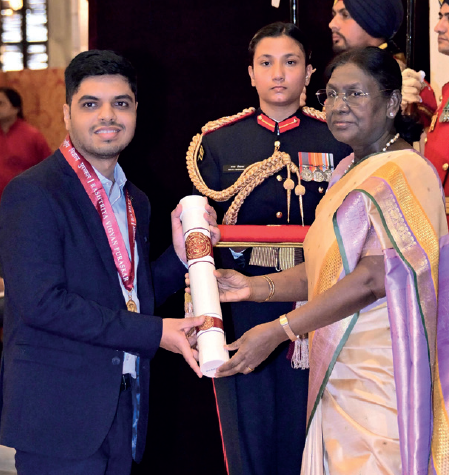
Image Courtesy: PIB
YOUNG SCIENTIST / ANKUR GARG
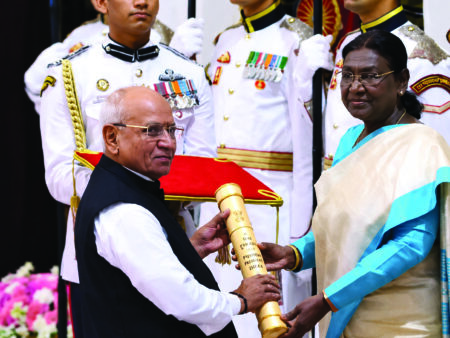
Young ISRO scientist Ankur Garg has been conferred with the prestigious Vigyan Yuva– Shanti Swarup Bhatnagar Award under the Rashtriya Vigyan Puraskar 2025 by President Droupadi Murmu. The award recognises exceptional contributions by young scientists in various fields of science and technology and places Ankur Garg among the country’s most promising scientific minds.
Working at the Space Applications Centre (SAC) of the Indian Space Research Organisation (ISRO), Garg has emerged as a key contributor in the field of space science and technology. His work is particularly linked with the use of artificial intelligence and advanced data-processing techniques in satellite applications—an area that is rapidly transforming modern space research and Earth observation systems.
Garg pursued higher education in Computer Science and Engineering at the Indian Institute of Technology Kanpur, where he completed his MTech in 2015. His academic excellence and deep interest in emerging technologies eventually led him to ISRO, one of the world’s most respected space agencies.
Over the years, Garg has been involved in projects that combine satellite imaging, machine learning, remote sensing, and AI-driven analytics. Scientists working in these domains are playing a critical role in strengthening India’s capabilities in agriculture mapping, climate monitoring, disaster management, urban planning, and national security. While ISRO has long been recognised for launching cost-effective satellites and ambitious missions like Chandrayaan-3 and Aditya-L1, a new generation of scientists such as Garg is helping modernise how data from space is processed and utilised on the ground.
Garg’s research and technological work has significantly contributed toward making satellite data easier to interpret using AI-assisted systems. In simple terms, these technologies help machines identify patterns from massive amounts of satellite imagery much faster than humans, enabling quicker responses during floods, crop failures, forest fires, or environmental changes.
His recognition also highlights the changing face of Indian science. Earlier generations of ISRO scientists were known primarily for building launch vehicles and satellites. Today’s young researchers are integrating artificial intelligence, automation, data science, and computational technologies into India’s space ecosystem. Scientists like Ankur Garg represent this transition, where space science is no longer limited to rockets and missions alone, but also includes intelligent systems capable of processing enormous quantities of data for real-world governance and development.
Apart from the Vigyan Yuva award, Garg has previously received appreciation within ISRO for team-based scientific achievements. His journey from IIT Kanpur to the Space Applications Centre has increasingly become an inspiration for engineering students and young researchers aspiring to contribute to India’s technological rise.
At a time when India is positioning itself as a major global player in the space economy, recognitions such as these also underline the importance of nurturing indigenous scientific talent. The success stories of young scientists working quietly behind the scenes often do not receive mainstream attention. Yet it is their research, innovation, and technological breakthroughs that form the backbone of missions which capture national imagination. As India moves toward ambitious goals including human spaceflight missions, advanced satellite networks, deep-space exploration, and AI-integrated scientific systems, scientists like Ankur Garg are likely to become increasingly significant in the country’s scientific landscape. His achievement is not merely a personal milestone, but also a reflection of the growing confidence of India’s young scientific community in shaping the future of technology and space research.